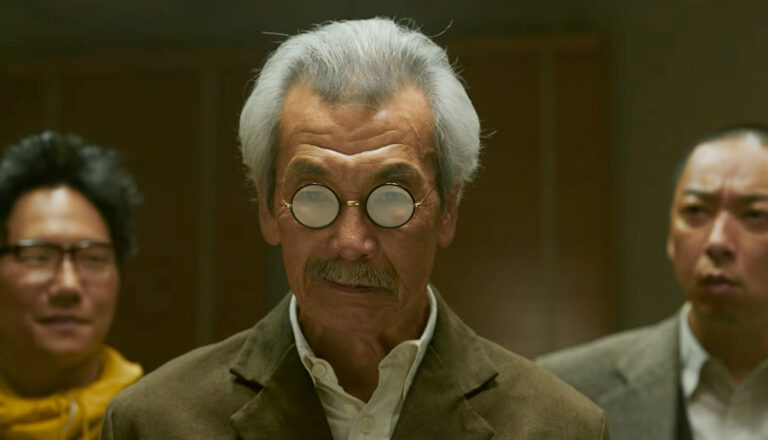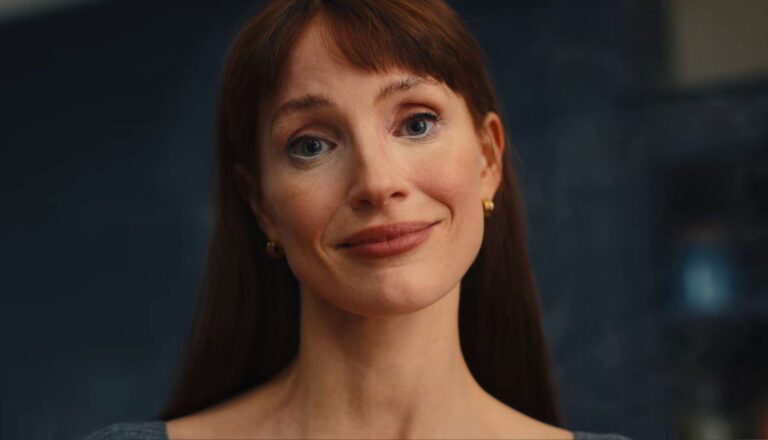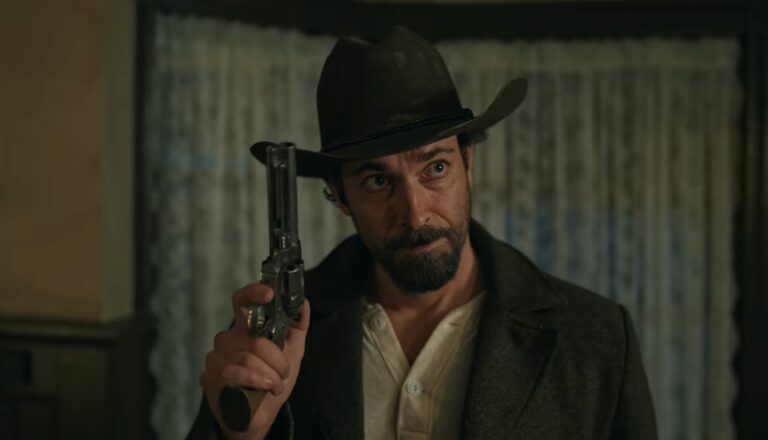

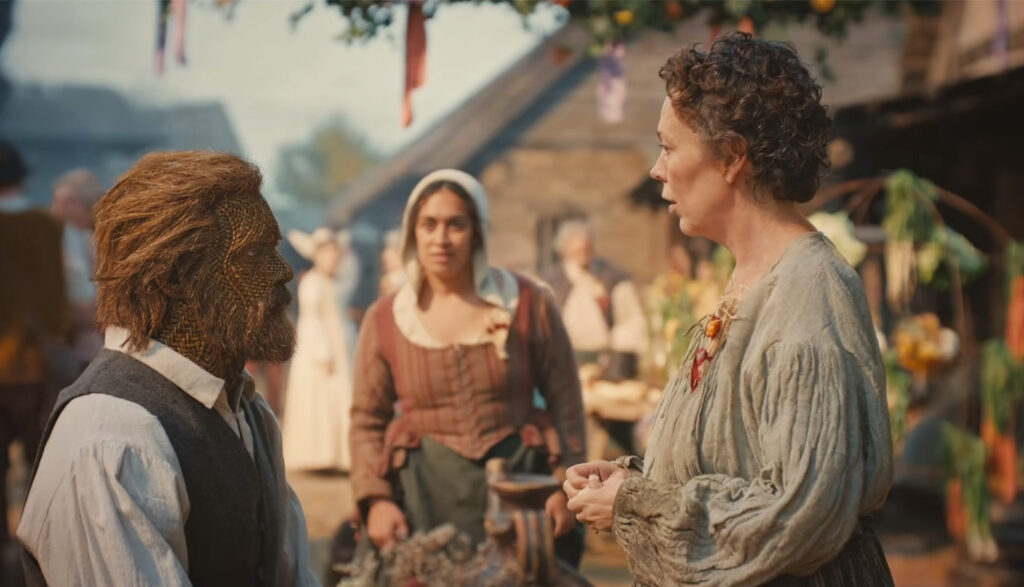
Wicker is a subtle marvel from a technical standpoint, but its confused central theme of found family is nearly entirely squandered by a harsh, depressing outlook on the sacrament of marriage. Sexuality, foul language and one surprisingly bloody scene are all woven into this shoddy cinematic basket.
Marriage. Marriage is what brings us together today.
But in The Fisherwoman’s village, marriage is perhaps nothing more than a regrettable tradition. Forget love, sacrifice, pursuit of your life partner: Marriage exists because, well, it always has! And who are we to break tradition?
For one reason or another, The Fisherwoman never got married. Perhaps it’s the light aroma of aquatic life that follows her wherever she goes. Perhaps, in her youth, other maidens were just fairer than she.
Out of a mix of curiosity and frustration with her solitary existence, The Fisherwoman enlists the help of The Basketmaker to fashion a husband. Presumably not expecting much, she is told to go to the chapel in a month’s time.
Could the talented Basketmaker actually fulfill such an uncommon request? As the anticipation builds and sleepless nights abound, a month passes. It is, at long last, time for The Fisherwoman to meet her husband.
But the entrance of the Wicker Man hardly goes unnoticed. The Fisherwoman is used to being a topic of conversation—but mostly jests and gossip, never jealousy.
Could this newfound matrimony be the one example this town has of sacrificial love? Or will the uncommon origins of this questionable marriage lead the already morally decrepit village to emotional ruin?
There are a few brief dialogue-free moments of supposed emotional intimacy between The Fisherwoman and her new husband. The pair go for a walk and share what seems to be a lovely picnic. The Wicker Man tells other townsmen that making his wife happy makes him feel secure as well.
Later on in the film, once more Wicker people are introduced, a woman chooses to care for a Wicker Baby that was cruelly left to die in the woods.
While the magic behind the Wicker Man’s life is never clearly explained, his existence, along with that of other Wicker people, harkens to some sort of mysticality. The Basketmaker tells The Fisherwoman that her newly created husband has chosen to love her, perhaps learning that love from her—although what is seen throughout the film doesn’t indicate that to be true. The Wicker Man was commissioned by The Fisherwoman to be a husband, and immediately after his creation, he runs to fulfill (what the film believes is) that duty.
The film seems to invoke a sort of mystical, pagan theology at its center—the wedding chapel so frequently used features so Christian iconography, and while there is a character leading the ceremonies, he hardly invokes that of a priest or pastor.
A character claims that “Mother Nature always provides.” Another outwardly asks if the creation of the Wicker Man is “against the gods.” As he’s fashioning his creation, The Basketmaker questions if this basket man could be the “perfect being.” A woman describes her neighbors as “devils.”
Two female adults recount a game they played as kids, where one girl played a minister to “marry” a girl and a boy. Then the “married” young girl would tell the boy to drink the “magic” water in a nearby river so that they may both instantly grow up together. A woman, hoping to get pregnant, resorts to superstitions, including a “fertility song” and drinking the breast milk of another woman, in belief that they may help her plight.
The Basketmaker reports that “the idea of spirit is wholly another” compared to the importance of how one looks outwardly.
Conversations about sex, or visual depictions of it, are featured in just about every scene. No female nudity beyond a few bare backs is explicitly seen, but viewers do catch glimpses of some bare rears and an entirely naked Wicker Man—with his genitals entirely on display.
We see or hear at least half a dozen sex scenes, accompanied by all the sounds one might expect—including some new ones, due to the Wicker Man’s basket material. Loud moans and creaking movements occur throughout these scenes, and townsfolk are told that the Wicker Man must frequently repair his marital bed. A woman fantasizes about sleeping with the Wicker Man—a daydream that viewers see as well.
Other scenes involve married couples engaging in intercourse, with the women looking exceedingly bored with their partners’ performances. Motions and sounds of sex are once again present in these scenes, though it’s clear no love is involved.
Innuendos and sexual conversations can be graphic and perverse, going into excessive detail about who is being fulfilled sexually and who isn’t. Lewd gestures meant to pantomime sex are made with household items, such as a butcher’s knife. Talk of sexual experiences is intercut with suggestive shots of characters kneading dough or sticking their hands into pies.
On two separate occasions, we witness a post-wedding tradition where the groom wears a sort of codpiece that sports a protruding carrot where his crotch is located—and a goat nips and bites at said carrot.
In another post-wedding tradition, the town’s female virgins line up to shake eggs made of wicker that contain colored powders: Yellow means the girl will have to wait longer for her groom; purple signifies the next woman to be married. As we’re told by townsfolk, this ceremony is about who will be hitched next—with any semblance of “love” being left out of the equation entirely.
When a Wicker Woman is later introduced, the whole town goes into a frenzy. Everyone wants the Wicker Woman for a different reason—all of them salacious. One man talks about using her to start a brothel. A married couple seeks to use her to spice up their marriage, stating, “There’s no shame in desiring a third.”
The Fisherwoman is briefly inclined to believe a false rumor of the Wicker Man’s supposed infidelity. A woman offers to pay someone with “services” (the implication being sexual) in addition to money.
After their wedding ceremony, the Wicker Man asks for The Fisherwoman’s consent before the two engage in any marital activities.
Most anyone who was subjected to the trailer for this film could expect baskets of sexual scenes; however, a few surprisingly violent ones will likely catch viewers off guard.
While repairing a roof, a man falls through it. He sustains a gnarly, blood-gushing gash to his foot. The town’s incompetent doctor attempts to stitch it up, but after a spurt of blood soaks the doctor’s face, he passes out. We are told the injured man died mere days later.
The Wicker Man gets lit on fire in one scene, and he’s later found in rough sorts: He’s missing both arms, and the flames took chunks out of his face and torso. A Wicker Baby is left for dead in the woods before being found and cared for. To the town’s horror, the elusive Wicker Woman is made of thorns. When she embraces and straddles her new owner, he screams, and blood pools under him from his injuries. Townspeople mistake sounds of sexual pleasure for a woman being killed.
We are told that a little boy died from infection after being told to drink excessive amounts of river water. The Fisherwoman says that her mother committed suicide. There’s talk of women dying in childbirth. A woman discusses seeking out a medical abortion, although it is unclear if she ever goes through with the process.
A woman hits another character with a basket, drawing blood. Fish are sliced into, and their guts ooze out during a few scenes.
Given the subject matter of the film, nearly every bit of harsh language is used in a sexual manner, making the words feel that much fouler. Nearly 30 f-words, as well as a handful each of the s-word, “c–k,” “bloody” and “b–tard.” One use each of “d–k,” “b–ch” and “a–” are thrown into the mix. Two misuses of God’s name, one paired with “d–n.”
Adult characters drink throughout at dances and a local pub. In one scene, a man is practically blackout drunk. “Medicine”—presumably opium—is given to a few injured individuals, with one woman abusing the privilege, consuming a concerning amount of the substance.
The ethics of Wicker are not favorable. While the words of the Wicker Man sound loving at first—especially when compared to the misogynistic male townsfolk’s description of their own wives—most all his dialogue still leads to the conclusion that he exists only to love The Fisherwoman, potentially without autonomy of his own. Lines like “I was made to love you” and “You are the reason I live and breathe” sound endearing at first—until they are taken literally: It is a fact that the Wicker Man exists to please his wife.
This moral conundrum once again rears its ugly head towards the end of the film, with the creation of the Wicker Baby. We are told its mother commissioned it in order to feel love from it—a disturbing notion. A character comments that the child is an “abomination.” The mother abandons the Wicker Baby shortly after its creation, treating the baby like property—as though the simple fact that she purchased the Wicker Baby means she can discard it like any other object.
One of the town’s traditions is for new brides to put on a painful-looking collar during the wedding ceremony. The symbolism is clear: The new husband owns his wife. This action is followed by the line “man and woman become man and his wife,” once again bashing viewers over the head with a painfully obvious metaphor.
Loveless marriages bonded only by tradition plague the entire town. There isn’t a single man or woman who isn’t constantly vexed by their marital partner. And for good reason, it would seem: The townsmen are lazy, misogynistic and think of their wives as nothing more than nagging shrews who don’t want to have sex as often as the men would prefer. The women are distrusting of their husbands. And they neglect to hold their spouses to a higher standard, instead preferring to fantasize about a life with the elusive new Wicker Man.
Jealous men briefly attempt to woo their wives and help around the house. This valiant effort is quickly abandoned as they realize that those pursuits take work, and they give up entirely, preferring to take their shame and turn it into anger towards the Wicker Man. A man temporarily locks away his wife so he can attempt to purchase the Wicker Woman.
A man tells another to not take his childless days for granted, saying it with such disdain that one wonders if he finds any joy in his fatherly duties at all. A woman reports that men are “one invitation away from calamity.” Another claims that whoever invented a woman’s womb intended on shackling females forever.
A woman urinates in a bedpan. In a later scene, a drunken man relieves himself on a wall.
During an argument with her newfound, uncommonly flammable husband, The Fisherwoman states that her initial request for his creation was practically a joke—a vengeful way to spit in the face of the town’s traditions.
As far as this film is concerned, the main “tradition” she’s attempting to spite is the holy sacrament of marriage.
Now, to the film’s credit, the townsfolks’ idea of marriage is far from the example so famously spelled out in the book of Ephesians. The Bible indeed calls wives to submit to their husbands, to respect them. But reading a few verses down in Ephesians 5, the Apostle Paul makes it abundantly clear that men should also love their wives as themselves. And that’s a notion clearly lost on the characters of Wicker.
This is where the film collapses from an ideological perspective. Yes, the self-serving, loveless marriages on display are despairingly far from the gift of marriage that our loving God has provided us—but the alternative Wicker provides is not much better.
We are told that the Wicker Man’s love is his own choice, learned from observing his wife—but to some extent, this notion cannot be true. He was commissioned and purchased solely for her service. The pair gets married and (thankfully, consensually) engages in sexual acts before we witness them speak more than a couple words to each other. Even if the Wicker Man, over time, learned about love from observing his wife’s actions, the initial time they spent together would not have been completely autonomous, as he existed only to serve her purposes.
Not a single relationship within the film even slightly resembles biblical marriage—which itself is intended to be a small taste of the forgiving, selfless love that God shares with his bride, the church. This film seems intent on pointing a finger at the worst examples of marriage it can conjure up, screaming, “Who would want that?!” And all without leaving the door open for a marriage that points back to a divine creator.
The closest example of a healthy relationship we get is The Fisherwoman and the Wicker Man. This may seem sweet at a first glance, but, as I’ve already pointed out, once thoughts of the Wicker Man’s potential lack of autonomy creep in, the entire cinematic basket that Wicker presents quickly falls apart.
The Wicker Man tells his wife that the concept of two individuals being on the same path (a marriage) but going in opposite directions on that path is baffling to him. But that’s what viewers will experience here: While Wicker is a subtle marvel from a technical level, sporting top-of-the-line set design and some well-crafted images, many believers will find this film a regrettable path to go down indeed.

Jonah Parker’s first interaction with Plugged In came when he was just five years old, after his parents read a review for The Chronicles of Narnia: Prince Caspian and deemed the content too intense for him. What started out as a contentious relationship between Jonah and a staff of reviewers who knew not of his existence would later turn into an appreciation for the site’s ability to present media content in a way that was accurate and fair. Jonah enjoys analyzing how our entertainment echoes the creativity of our Creator while finding glimpses of Biblical truths within every genre. He believes that Robert Pattinson’s Batmobile is the perfect mix of cool and practical.