
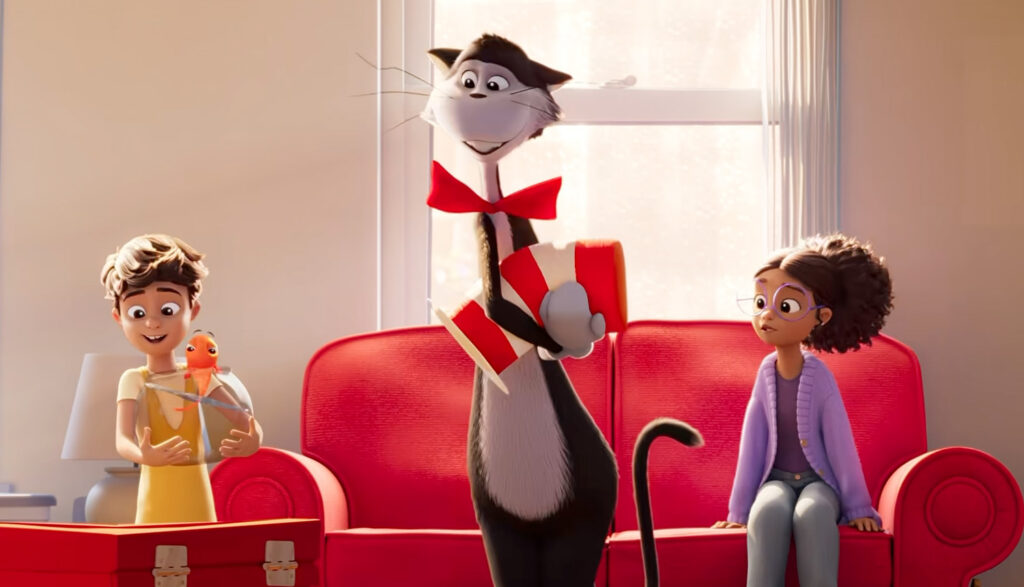
While sensitive little ones may find the film’s “Something” monster a tad too frightening, The Cat in the Hat often wears its heart on its sleeve. At times, the movie can be needlessly noisy, but it’s also frequently endearing. Families can certainly glean a few solid lessons from the Cat’s goofy antics.
The Cat in the Hat is almost too good at his job.
Sure, by all measurable metrics, the kids that he interacts with start out in the “frowner downer” category. But by the time his magic hat full of random amusements is emptied, they often end up in the coveted “deliriously delighted” camp.
The Cat is truly a master of his art. The only downside to his exceptional skill at cheering up kiddos, is that his “mess meter” is equally off the charts as well.
In fact, the Cat’s messiness has been measured to the amount of 97,810—which, even without a comparison to his coworkers’ mess stats, is still a high number in any regard. Some might even say a record-breaking one.
The Cat has one last chance to prove that he can delight dour children without causing so much chaos. And the powers that be have handed him an assignment more difficult than his last few combined.
Siblings Gabby and Seb have recently moved to a new town. They’re nervous about starting over and saddened by their single mom’s need to pick up more nursing shifts to support their family. Gabby, in particular, feels excessively misunderstood by her “boring” mother, and she misses her old home.
Now, both to save his own stripes and help some bummed-out kids in the process, the Cat and his newfound friends must venture into a few magical moving boxes in the hope of shifting some attitudes for good. Perhaps the Cat can show Gabby that she and her family have a lot more in common than she understands—and that while change is hard, it can also be a beautiful thing.
But time is of the essence: The Cat intentionally snagged a device from work called the “Go-Backer,” which has the ability to change the past, in order to retroactively clean up his messes before his bosses find out. But as he did so, he accidentally awoke a creature called a “Something” that is obsessed with days gone by.
Whatever adventures the Cat and his kid companions go on, they must act quickly—before Something uses the Go-Backer to put everything in jeopardy.
Beyond the obvious positivity that the Cat brings to children, the film earnestly wears its heart on its sleeve—showcasing a family brought closer together through a difficult move.
Initially, Gabby and Seb don’t understand why their hard-working, single mother is so “boring.” However, through their adventure in magical cardboard boxes, they begin to understand their mother. Long shifts at the hospital, piles of paperwork and a lack of time for music or crafts are not just part of her adult life: They’re done as sacrifices for her children.
Gabby’s love for pep band is initially something she’s embarrassed of, after a new classmate asks her (with positive connotation) if she’s a “band nerd.” However, after embracing the joy that music brings her, Gabby later responds that she is a band nerd, and the two girls bond over a mutual love for their art.
The kids’ journey brings them closer together as well, reminding them of the times they used to play together. And, while a part of Gabby will always miss her old home, her appreciation for her mother’s sacrifice in moving their family to a good school district imbues her with a sense of optimism about the next phase of life.
We are told that when she was young, the kids’ mom put on a free concert at a retirement home on Christmas Eve for those who didn’t have family or friends. The mom’s love for her kids is extremely evident throughout the entire film. A stubborn landlady learns to hold empathy for others. As friends encourage and support each other throughout the film, we’re reminded that “you should always stand up for a friend.”
While the confines of the Cat’s magic are unclear, the film does present it as something that is limited. No wands, spells or runes are found in the film—just near-constant use of childlike wonder that feels more like kids playing with toys than magic. We see talking animals, pocket dimensions within moving boxes and couches-turned-vehicles throughout the film.
The Cat’s world is populated by many imaginative creatures, including the “Things,” anthropomorphic, blue-haired creatures that love to cause mischief and mayhem.
A toy that has been transformed into a living creature within one of the magical box realms is said to be a “psychic” narwhal, although his abilities are contained to one scene that’s so noisy, they mostly get lost in the shuffle. Gabby and Seb’s pet fish becomes sentient due to the Cat’s magic.
The Go-Backer is said to be a piece of technology, but it has the ability to transport its users back through time. The tool’s overuse turned an innocent creature into a large monster.
Nothing overtly sexual weighs down the Cat’s hat beyond a few jokes that will likely fly straight over kids’ heads. Due to all the ultra-quick, often rhyming wordplay, comments such as “My father has other kids?” or “I don’t know, did he go on long-distance trips?” vanish before little ones may understand the connotation.
Within a few of the magical realms, several pairs of underwear drift about, flying like birds or swimming like large manta rays. An angered landlady exasperatedly shouts, “What in the turtle panties was that noise?” One of the Things sits on top of a box from which our characters are attempting to escape, with his rear eclipsing the exit. The characters quickly toss around multiple jokes about the “crack” that they must now escape.
During a dramatic, soap opera-esque finger-puppet play put on by the Cat, two characters smooch, and one declares, “The baby is yours.”
A couple kisses in a flashback. The Cat leans in to kiss his fish (voiced by a male actor), but the fish vehemently declines the offer—the moment is clearly played for humor rather than any ulterior motive.
While the vast majority of the nonstop action in The Cat in the Hat is on par with your average Looney Tunes venture (think excessive smacking, falling and blowing up—all with no serious threat of bodily injury), the film does sport a creature that little ones may find rather frightening.
This beast, named Something, was once an innocent Thing, who used the Go-Backer repeatedly to revisit a good time shared with friends. Becoming obsessed with reliving this memory, over time the Thing morphed into a slender, jagged-toothed, glowing-eyed beast—a creature that looks like it would fit as a villainous lizard from the How to Train Your Dragon series of films. The Something lurks in the shadows, chasing our characters from a variety of locations—at one point grabbing a young boy and holding him hostage with one of its sharp claws.
In a dramatic presentation, we are told that if Something gets the Go-Backer, it may tear the fabric of the universe to shreds. The beast is described as violent and menacing, although we never see it inflict much harm on anyone.
Beyond the eerie design of Something, cartoonish chaos abounds. When first entering the house of Gabby and Seb, the Cat is met with some pepper spray to the eyes as Gabby yells, “Stranger danger!” Characters smack and crash into each other, household furniture is demolished, and the general level of animated destruction is unsurprisingly high.
In a fight with Something towards the end of the film, random objects are launched at the beast, from flying underpants to sentient pieces of pasta. Post-battle, the Cat proclaims that he is severely concussed.
Gabby goes back through time to witness a concert that her mom put on as a child. Her initial perspective is that the event went horribly wrong—with people needing oxygen and being wheeled out in wheelchairs. (With more context, however, Gabby learns that the event took place at a retirement home, and all involved were safe and happy.)
A few characters printed on a sheet of paper shout in fear as the paper is shredded by a giant shredder. This same household appliance threatens to shred our main characters as well, although they narrowly avoid that fate. A sentient fish is almost poured into a toilet, and in another scene, a group of Things attempts to eat him. While juggling a plethora of random items, the Cat accidentally spills “the ashes of Nana” into his mouth, coughing and scraping them off of his tongue.
While no harsh words litter the script, a few light ones, such as “crap” and “twit,” pop up a time or two each. Light name-calling, including “loser” and “stupid,” floats about infrequently, as well as “heck,” “gosh” and “good Lord.”
None.
While clearly not encouraged, the film briefly mentions that screen addiction has made the Cat’s job more difficult throughout the years.
While not excessive, the film certainly sports some potty humor. In one scene, the Go-Backer is used to reverse the action of a bird defecating. Jokes about farts and rear ends fly infrequently. A few decorative signs in a bathroom read “potty like a rockstar” and “poopsie daisey.”
The Things communicate with each other through belly smacking, rear slapping, toot noises and mouth clicking—a joke that landed every time with the littles in the audience, but one that I imagine will get old rather fast for parents.
An antagonistic character in the film proudly states that “you should never stand up for a friend,” although the film itself clearly doesn’t take this view. A character tells another that “live, laugh, love” is the only rule that matters, and that all other rules were made to be broken.
Like the film’s quickly changing, brightly colored images that hardly grace the screen for more than half a second before zipping away, The Cat in the Hat is a lot of things. (Get it?) Thankfully, most of these things will be pleasing to parents curious about this animated adventure.
Now, the cynical part of me wants to lay into the film a bit. Early on, the Cat gazes with sadness at two kids who’d prefer to scroll on their tablets rather than indulge in the magic of childhood play. He comments on the current state of kids’ attention spans, how it’s become increasingly difficult to keep them entertained. However, quite ironically, the film’s breakneck pacing seems to inadvertently hold a similar belief—that the way to rein in kids’ attention spans is not to expose them to calmer media, but to outpace an alluring iPad game.
Also, that ideology feels a bit overplayed: Families who frequent the local cineplex will likely recall a few other recent films tackling similar themes of childhood innocence and identity with more precision. In this vein, Inside Out 2 and Toy Story 5 come to mind.
But in fairness, this most recent outing from the hat-touting Cat shines in its own right. Many families will find the content here navigable. And where the film lacks in originality, it certainly doesn’t falter in colorful creativity. Bill Hader’s voicework is sharp, funny and genuinely rather impressive as the Cat.
While some sensitive little ones may find the Something monster a tad too frightening—and parents may regret exposing energetic children to the needlessly noisy Things—the film leaves viewers with a message anyone might hope their kids will take to heart:
“You should always stand up for a friend.”

Jonah Parker’s first interaction with Plugged In came when he was just five years old, after his parents read a review for The Chronicles of Narnia: Prince Caspian and deemed the content too intense for him. What started out as a contentious relationship between Jonah and a staff of reviewers who knew not of his existence would later turn into an appreciation for the site’s ability to present media content in a way that was accurate and fair. Jonah enjoys analyzing how our entertainment echoes the creativity of our Creator while finding glimpses of Biblical truths within every genre. He believes that Robert Pattinson’s Batmobile is the perfect mix of cool and practical.