

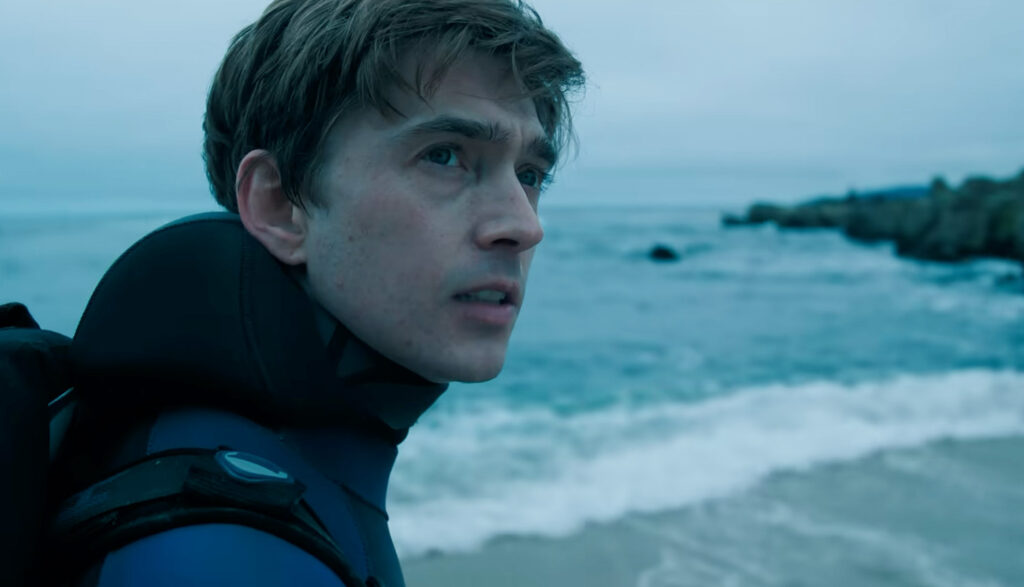
Jay Gardiner has the worst day of his life after being swallowed by a whale. Audiences witness the consequences of being digested. Bloody wounds and crunching bones add to the film’s visceral intensity, along with a school of swimming profanities. While this film will be too deep a dive for little ones, older audiences may appreciate some sweet moments of reconciliation between an emotionally estranged father and son.
60 minutes.
That’s how much air Jay Gardiner has in his tank. Only an hour to search for the bones of his deceased father. Jay has a rough idea of where his father took his own life, but it’s a big ocean—and Jay knows better than most that the sub-nautical kingdom doesn’t much care for what humans desire.
Mitt Gardiner, Jay’s dad, always found peace within that notion though. The ocean provides for itself, and maybe if humans weren’t so insistent on polluting it with negligence and wasteful tourism, it would provide for us as well. For a man like Mitt, being a part of something larger than himself, away from the rat race of the world, was all he desired—and all he wanted to share with Jay.
55 minutes.
Just one bone would be enough, Jay thinks. Anything to finally bury a part of his father and give his mother and sisters some sort of closure. Anything to prove that he’s even half the diver, half the man, that Mitt was.
All is going about as well as it can in a waterscape so unpredictable, until Jay hears an ear-splitting clicking noise. Soon, Jay will be the only human witness to a certain giant squid’s attempted escape from its natural predator—the sperm whale.
50 minutes.
What happens next is a violent blur of creatures thrashing to win their own survival. Sperm whales don’t eat humans—at least, not intentionally. But they do frequently snack on squids, and this particular squid has a tentacle or two wrapped around Jay.
45 minutes.
When Jay wakes up, it doesn’t take long to realize where he is—and how much air he has before any number of cruel fates might cut his life short. Left only with the lessons of the ocean his late father taught him as a child, Jay must use his limited resources to find a way out of this biblical predicament.
And while priorities have shifted from bone collection to survival, Jay may just find some sense of closure with his father’s passing after all.
While Mitt’s relationship with his son was strained at best, it’s clear that he was present for his wife and daughters—as well as the community at large. Several townsfolk recall times when Mitt saved them or taught them about the ocean and how to safely explore it. Jay’s mom and sisters recount good times with Mitt, laughing at the memories of his softer side—memories that Jay never fully felt a part of.
While he’s stuck in the belly of the beast, Jay imagines conversations with this father that never took place in real life. These fabricated discussions help Jay to process his relationship with his dad, and he comes to the conclusion that while Mitt was harsh on him in ways that often felt harmful, it’s the knowledge of the ocean imbued by Mitt that may just save Jay.
A flashback of Mitt holding Jay as a baby provides the most sentimental moment of the film, as Mitt tearily tells his newborn son that he’s terrified of how he might mess up as a father. The only way Mitt knew to love his son was through sharing the harsh oceanic domain that he called home—a sentiment that Jay never fully understood while his father was alive.
Whalefall is based on the eponymous novel by Daniel Kraus. While much of the explicit spirituality written in the book has been shelved in this film adaptation, viewers still get a strong sense that Mitt’s connection to the ocean is far more than a hobby.
Mitt views whales, as well as the cyclical nature of life and death, as beautiful, haunting and spiritual. As soon as his physical health prevents him from being a part of that world, he decides to take his own life. One might gather that he preferred his final resting place contribute to the ecosystem that he loved and borderline worshipped. His comments that “the ocean always provides” and “the whale is forever” support this notion.
A diver whom Mitt saved from drowning recalls that Mitt “guided me up like an angel.” While telling his family why he’s refused treatment for cancer, Mitt reports that he doesn’t want to be “poked like a voodoo doll.” Mitt tells Jay that long ago, the Inuit people would use every part of a whale, both for food and religious rituals, claiming “every part of the whale became a part of them.”
Call it dwindling oxygen or the permeating need for some sense of reconciliation with his deceased father, but Jay reaches a point where he begins to hear his father’s voice within the whale. This voice guides Jay on how to escape his deadly predicament and provides a way for the father and son to have some healing conversations that they never got the chance to have while Mitt was still alive.
Mitt makes a passing comment that his favorite author, John Steinbeck, was “god.”
The voice of Mitt within the whale asks Jay whether he has a significant other, girl or boy. Jay responds that he appreciates the sentiment of his dad’s support either way, but he does not have a significant other. Mitt and Jay discuss a section of the Steinbeck novel Cannery Row, in which a group of prostitutes make a quilt out of lingerie.
Both Jay and Mitt are seen shirtless at different points in the film.
[This section contains spoilers.]
As one could assume from the premise, Jay’s body goes through quite the beating in this film—but given the film’s PG-13 rating, parents may be surprised just how much of that is on full display. Effective sound design also contributes to moments of physical torment not seen but heard.
The crunching, contorting stomach muscles of the whale bash Jay around almost constantly—usually accompanied by Jay screaming and, in a few cases, bones breaking. A fight within the whale’s stomach, between poor Jay and an undigested squid, leaves the young man in rough shape, as tentacles slam him around the inside of the beast and wrap around his neck tightly. The sharp beak of the squid bites down on Jay’s neck, leaving a painful, bloody wound in its wake.
That’s just the start of Jay’s bodily torment: After mistakenly climbing into the whale’s second stomach, Jay’s hands are badly burned by stomach acids. In an attempt to flee that area of the whale quickly, his hand blindly presses down hard on a squid’s sharp beak. Jay screams in agony as he pulls the object out of his hand, accompanied by a thick spurt of blood. The ever-contorting stomach muscles of the behemoth break Jay’s ankle, and audiences see his foot bent in a way that’s far from natural.
As the whale dives to depths not friendly to the human body, Jay’s eardrums both burst—a wound made all the more evident by some effective sound design. His eyes threaten to bulge out of their sockets, and blood begins to trickle from his nose and ears before the whale’s dive is interrupted. An explosion towards the end of the film leaves Jay’s face burned and bloodied.
Between all of that, and the constant crunching of nearly being digested, one could imagine that Jay’s injuries extend beyond what is visible onscreen.
Jay is not the only being gravely injured during the film’s runtime. The whale itself sustains brutal, bloody injuries as well. Between the sharp tendrils and chomping beak of the squid it ingests and a near-fatal attack by a fleet of vicious orcas, the whale bleeds throughout the film, both internally and externally. The orca attack results in wounds that prove to be fatal for the creature, as it loses a fin and gains dozens of other injuries.
Jay inflicts some internal pain to the whale as well, stabbing its stomach lining and tongue repeatedly with a squid beak. Jay eventually jams his oxygen tank into the flesh of the now-deceased whale to blow a hole in the side of the creature. Bloody chunks of the beast’s flesh rise to the surface as the main carcass sinks back to the depths of the water.
The giant squid (presumably one of many) puts up a solid fight against being eaten, but it eventually goes limp after a large crunch noise from the whale’s digestive tract.
Mitt instructs Jay from a young age on how to survive in the harsh ocean, frequently discussing the dangers of running out of oxygen, getting tangled in seaweed, jagged rocks, etc. We hear talk about some of Mitt’s more dangerous jobs, such as diving for golf balls in the murky waters of country clubs.
In a drunken stupor, Mitt crushes a beer can on his forehead, drawing blood. As Jay attempts to tend to his father’s wound, Mitt pulls a knife on his son, intending to cut Jay’s forehead in a similar manner: He claims the whales will respect them more if they sport matching scars. Jay wrestles the knife from his dad’s grip before any further damage can be inflicted.
Mitt kills himself, fastening weights to his body before entering deep waters. Prior to taking this final dive, we see Mitt coughing violently from a physical ailment: He has cancer but has refused treatment, preferring to end things on his own terms. He arranges notes for his family and friends just before his fatal plunge.
Turns out that surviving in the belly of a behemoth dredges up some foul profanities. Much of Jay’s dialogue is delivered though a diver’s breathing apparatus, and it can be difficult to accurately make out every word. However, by my count, one f-word and 10 s-words float freely in the film, as well as “a–,” “b–ch” and “d–n.” At least 10 misuses of God’s name—including one paired with “d–n”—add to the murky language.
Adult characters drink wine socially on multiple occasions, and the film alludes to the alcohol enhancing their mood. It would seem one of Mitt’s vices is cheap beer, as he is typically seen with a crushed can or two nearby. In one scene, Mitt’s drunken state and impaired decision-making briefly put Jay in an unsafe position—which becomes the final straw of their already contentious relationship.
A man describes nitrogen narcosis (a lack of oxygen underwater) like being drunk, stating the phenomenon morphed his perception of reality.
The film portrays Mitt’s suicide in a way that implies his close friend Hewey knew Mitt’s plan and even assisted him by rowing Mitt out to a section of water known to house a deep cavern under the surface. Hewey cries as Mitt dives into the water, knowing that his friend won’t be coming back up again.
After Mitt receives his cancer diagnosis, his wife and daughters beg Jay to reconnect with him one last time. For months, Jay refuses, either waiting for Mitt to reach out himself or far too hurt by his father’s past actions to attempt reconciliation.
Mitt’s version of love was flawed, to say the least: He paired harsh scolding with a passive aggressive nature that made Jay feel guilty whenever he couldn’t pass one of Mitt’s tests or wanted to hang out with friends instead of practice diving. The tensest example of verbal berating comes when a drunken Mitt rants to his son, yelling that Jay can’t even swim away from the conversation due to his “soft lungs.”
“Prey’s best chance of survival is to become so dangerous the predator can’t help but let it go.”
This advice from Mitt is what ultimately leads to Jay’s salvation. But, if Mitt’s harsh instruction hadn’t driven the father and son apart in the first place, Jay likely never would have felt the need to search for the bones of his father. He never would have been swallowed by the whale, coming about as close to death as one could.
For Mitt, sharing his love of the ocean and ensuring that his son could survive anything the waves threw at him should have been enough. Everything he did was, admittedly, for Jay’s benefit. But Jay never understood that. He felt that his father’s impatient instruction came from a deep sense of disappointment—and a lack of trust in his son’s ability to live up to the Gardiner family legacy.
Living out Mitt’s lessons, though, allows Jay to break out of this cyclical nature of hurt. Spending time in the belly of a whale helps Jay to finally understand that while his father’s methods were far from ideal, they were the result of a broken man trying to show love toward his son the only way he knew how.
In many ways, Whalefall offers audiences exactly what they may expect. Any film tackling survival within the harsh conditions of a whale’s stomach is going to flaunt near-constant tension and nauseating bodily harm to its lead character. And while the extent of the violence, as well as some harsh profanities, may surprise curious viewers, I’d imagine the film’s loudly beating heart will as well:
Absolution through trial. Closure because of an ironic realization that Mitt did love Jay—and it’s that love that serves as Jay’s best chance of survival. The way to understand Mitt’s world was to be (literally) swallowed up by it.
While certainly not for the squeamish, Whalefall’s plunge into a story of survival unearths a deluge of familial healing in its depths as well.

Jonah Parker’s first interaction with Plugged In came when he was just five years old, after his parents read a review for The Chronicles of Narnia: Prince Caspian and deemed the content too intense for him. What started out as a contentious relationship between Jonah and a staff of reviewers who knew not of his existence would later turn into an appreciation for the site’s ability to present media content in a way that was accurate and fair. Jonah enjoys analyzing how our entertainment echoes the creativity of our Creator while finding glimpses of Biblical truths within every genre. He believes that Robert Pattinson’s Batmobile is the perfect mix of cool and practical.