

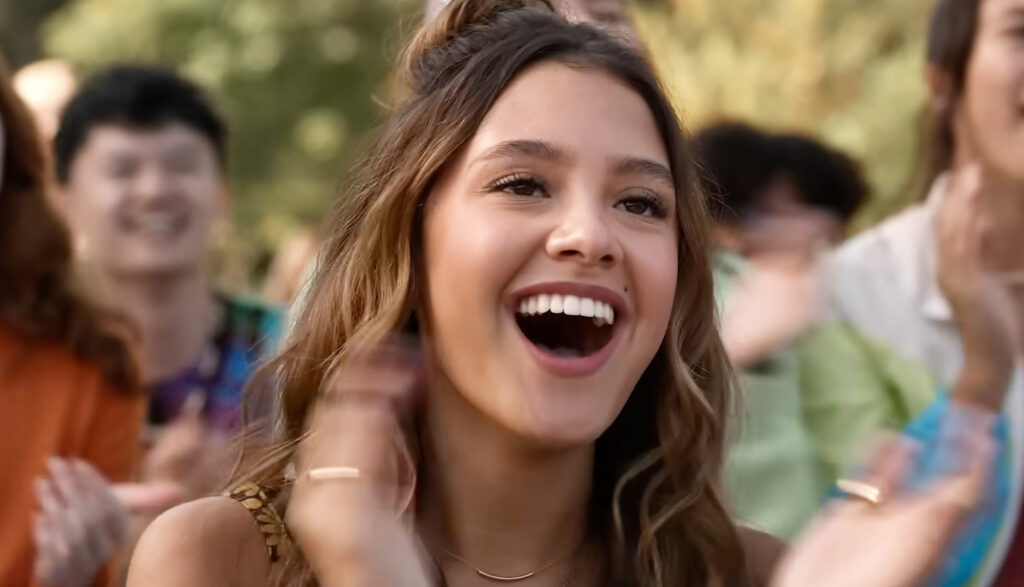
A new set of campers arrive at Camp Rock, ready to explore their musical abilities and find fame—not necessarily in that order. Disney’s Camp Rock 3 features some outfits that reveal a peek of midriff, slightly sultry dance moves and a teensy bit of language. But the biggest issue might be the movie’s “my way” mentality.
Nearly 20 years ago, a young Mitchie Torres attended Camp Rock and met a young Shane Gray and his two talented brothers. They all went on to become Demi Lovato and the Jonas Br—er, they went on to become famous musical acts.
Well, Camp Rock is still hanging onto that vaunted legacy with both fists. Practically everyone who comes to this camp is eager to play music and primed for superstardom—though perhaps the balance between music and fame can feel a bit off.
Sage loves music. But she hungers for fame. “I want the spotlight to shine in my eyes,” she sings before she swallows her first bite of camp-cooked oatmeal. She left her brother’s band because they weren’t quite ambitious enough for her taste, and she now has her eyes locked on becoming Camp Rock’s next big breakout star.
Sorta awkward that her brother, Desi, is at the camp, too.
Desi still holds a grudge over the whole band-breakup thing. His emphasis has always been on the music. If people want to turn him into a pop icon because of that music, well, that’s all well and good—as long as it doesn’t keep him from jamming. He’s at Camp Rock to find folks who are just as passionate about the beats as he is.
But when The Jonas Br—er, I mean, Connect 3 return to camp to seek out their next tour’s opening act, Desi decides that maybe the spotlight isn’t so bad. Not if he can keep Sage out of it, anyway.
But with Connect 3 dangling out the biggest of big breaks, Sage and Desi face plenty of competition. Bad-boy Fletch arrived at camp in the back of a Sheriff’s car, but that won’t stop him from singing his heart out. Rosie comes with cello in tow, ready to explore her own, less classical musical talents. Cliff thumps his drumsticks on pretty much everything, so why not take those drumsticks on the road?
And Madison and her two in-tow backup dancers? Well, she’s already a star—online. She’s ready to take the next step, even if that means she uses other campers as a convenient set of stairs. Oh, and of course, there’s all those other Camp Rock campers who love music and applause and would love to open for Connect 3, too. But really, who cares about them?
Sage is ambitious, and the movie tells us that there’s nothing wrong with a little ambition. But as nice as fame might be, Camp Rock 3 insists that friendship means more.
Sage and her bro naturally patch up their sibling relationship. And both of them bond with Fletch, Cliff and Rosie, too. They become the best of pals, and Sage comes to realize that her priorities might’ve been just a wee bit out of whack. “I just always put my dreams before everything else,” she says. “This time it’s the ‘everything else’ that I can’t stop thinking about.”
The campers learn lessons about acceptance and forgiveness. They explore new talents and learn to embrace new sides of themselves. The brothers of Connect 3—who start the movie squabbling—also patch things up. A bit. And the film ultimately suggests we’re stronger together.
“It’s not just about one person,” someone says, listening to a group of musicians make their music. “It’s about the way they make each other shine.”
Camp Rock also has a firm no-phone policy—a sentiment that Plugged In can get behind. “Camp Rock is better face-to-face than screen-to-screen,” the camp’s leader says.
Cliff calls Rosie the “goddess with the cello.” We hear about how “magical” Camp Rock can be. The human soul is referenced.
Sage and Fletch quickly become an item. They cast languid glances at each other, and the two almost kiss before getting interrupted. They’re not the only potential pairing: Callie, Sage’s talented dancer friend, develops a crush on Desi, which may be requited. Cliff harbors feelings for Rosie, which most definitely are not.
Female characters wear clothing that hug the body and can reveal just a touch of midriff. Dance moves can feel rather sultry.
[Spoiler Alert] Mitchie—played by Demi Lovato—makes a cameo toward the end of the movie, and Lovato served as one of the movie’s executive producers. In real life, Lovato characterizes herself as pansexual (though she’s again using she/her pronouns), and she’s become an icon in the LGBT community. But there’s no indication of the singer-producer’s current, real-world sexual identity in her brief appearance in Camp Rock 3. As Mitchie, she warmly greets her former boyfriend, Shane.
Fletch’s arrival by squad car sparks plenty of rumors. “I heard he’s banned from most of Canada and the entire state of New Jersey,” someone tells Sage. And when Fletch’s young cabin mates display a bit of fear at his presence, Fletch jokes that if he was planning to harm them, he’d do it when the lights go off. (In reality, Fletch’s arrival in the Sheriff’s car had nothing to do with any illegal activity.)
That’s typical for Camp Rock 3, where any allusions to violence are played as jokes.
Someone pinches a snoring camper’s nose with her fingers. “I wasn’t suffocating him,” she says. “I just wanted him to stop breathing!” Desi tells Sage to “break a leg,” a common enough message among performers that actually means good luck. But Desi takes it further: “Maybe even break two,” he adds. “For balance.” When a camper confesses that she’s thinking about doing something out of character, another camper asks, “Is it murder?” (It is not.)
Someone is accidentally knocked over by another camper. We hear that someone’s mother recently died.
Two uses of God’s name in the context of OMG.
None.
Influencer Madison is the camp’s requisite bully. She steals several items from other campers and takes it upon herself to decorate/deface them with paint and glitter. (Even Rosie’s cello is “bedazzled.”) Madison also does her best to get the five friends kicked out of camp through underhanded means (breaking camp rules in the process.)
That act leads to a massive paint fight in the camp’s arts and crafts shed. Paint and paste fly everywhere, splashing on campers and sullying the building itself.
The camp holds to a strict “no phones” policy, and we hear that a few campers are kicked out of camp for breaking that rule. One of our core characters hides a contraband phone—but only to catch a critical, life-changing call. Another character brings the phone to the attention of the camp leadership.
Rosie’s parents worry about the corrupting nature of non-classical music (which would seem to make Camp Rock an odd choice for them to send her to for the summer). “My parents forbid me from indulging in recreational melody,” she tells Sage. “It leads to … jazz.” (She clearly is indeed influenced by recreational melody, and her attitude later in the movie might suggest rebellion against parental authority.)
Someone throws Cliff’s drumsticks on a cabin roof (tired, it would seem, of his incessant drumming.) There’s a reference to lice. Lark—Connect 3’s manager who’s scouring Camp Rock for the group’s next opening act—thinks it’s a great idea to let five teens (two girls, three boys) spend a night largely unsupervised in a touring bus. (Nothing happens, of course, but still.)
Cynically, I sometimes wonder whether Disney’s TV movies are a self-aware, self-perpetuating machine.
It works like this: The Mouse House releases a Disney Channel film about how great the spotlight is. The movie becomes wildly popular, Disney makes tons of money, churns out scads of merchandise, and a good chunk of its fans start looking for said spotlight. (A very tiny subset of that group even have the talent to find it.) Disney holds auditions for its next Disney Channel film, and voila! The cycle begins anew.
Camp Rock 3 attempts to debunk that cynicism. Sure, our core campers explore their music and chase fame here. But most importantly (the movie tells us), they find each other. They find friendship. And that’s what’s really important. Add to that the movie’s lack of content issues—many Christian films have more superficial “problems” than this one—and Camp Rock 3 feels like a family-centric win.
But I can’t shake that cynicism. Not as the camp’s adult manager screams to her new summer charges that “Legends are made here!” Not as Sage gushes that the camp is essentially a “historical landmark,” given all the stars it’s churned out over the years. Not when cello-playing Rosie makes a Sandra-Dee-in-Grease turnaround in the final stanza, strutting in short-shorts, a midriff-baring top and singing out against the way her parents raised her. “No bowing down, no sweet ballet,” she sings. “This is my sound and I play my way.”
Sure, maybe Rosie’s parents were a little overbearing. But the whole “my way” theme has been so central to Disney’s messages to tweens for decades now that it’s hard to ignore.
Ironically, Disney does its best to make its own manufactured stars play Disney’s way—with the studio heavily managing their careers and public personas as long as it can. And when stars inevitably bolt the Mouse House and take Disney’s own messages to heart, the “my way” mode of thinking has come with some mixed results.
At one point, Lark walks through the camp’s green forests and stumbles on a rock. How stereotypical, she mutters.
It seems that Camp Rock 3 comes with its own not-so-musical rocks to stumble over. It looks clean and nice and even beautiful at times. Certainly, the songs are just as catchy as ever, and the kids just as talented. But we gotta watch out for those worldview rocks, too. Without some guidance, your kids just might trip on one.

Paul Asay has been part of the Plugged In staff since 2007, watching and reviewing roughly 15 quintillion movies and television shows. He’s written for a number of other publications, too, including Time, The Washington Post and Christianity Today. The author of several books, Paul loves to find spirituality in unexpected places, including popular entertainment, and he loves all things superhero. His vices include James Bond films, Mountain Dew and terrible B-grade movies. He’s married, has two children and a neurotic dog, runs marathons on occasion and hopes to someday own his own tuxedo. Feel free to follow him on Twitter @AsayPaul.