



If you’ve ever thought about the incongruity of we Plugged In folk dogmatically pontificating about the dangers of screens and social media while also promoting all our content through screens and social media … well, you’re not alone. We discuss that particular irony all the time. (If only we could just give you a call or meet up for coffee.)
However, if you’re looking for a monumental example of irony—on the level of politicians complaining that nothing ever gets done in Washington—you need look no further that the tech titans who created social media to begin with.
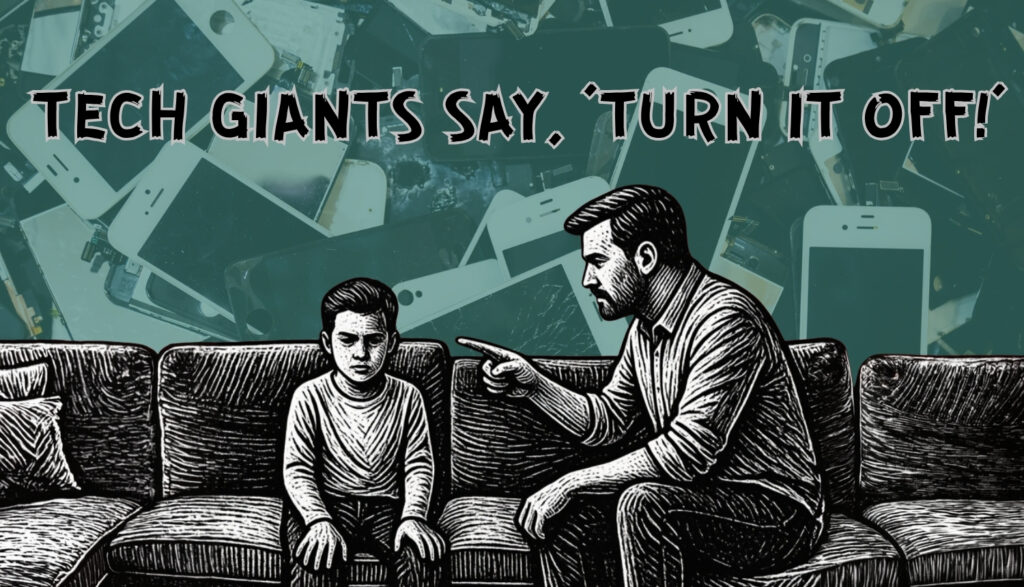
It turns out that those social media purveyors are the first to say they won’t let their kids within a country mile of the stuff. And let’s face it, they’ve got the inside track.
They know it’s all designed to be addictive. They’re the ones who construct the algorithms that keep pulling people back in like bees to brightly colored fields full of flowers. They then willingly reap the resulting financial honey, while also steering their own kids away.
Billionaires Say Nay
You may have, for instance, heard about Shou Zi Chew, the CEO of TikTok who testified before Congress about all the many reasons that TikTok should not be banned. And at the same time, that same CEO declared that he doesn’t let his kids on the app. Likewise, Meta founder Mark Zuckerberg said he doesn’t want his children sitting in front of a computer screen for long periods of time. Rather, they should spend their time outdoors, reading Dr. Seuss and exploring nature.
Want more? Bill and Melinda Gates of Microsoft fame said they didn’t allow their kids to own smartphones until they turned 14, and they kept strict time limits and kitchen-only access for computers. Snapchat CEO Evan Spiegel and his wife reported that they limit their children to a strict maximum of 90 minutes of screen time per week. Even Steve Jobs was famously restrictive with his kids, keeping them clear of Apple’s iPad.
There are many other news stories with the same slant. And there are many reports of tech giants and Silicon Valley employees sending their kids to Montessori or Waldorf schools that steer students away from screens and technology and towards pens and paper.
These tech-focused men and woman have done their own internal studies. They know that young girls who use social media for most of their day are much more likely to be depressed. They recognize that teen boys are more likely to be targeted through social media for sextortion scams. And they understand that there’s a huge problem of kids being routinely subjected to unwanted sexual advances, harassment and misogyny on their websites.
A New Study Points the Way
Now, don’t get me wrong, I’m not bellyaching about the fact that these technology wunderkinds want to protect their kids from all of this potentially destructive stuff. Not at all. In fact, I think that most moms and dads ache with that same desire to shield their loved ones. I’m simply suggesting that we follow the billionaire’s example when it comes to screens at school and home.
It just so happens that social media has been around long enough that average people are beginning to see the impact it’s having. And more and more schools are leaning toward locking away screens and tech during the school day in an effort to aid the learning process.
A major National Bureau of Economic Research study from this past April—examining cellphone bans across thousands of U.S. schools—found that strict bans reduced in-school phone use by roughly 80%. And while detractors noted that kids’ grades didn’t seem to be markedly improved by phone restrictions, they didn’t tend to notice the study’s most important discovery: It turns out that when phone use was locked down long enough, the kids’ wellbeing began to dramatically improve.
Without phones, the constant notifications were never heard, the incessant distractions weren’t seen. Cyberbullying decreased; kids started feeling better about themselves. In other words, for those six hours in a lockbox, phones and social media-driven urges didn’t intrude. Teachers reported that kids were more focused in class. Life was better.
Home Front Proffers
And you know what? Those same kind of limited phone-use positives can be carried home after school, too. Even in a world inundated with screens, it’s reasonable to suggest family lockdowns of everybody’s phones for certain periods of time: During mealtimes. While working on homework. In the midst of special family moments. In that hour just before bed.
Experiment a bit. Talk with your kids about the possible adjustments and impacts. Just see what kinds of positive outcomes may result. Hey, the tech billionaires think those are smart suggestions. And we very ironic Plugged Iners do too.

Recent Comments