

The crew of Apollo 13 is set to man America’s third trip to the moon when something goes terribly wrong, and it requires heroic efforts to save them. This historically accurate and well-crafted film powerfully displays the dogged determination and bravery of all involved. But there is more foul language here than you might expect, along with smoking and drinking.
Jim Lovell had flown several astronaut missions over the years as America’s space program was finding its footing in space. He’d orbited the Earth, gone on space walks and even flown to and orbited the moon. But he’d never left his footprint on that lunar surface.
Lovell was so close and yet so far. He’d looked out the command module window and seen the cratered, dust-covered surface. He even named a lunar mountain after his wife, Marilyn. But he never touched down. And the fact is, he’s been a bit nervous that he might never get that chance.
You see, America was first to the moon. It was a huge moment. It was exciting. Everyone in the world watched and cheered. But just over a year after Neil Armstrong completed the first moon landing and planted the American flag on the moon’s surface, it feels like the American public has moved on. Public interest and financial supporthave quickly waned.
However, the Apollo 13 mission is still on the board for March of 1970. And it turns out that Jim Lovell is tapped to be its captain.
At the news, Marilyn Lovell is equally excited and terrified. I mean, she’s well aware that Jim wants this moon landing experience. He’s trained rigorously, studied, practiced. He’s performed everything by the book and to the finest granular detail. Jim’s crew and support staff are made up of pilots and technicians who are just as dedicated and passionate about space travel as he is.
But things sometimes go wrong.
Back in ’67, a catastrophic flash fire erupted inside the Apollo 1 command module during a routine launch rehearsal test. Three good men died. And everyone in and around that capsule was every bit as careful and dedicated as the crew members are now. That fact weighs on Marilyn.
Frankly, Marilyn is right to worry. For if we were to magically swoop in on the already assigned, appointed and waiting service module for the Apollo 13 mission, bore through its aluminum honeycomb panels, make our way past the milled aluminum support beams and into the heater/fan mechanism of the compartmented liquid oxygen tanks, we might, on very close examination, noticed some lightly frayed wires.
That wire damage is nothing much to see, really. But while flying between the Earth and the moon, it might just cause a spark during a routine oxygen tank stir. Any idea what a small spark might do to 326 pounds of pressurized liquid oxygen?
Yes. I’d say Marilyn has every right to worry.
The Apollo 13 disaster was a very real event in our history. And the film shows us incredible individuals who worked tirelessly to bring home the astronauts aboard safely.
Ken Mattingly, for instance, is an astronaut who was pulled off the Apollo mission, but he spends long, weary hours at the Houston command center trying to devise shortcuts and work-arounds for damaged systems and a lack of power. The film takes time to praise the technicians who worked themselves to the point of illness in an effort to invent ways to keep the struggling crew alive.
All of the crew members are held up as never-flagging heroes. But Jim Lovell shines brightest as he pulls his team together and helps them focus on life-saving essentials. He takes responsibility for every problem and encourages his crew in emotional as well as physical ways. (When crew member Fred Haise gets sick, Jim provides him with aid.)
Apollo 13 also portrays Jim and Marilyn Lovell as a very loving couple who supports each other while still fulfilling their children’s needs. Marilyn not only has to work through her own emotional agonies but care for suffering family and friends. She makes sure that Jim’s elderly mom, Blanch, is cared for, too.
Blanch, in turn, comforts her granddaughter. “Don’t you worry, honey,” the elderly woman tells her weeping grandchild. “If they could get a washing machine to fly, my Jimmy could land it.”
There’s a subtle nod to God’s hand moving in the film, made in the form of an old TV interview with Jim Lovell where he described a frightening situation from his past. He talks about losing his instruments and cockpit power while piloting a jet at night and being saved by a what he saw as a “miraculous” event. There’s no direct mention of God guiding Jim, but the film uses this old interview snippet as a means of connecting that seemingly heaven-sent help with the amazing things taking place during the Apollo 13 emergency.
We’re told that the House and Senate passed a resolution asking Americans to pray for the struggling astronauts. At the same time, Pope Paul leads followers in prayer for the men, and prayers are lifted up at the Wailing Wall in Jerusalem. A local priest sits with Jim’s family as they watch a news report about the Apollo 13 crew and their struggles.
While trying to get quick information for the Apollo 13 crew, Mission Control leader Gene Kranz snaps at a technician, “I don’t want the whole d–n Bible, I just need a couple chapters. We’ve got to get something up to these guys.”
Early on crew member Jack Swigert is established as a guy who uses his status as an astronaut to flirt with and pick up women. For instance, he describes a spacecraft docking using winking innuendo. We see him and a female companion stepping out of his bathroom shower wrapped in towels.
We also see Marilyn squatting down in the shower (we see her bare back, the side of her leg and her arm) as she tries to retrieve a ring that she accidently dropped into the drain. After a party at their home, a slightly tipsy Jim and Marilyn joke together and snuggle in a lawn chair.
Marilyn has a nightmare involving her husband getting sucked out into space after a command module accident. Jim talks about the accidental fire that killed three astronauts.
We see the explosion that takes place in the Apollo 13 service module, which blows out one of the craft’s aluminum walls. Later, when the command module separates from the damaged service module, the camera closely examines the ravaged structure.
However, most of the story violence plays out in the form of the astronauts struggling with a lack of power, the growing cold and the danger of carbon dioxide poisoning. The crew and the mission command staff work against the clock to somehow bring the three men home through worsening conditions.
There are seven s-words in the dialogue, along with nine exclamations of “d–n” and several uses each of “a–” and “h—.” God’s name is blended with the word “d–n” seven times, and Jesus’ name is misused once. Someone uses the word “frapping” as a profanity substitute.
Partygoers, supervisors and command center technicians smoke cigarettes and cigars throughout the film. People down lots of mixed drinks and beer during the Lovell’s party. (Jim and Marilyn end the evening a bit tipsy.)
One astronaut gets sick in space and vomits in zero gravity. We also see one of the astronauts urinating in a command module tube and ejecting the waste into space (no body parts are exposed).
News networks decline to air anything about the Apollo 13 flight until something goes horribly wrong and it looks like the astronauts might die. As the danger level and tensions rise, people get angry and argue.
Apollo 13 is one of those classic films that works because of a very good director.
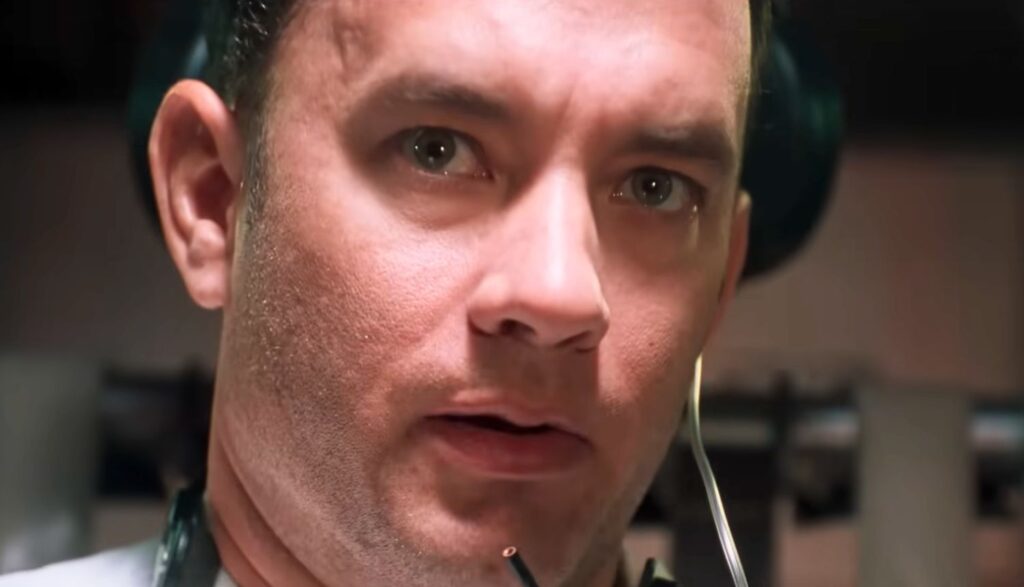
Don’t get me wrong, all the story elements are excellent, the ensemble cast is top shelf, and the set pieces and locations all feel spot on. But it’s Ron Howard’s direction that makes it gripping: Through his edits, in-scene quick-cuts and exacting camera angles, he manages to capture fear-filled eyes and errant sweat drops, the swirl of nervously sighed-out cigarette smoke. All those tiny film details and perfectly captured moments are what make this drama click.
Many of us know how the Apollo 13 story ended—it was officially labeled as a “successful failure” since nearly everything went wrong, but the crew was miraculously brought home safely—but Howard shapes his film to help us experience how it all felt, moment by moment. And better yet, all that slick film craft never gets in the way of the heroic story: It just heightens the tale with color and emotion.
There’s also something spiritually powerful about the real-world story behind this film. While Apollo 13 doesn’t directly lift up faith or people of faith, it does lightly nod in that direction. And when you consider that NASA’s “room full of computers” and all the tech in the Apollo spacecraft combined had far less computing power than the phone in your back pocket, Apollo 13’s “successful failure” is a truly miraculous event.
As far as questionable content is concerned, there’s more crude language here than you might imagine (or remember) in a PG-rated film. And there’s smoking, drinking and a dash of winking sexual innuendo in the movie mix as well. So, please check out the sections above before launching the whole family into this well-dramatized slice of history.

After spending more than two decades touring, directing, writing and producing for Christian theater and radio (most recently for Adventures in Odyssey, which he still contributes to), Bob joined the Plugged In staff to help us focus more heavily on video games. He is also one of our primary movie reviewers.