

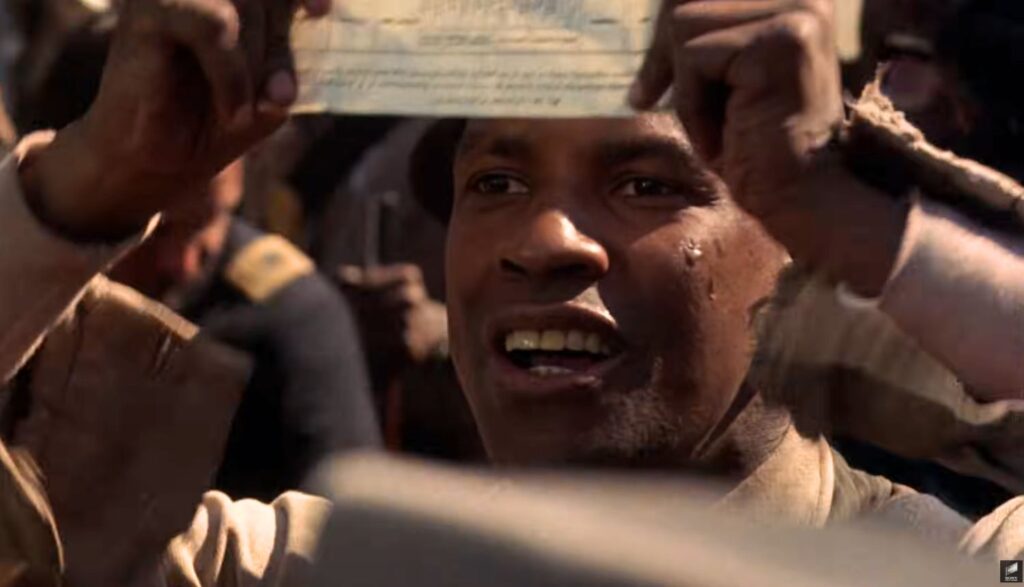
Glory tells the true story of the 54th Massachusetts Infantry, a regiment of African American soldiers during the Civil War. The 54th‘s courage on the battlefield inspired Congress to create even more Black regiments, turning the tide of the war. But visceral, bloody battle scenes and foul language make this a film to approach with extreme caution.
In September of 1862, the Civil War has been tearing the country apart for more than a year. Rumor has it that President Lincoln is planning to issue an Emancipation Proclamation to free all the slaves. And Robert Gould Shaw, a 25-year-old Union officer recently returned from the Battle of Antietam, has just been given a colonel’s commission over the newly minted 54th Massachusetts Infantry—the first regiment compromised entirely of African American soldiers.
Some of the recruits were born free men, others are former slaves. All wish to fight for the freedom of Black people everywhere.
But Shaw worries that these volunteers are ill-prepared for the realities of war.
Even if Shaw can somehow get them up to snuff, there’s little chance they’ll see any action: Apparently freeing a slave is one thing; handing that freed slave a rifle is quite another.
Shaw’s troops are held in such low regard they haven’t even been given the most basic necessities, such as socks and shoes, let alone a blue Union uniform.
But Shaw won’t give up on his men. Unlike their white compatriots, these men aren’t just fighting for land rights or governing principles: They’re fighting for their freedom. It creates a sense of camaraderie and strength of heart completely foreign to Shaw—and he can’t help but admire the sense of pride and dignity these men carry into even the most menial of soldierly duties.
Shaw is determined that the 54th will receive their chance to prove themselves in battle. Because if their regiment succeeds, it could turn the tide of the war.
As the film begins, we truly get a sense of the times. Civil War-era America, even in the North, was a place filled with discrimination and bigotry. Shaw’s parents are prominent abolitionists, so he’s somewhat the exception to the rule. He even grew up alongside one of the men in the 54th, Thomas Searles, a free Black man who can speak and read as well as Shaw himself. However, Shaw comes to realize that, even with his more egalitarian upbringing, the color of his skin has granted him many privileges.
That privilege, at times, makes it difficult for Shaw to connect with his men. He admires their ability to shift from grave, marching soldiers to carefree, singing men at the end of the day—but he doesn’t understand it. He struggles to strike a balance between strict commanding officer and fellow soldier at arms.
But Shaw eventually does find that balance. He realizes that, quite simply, the men of the 54th are risking their lives, their freedom to be there. They want to fight. All they ask of Shaw is to give them that chance—the chance to prove themselves as men. So that’s what Shaw does, inspiring courage and steadfastness in the process.
Of course, Glory isn’t just about Shaw’s transformation or bravery. Far from it.
We see the former slave Trip learn how to let go of his hatred and selfish attitude and instead focus on what his service means to others. Indeed, Trip comes to view the 54th as his family, the one he never knew as a slave.
Thomas spends a great deal of the film being ignored by his childhood friend, which clearly hurts his feelings since he was Shaw’s first volunteer for the 54th. Shaw even forbids a mutual friend (a white officer) from fraternizing with Thomas since officers and enlisted men shouldn’t mingle. But both friends come to understand that Shaw’s refusal to acknowledge Thomas is born of a desire to prepare him for battle, not wound him. As a result, Thomas displays great bravery on the battlefield, even saving a fellow soldier.
John Rawlins—another former slave who worked as a gravedigger for the Union before volunteering to serve—is an unceasingly patient man. He uses his wisdom, born of years of experience in both the southern and northern states, to bridge the gap between African American soldiers and their white officers. He helps Shaw understand that what the men need is a sense of dignity. And when his fellow troops begin to harbor resentment against white soldiers, he’s the first to remind them that those same soldiers have been fighting and dying in the Civil War—fighting and dying for their freedom—for several years now.
The men of the 54th (including the white officers in charge) are presented with multiple opportunities to abandon the regiment. But they refuse to leave. These men want their freedom; they want the chance to fight for it. They’re scared, certainly, but they would rather go down standing up for what they believe in than tuck tail and run. Their bravery earns them the respect of other regiments—ones that had previously shown them disdain. And their courage and discipline on the battlefield inspires Congress to raise up additional African American troops: 180,000 volunteers, we’re told.
On the eve of battle, men of the 54th join together in song. The lyrics they sing reference Noah and the Ark. They take breaks in the song to say prayers. One man’s prayer references gratitude to God. He says that he has no fear of dying because he knows that “blessed Jesus Almighty” is with him. Another man thanks the Lord for His grace and many blessings. He asks that if they die on the morrow, that God will let their families know that they died facing the enemy—fighting against those who oppressed them—for freedom.
When the volunteers of the 54th first come together, Shaw says to them, “May God bless us all.” During a critical moment, when the men could have left the regiment but didn’t, Shaw exults, “Glory hallelujah!”
Thomas teaches one of his fellow soldiers how to read, and we later see that soldier reading the Bible. A man folds his hands in prayer before a meal. Someone sings “Hark the Herald Angels Sing” at Christmas. During a parade, Rawlins instructs some African American children to tell their parents “how Kingdom come in the Year of Jubilee.” We hear a reference to the hand of God and to the Jewish people.
We hear about transcendentalism. A drill sergeant seemingly tries to insult (and thus motivate) some soldiers by calling them Hindus.
We see a single woman standing with a group of soldiers, drinking heavily with the men as they all leer at her. Women at a ball wear off-shoulder gowns that bare some cleavage.
A drill sergeant insults his troops in an attempt to break them, calling them “whores” and asking one man if the man’s genitals were cut off at birth. He calls another man a “prissy schoolgirl.”
Like many war films, Glory can be quite visceral. Cannonballs and bullets fly, sending soldiers careening through the air. Troops graphically lose limbs and faces—and many writhe in agony or try to crawl to safety after sustaining such injuries. Early on, one man’s head is blown completely off, spattering Shaw’s face with blood. Shaw himself gets nicked in the neck by shrapnel.
And that’s just the ranged attacks. Soldiers move in closer for melee skirmishes, stabbing their enemies with bayonets and swords. When weapons aren’t at hand, fists and feet do the job. One man even picks up a tree branch to beat his enemy.
These battles are gruesome to watch, and the aftermath is no better. Bodies litter battlefields. Corpses are piled in mass graves. While Shaw is getting patched up in an infirmary, a man nearby screams in horror and pain as doctors attempt to saw off his wounded leg: He begs them to stop cutting.
We hear about battle losses, and if you’re up on your Civil War history, then it’s not a spoiler to learn that many of the characters we meet in Glory perish.
Trip’s feet, from his first day at training camp, are badly blistered, bruised and bleeding. They get worse as training commences, the result of substandard footwear. At one point, he sneaks off to a nearby farm to see if he can find new shoes, but he’s caught by his commanding officers. Unaware of Trip’s true goal, they label him a deserter—the punishment for which is flogging.
One officer appeals to Shaw, asking him not to follow through on the flogging, but Shaw doesn’t back down. When Trip’s shirt is then removed, we see dozens of scars crossing his back: Trip was frequently whipped as a slave. The officer carrying out Shaw’s orders hesitates, looking to Shaw for confirmation, but Shaw orders the man to follow through. The officer whips Trip with a cat-o’-nine-tails several times. Trip flinches, but he doesn’t cry out, shedding only a single tear. Later, we see Trip’s wounded back and feet as they’re being bandaged.
Trip tries to start several fights throughout the film. More than once, his friends must physically restrain him.
When African American soldiers (not men of the 54th) raid a town, one of them gets into a fight with an African American woman. He punches the woman in the face, knocking her to the ground. A white woman grabs the man, telling him to leave the other woman alone. He grabs her by the hair and prepares to punch her as well. At this point, his commanding officer intervenes, ordering him to release the white woman (while he did nothing to defend the Black woman). When the soldier fails to obey, his commander shoots him in the chest, killing him. The officer then blames the local women for starting the disagreement.
A drill sergeant screams at the men of the 54th as he trains them. When they don’t respond, he often resorts to physical corrections. At one point, he stomps on a man’s feet to teach him right from left. Elsewhere, he disarms a soldier and knocks him to the ground with the man’s own gun. When a soldier collapses after a run, the sergeant kicks him in the stomach, ordering him to get up.
Rawlins slaps a man across the face. Someone talks about squirrel hunting. Soldiers follow orders to burn a town to the ground.
Perhaps unsurprisingly given this film is set during the Civil War, the n-word is a familiar slur, used roughly 20 times. When used by white people, it’s typically an insult. But Trip frequently uses the word as a more cultural term of kinship. However, when he calls Rawlins the n-word, the older man scolds him, informing Trip that he refuses to be called the term, even by his own people.
In addition to the n-word, we also hear African Americans called Negroes and “coloreds.” Several slurs refer to them as apes. (Trip even imitates a chimp while mocking one of his fellow soldiers.)
One use of the f-word and two of the s-word. We also hear uses of “a–,” “b–tard,” “b–ch,” “h—” and “t-ts.”
God’s name is misused about 11 times, once paired with “d–mit.” Jesus’ name is abused another three times or so, once joined together with Mary’s and Joseph’s names.
Trip repeatedly calls Thomas “Snowflake” because he believes that Thomas wants to be white.
Men smoke cigars and pipes throughout the film.
We see folks imbibe on several occasions, usually in celebration. However, some men drink from flasks as a sort of anesthesia as they undergo surgery or medical procedures. A doctor calls out for chloroform to subdue a man as he surgically removes the man’s leg.
We witness moments of racism and hear about slavery. Many white people suggest that African Americans are inferior to them, both in intellect and physical prowess. It’s for that reason that the Union is hesitant to use the 54th for anything besides manual labor.
Shaw grows furious when he realizes a quartermaster has been withholding supplies (namely shoes) from his regiment partially because the man doesn’t believe they deserve them. (The quartermaster even seems to think it’s funny.) Elsewhere, a white soldier refuses to obey a command from Rawlins (who is a higher rank).
However, a couple of African Americans are similarly prejudiced against white people. Trip, for instance, is convinced that all white people are the same, that none will ever treat him with decency or dignity.
A drill sergeant for the 54th screams a variety of colorful terms at soldiers as he trains them. Many of these retorts are racist (which one officer notes), but as the film progresses, it seems the sergeant is just trying to do his job. He’s trying to prepare the men for war, which certainly would include performing battle tasks while bullets fly and enemies shout insults. Still, his methods are severe and drive at least one man to tears.
Later on, Shaw employs similar harsh (but perhaps necessary) methods, firing a gun repeatedly next to a man’s ear as the man attempts to reload and fire his rifle multiple times. Shaw was clearly trying to recreate the conditions of battle to help train the man, but it’s still shocking to witness.
And speaking of battle conditions, Shaw appears to be suffering some aftereffects of such. He flinches when someone shuts a window loudly. He seems to experience a sort of anxious response when his men first get their rifles and pretend to shoot each other.
The colonel of a second African American regiment—one made entirely of freed slaves—doesn’t show his men the same dignity and respect that Shaw does. Instead, he takes his regiment to a nearby town on a “foraging” mission. Really, they just loot the town. And when things take a violent turn after one of the townsfolk stands up to them, the colonel orders Shaw to have the 54th torch the place.
That same colonel tells Shaw that he owned slaves in Oklahoma before the war, so commanding them, he says, comes naturally. (His soldiers call him “Massa Colonel,” which he doesn’t correct, implying that he sees them as slaves more than soldiers.) We learn the man is in cahoots with another officer, both using the war as an excuse to raid and pillage nearby towns and mansions for personal gain. Shaw threatens to expose them.
Shaw’s men are mocked by this regiment, but they refuse to be goaded. Other white regiments similarly mock the 54th, clearly thinking themselves superior.
We also get some indications of other discriminatory attitudes. A colonel of another regiment suggests that all “secesh” (people who seceded from the United States to join the Confederates) should be “swept away by the hand of God like the Jews of old.”
War is not pretty.
People die, often in bloody ways. Soldiers, many of whom have never fired a rifle before they enlisted, are forced to kill their fellow man. War changes people, sometimes for the better and sometimes for the worse.
Glory shows us all of that.
This 1989 film earned Denzel Washington (who plays Trip) an Academy Award for Best Supporting Actor. It can be found on many a “Top Ten War Films” list or “Best Patriotic Movies” list (including our own).
The hope in this film is palpable. It’s hard to not be inspired by the courage and bravery of the 54th—a real regiment of African American soldiers during the Civil War, oh by the way—as you watch.
But war is not pretty.
Glory, for all its impressive cinematic and storytelling skill, is rated R for a reason. Oddly, this film doesn’t feel as gory as many modern slasher flicks or high fantasy adaptations. But somehow, it feels more visceral.
I think it’s because the bloody battles we witness aren’t meant to be gratuitous. The director wasn’t going for shock value. Rather, Glory is trying to meaningfully depict some of the more gruesome battles that are a very real part of our history. And that realism—the pain, the horror, the struggle—is what makes the deaths witnessed here feel so much more terrible.
Language here includes one use of the f-word, multiple abuses of Jesus’ name and repeated uses of the n-word. (Though that’s not exactly shocking given the time period in which this is set.) And we also get a very real sense of the racist attitudes that permeated not just the southern states, but the northern ones as well.
If you’re looking for good historical war films, Glory is certainly up there. But for families, it’s one that should be approached with extreme caution.

Emily studied film and writing when she was in college. And when she isn’t being way too competitive while playing board games, she enjoys food, sleep, and geeking out with her husband indulging in their “nerdoms,” which is the collective fan cultures of everything they love, such as Star Wars, Star Trek, Stargate and Lord of the Rings.