

The Death of Robin Hood is a grim, brutal movie that flirts with the idea of redemption without ever embracing it. What the film does embrace is extreme violence impartially inflicted upon men, women and children onscreen. A couple scenes feature nudity and masturbation, and the film also briefly deals with assisted suicide.
You might be familiar with the tale of Robin Hood—the heroic outlaw with a bow in hand who, alongside his band of Merry Men, stole from the rich and gave to the poor. He protected the meek and innocent. He gave food to the widow and orphan.
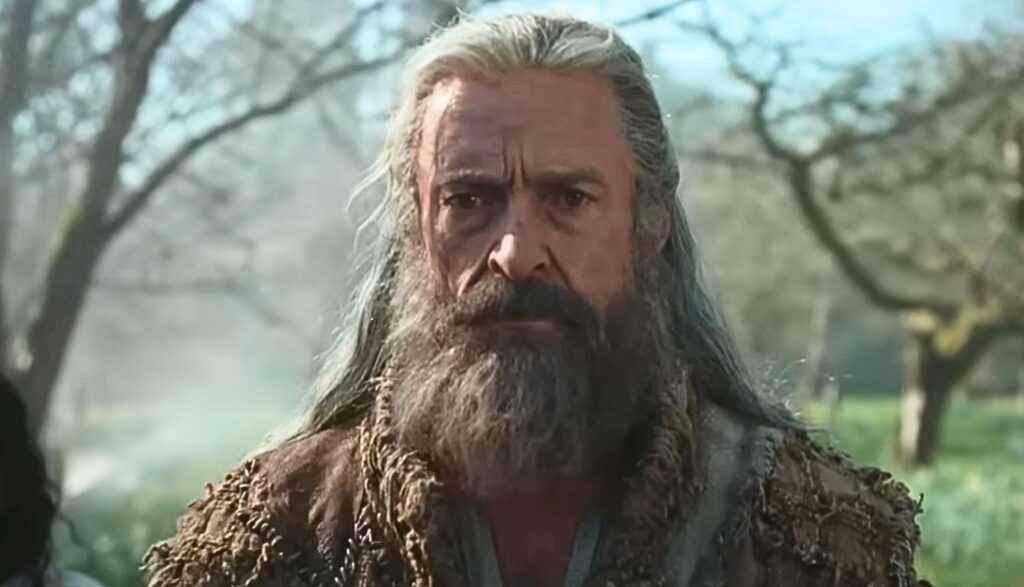
But the real Robin Hood? The elderly one who’s staring into the fire with eyes that long for death? He knows all of that is a tale of half-truths.
The truth is that he robbed and killed for the joy of it, nothing more. Sure, he stole from the rich, but he stole from the poor, too—and he kept it all for himself. In his time as a bandit, he’s killed so many people he couldn’t tell you the number. Sometimes, he doesn’t even remember why he killed someone.
One may gather that Robin is tired of all this bloodshed. But bloodshed continues to haunt him: He may not remember the faces of those he’s killed, but the kin of those faces remember him—and they always come seeking vengeance.
One family has nearly found it. They’ve come to kill Robin and his fellow outlaw, Little John, for slaughtering their cousins, brothers and children. Robin and John survive the attack, but Robin’s resulting wounds prove fatally threatening. Desperate to save Robin, John takes him to Sister Brigid, the prioress at the Priory of St. Clement, situated on an island away from the mainland.
The prioress knows not who Robin is; she only knows he is a man in need of care. And she gives it, provided he help out catching game and picking fruit from the orchard to help care for the island’s many orphans. If Brigid knew who he was, perhaps her response would be different. Could a man who led such an evil life truly deserve to live in a safe haven like this? Could he even accept such kindness?
Rest, however, is short. Vengeance soon finds Little John, leaving Robin to care for the man’s daughter, Margaret, who others still hope to slay as retribution for Robin and John’s murder of their own children. It leaves a tired Robin constantly alert to any threats that may come to harm Margaret and the priory.
Because if vengeance can find Little John, might it also find its way to the island?
In a movie that’s filled to the brim with depravity, the priory is an island that cultivates peace. Brigid, assisted by a man with leprosy, takes care of orphans on the island. She gives food and healthcare freely to those in need. Whether intentional or not, the film shows how Christians specifically slowly transformed the world from a place of self-centered survivalism to one of caring for others.
The leper likewise tells of Christian forgiveness: He mentions that Brigid does not care about who they once were. Robin identifies the man as a former mercenary, for instance. But for those willing to put away their past sins, Brigid tries to be a light in the world—and that’s in spite of dealing with her own great sorrows.
Robin cautions a young man on a track to a life of vengeance to simply go back to what remains of his family. He explains that he himself has lived a life of bloodshed, and it is a terrible life. The young man takes Robin’s advice (which is good advice in general, though severely marred by the fact that Robin was one of the men who slew the man’s family in the first place).
A man whose ear Robin had cut off in a previous scuffle forgives Robin for the attack. When someone else discovers Robin’s fault against her, though she is in great agony over the revelation, she ultimately chooses mercy.
When a woman asks Robin if he feels remorse for those he’s killed, he simply says that he feels tired.
A Christian woman prays just before she goes to try to slay Robin Hood. Other people pray a litany for forgiveness over a dead child before going to kill Robin for slaying the boy. A woman teaches Little John some prayers. When Little John’s wife is killed in retribution for a family’s loss, Little John slays the remaining family members. Afterwards, he prays a prayer of St. Anselm, and he places rosary beads in his dead wife’s hands.
Little John claims Sister Brigid has “healing magic.” A man references Christian philosopher Boethius’ The Consolation of Philosophy, summarizing it by saying that “it did not matter if this whole world were misery because he had one thing that could never be taken—his mind, and in his mind, he had God.”
Someone recites John 14:2-4 in prayer.
Brigid tells Robin that the priory stands upon what was once a holy site for druids, which then became a temple spot for the Romans. She believes there is power in the island—never expounding upon what she means by that—that draws the religious there.
In one scene, Brigid sneaks off to masturbate in a cave. She’s still clothed and turned away from the camera, but we hear moaning. Robin and Little John prepare for an ambush by stripping naked and covering themselves in mud—we see their bare rears. Robin and Brigid cast a couple wistful looks at each other.
The Death of Robin Hood depicts extreme, visceral violence, especially in its first act—showcasing just how savage of an outlaw Robin actually is. Each kill comes with plenty of blood and gore.
When we first meet Robin, a woman attempts to slay him in his sleep, but he catches her off guard, stabbing her in the neck multiple times before finishing her with a blade to the temple.
Robin and Little John kill many others, too: They kill a passerby on the road to loot him. They slaughter a family and the family’s dog to steal their land. Disturbingly, when a young boy flees through a field, Robin fires an arrow, which impales the boy through the back of his head and out of an eye. (As if that weren’t enough, we later see the boy has survived, walking traumatized to his cousin’s home with the arrow still protruding. He dies soon after.) We see another man suffer the exact same injury—an arrow through the back of the head and eye. We are told that Robin once burned a man alive alongside the man’s children.
Someone states that, for the slaughter of his family, he will take the lives of both Little John and Little John’s daughter as payment. John buries an axe in that man’s head. Others, coming to slay the duo for the same reason, attempt to burn Little John and Margaret alive in their home. Robin engages in a minutes-long, brutal fight with them, which includes stabbing a man through the hand and then tearing that appendage in half. Others take arrows to their heads. Robin is stabbed and clubbed with a mace. Men bleed out slowly after having their throats cut. Robin impaling a man through the eye with a burning torch. A man stabs a woman in the stomach multiple times.
John’s prepubescent daughter, Margaret, looks on in horror as men stab her mother to death—and as her father then slays those men. Later, when she arrives at the priory, we’re told that other men did “terrible things” to her, leaving her further traumatized—enough so that, in a state of panic, she stabs another boy at the priory and runs away.
Robin undergoes multiple bloodletting treatments. A man dies from leprosy, his face covered in boils and blisters. Someone cauterizes Robin’s wounds with a hot iron. Robin kills a trapped and twitching rabbit by stepping on its neck onscreen. We watch him teach Margaret how to skin a rabbit, and we also see him removing the entrails of some larger game.
[Spoiler Warning] Robin asks Brigid to assist him in suicide via bloodletting, and she does so. He bleeds out through his bedsheets.
None.
Robin drinks alcohol. In one scene, he laments that another man is more inebriated than him.
None.
Let me introduce you to a new kind of Robin Hood: Rather than glorify the familiar archer as an antihero, the filmmakers here have decided to depict the fan-favorite bandit instead as a sad old failure who regrets his life mistakes.
The Death of Robin Hood revises the mythical outlaw’s history into one where, within minutes of the movie’s opening, audiences may actually find themselves sympathizing with the Sheriff of Nottingham and calling for the gallows. To put it simply, this version of Robin Hood is an astoundingly terrible guy—the kind of person whose favorite pastime is probably kicking puppies or something.
But perhaps plagued by the command to “show, don’t tell,” the movie ensures you’ll see just how vile of a creature this Robin Hood is: When a family has the audacity to chase Little John off the land of a relative John had killed, John goes to Robin for aid. All it takes is the mere suggestion that it’ll be a fine battle to convince Robin to assist Little John in slaughtering the family. And viewers get to watch as each member of that family, including a small child, falls to blade or arrow.
That sort of carnage is used to set up the elderly Robin as a man haunted by his actions. It seems Robin cannot escape his past, though that may be because those he hurt in the past now demand retribution—which, of course, leads to more death and spurs on even more vengeance.
One gets the sense that Robin longs to die—indeed, the film briefly deals with the topic of assisted suicide—and yet, when the next attacker comes, he can’t help but fight for his life.
But The Death of Robin Hood falls, strangely, into the same trap that the controversial Christian film Redeeming Love did—albeit with violence rather than sex. Both films want to show a tragic character dealing with the guilt of their sin, but both seemingly relish in showcasing those sins for the audience, as if to say, “This is wrong, but hey, isn’t sin fun to watch?”
And what makes The Death of Robin Hood more brutal, of course, is that it flirts with the idea of Christian redemption without ever truly embracing it. The events of the film move Robin to a sense of stoic guilt for his actions, especially in light of the grace Brigid has shown him. He recognizes himself as a wicked man who deserves death—but though others offer him forgiveness, Robin seemingly never moves beyond his guilt, ending the movie on the same tired, dreary note upon which it began.
A gest of Robin Hood this movie may be. But for audiences, this gest is no jest at all.

Kennedy Unthank studied journalism at the University of Missouri. He knew he wanted to write for a living when he won a contest for “best fantasy story” while in the 4th grade. What he didn’t know at the time, however, was that he was the only person to submit a story. Regardless, the seed was planted. Kennedy collects and plays board games in his free time, and he loves to talk about biblical apologetics. He’s also an avid cook. He thinks the ending of Lost “wasn’t that bad.”