


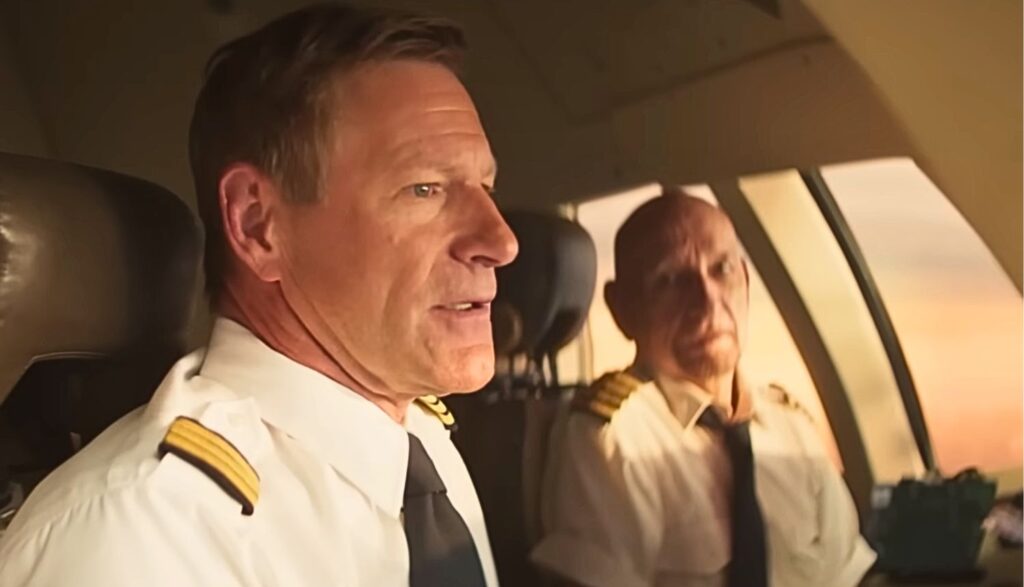
An exploding plane crashes down in the middle of the ocean and gets attacked by a ravaging shiver of sharks. Hundreds of people are slashed, burned and eaten. Blood gushes. There is some heroism on display and moments when people think of the families they love. But Deep Water is essentially a ‘70s disaster movie throwback with more realistic carnage.
Ben is an airline first officer who rightfully should be in the captain’s chair. But circumstances just haven’t gone his way: professionally or personally. So Ben soldiers on, making up for his ill-starred life by determining to always cross all his t’s and dot all his i’s.
Some people don’t appreciate Ben’s compulsiveness about rules and procedures. The captain of Ben’s current flight to Shanghai is one such person.
Captain Rich Peters is the type of guy who sips cocktails with a gaggle of flight attendants the night before a flight and eases his way through setups and other headaches the next morning. Rich is smooth and laid back, and he likes his flights to be that way, too. Rules and rule keepers can be so irritating.
However, Ben is sure that the one time he skips his usual double and triple checks of the plane’s navigation equipment, radios and warning systems, that’ll be the time that something goes sideways. The truth is, though, that even with excessive caution, you can’t micromanage freakish happenstance.
Rigid procedures don’t compensate for random sparks that detonate your 747 over the middle of the ocean. And they don’t prepare you for crashing down—with hundreds of dazed, wounded and dead passengers—into an ocean populated by rabidly hungry sharks just waiting for a flaming banquet from on high.
Nope. In bizarre situations like this, you really do need to go with the flow. In fact, when a plane gets unceremoniously ripped into burning chunks and splashed down thousands of miles from any rescue, you need to toss out triple checks and start relying on instinct.
Of course, Ben will also need to hope that his luckless life patterns take a turn for the better.
Ben and several other members of the flight crew make brave and daring choices to help survivors live long enough to be rescued. Both Ben and a flight attendant named Zoe swim into waters they know are shark infested to save people. Some passengers also try to save the wounded.
The film tries to encourage international cooperation and friendship between foreign nations. There are two sports teams on the plane, for instance, one from the U.S. and another from China. And a pair of young men—one from each team—clash fiercely early on. Later though, one clasher saves the other’s life, and they form a bond, working together tirelessly to help others in need. We also see a fishing trawler abandon a record catch and do everything possible to save crash victims.
Some people look at pictures of family members before their imminent death—murmuring words of love. In like manner, Ben comes to realize that the emotional struggles he’s been having with his family members are foolish. He calls to tell them he’s coming home soon. They all express their love for one another.
During a dire moment, we see a man praying. A dying woman looks at a picture of her granddaughter and says she she’s going to have a chat with God and ask him to fill the girl’s life with “as much joy as you’ve given me.”
A recently married couple go to the plane’s bathroom to have sex. We see them kissing passionately and caressing one another. (Both are fully clothed.)
A young woman traveling with her sports team, Lilly, has a crush on her team’s male captain, Sam. And while Sam’s feelings are mutual, he tells a friend that the team rules forbid team members from dating. The friend replies that no one cares about that rule. Later, Sam kisses Lilly’s forehead and she kisses him on the cheek.
Deadly and destructive violence are woven throughout this film. After a relatively brief introduction, that ongoing carnage begins with a fire in the 747’s cargo compartment. Men climb down to the lower deck to extinguish the flames, but the fire is already out of control. Oxygen tanks explode, obliterating the men and riddling the passenger cabin with fiery projectiles that rip holes in the walls.
Passengers get battered by falling luggage and debris. Some get killed instantly, others badly bloodied and rendered unconscious. Entire rows of seats, and their passengers, get sucked out through gaping holes in the plane’s walls. The engines explode from sucked-in debris. When the hurtling plane hits the water, a coral reef rips the bottom of the craft open, then the plane gets torn into fiery chunks by the force of the crash and onrushing water. The cameras watch closely as some people get trapped, drown or get consumed by roaring flames.
The remaining survivors are in shock or left screaming. Soon after, they’re set upon by a large shiver of hungry sharks. Bodies of the dead get pulled under water, and they reappear missing limbs, fingers and large chunks of flesh. The sharks repeatedly grab people and drag them beneath the waves. A few escape, but they are generally pulled out of the water with streaming wounds or missing limbs. The flight crew renders first aid, but bloodiness abounds.
Rescuers do eventually show up to help the survivors. But the sharks instantly attack one rescue swimmer as she’s being lowered from a helicopter. She’s lifted back up missing her leg. A shark then leaps out of the water and gobbles the woman whole, pulling the helicopter out of the air. Other sharks jump out of the water, chomping down on victims in rafts. Some victims get bitten, others are seemingly cut in twain, but the camera doesn’t examine the remains closely. Underwater swimmers are shocked when encountering dead bodies of people they know. A man shoots a flare into a shark’s open maw, setting the animal on fire.
In addition to the film’s massive, bloody carnage, we see some smaller struggles between humans—people batter each other with punches and pummels. We hear that Ben once punched a senior officer in the Air Force.
There are two spoken f-words (and one silently mouthed f-word) and two s-words in the dialogue. They’re joined by one or two uses each of the words “h—,” “b–ch” and “a–hole.” God’s name is misused twice (once in combination with the word “d–n”).
A guy smokes repeatedly in the airport, on the plane and after the crash, regardless of how many people ask him to stop. And the film symbolically uses this rather offensive individual as a statement against smoking.
Captain Rich parties with a group of women drinking cocktails in a hotel bar (though it appears that he only drinks water). Ben drinks a beer with his dinner.
An unpleasant person complains that a flight attendant can’t give him a vodka and soda that he wanted.
A completely obnoxious American passenger consistently disregards requests and rules to pursue his own selfish choices. In fact, his actions not only lead to a detonation that crashes the plane, but he thereafter is also the direct cause of a young woman’s death as he repeatedly endangers every survivor.
A tween girl named Cora is none too happy with her recently remarried dad. And she treats her younger stepbrother badly. After the crash, though, she searches frantically for him and feels guilty for not protecting him when she should have.
People vomit after the shock of the plane crash.
Deep Water is one of those films that seemingly harkens back to the golden age of disaster movies in the 1970s. It feels like it’s cut from the same cloth. This pic is packed with every disaster trope you can imagine, from endangered kids who make stupid choices to a heroic lead who overcomes his failings to embattled foes who become the best of friends.
In fact, it’s fair to say that Deep Water is actually two disaster movies rolled into one: an explosive plane crash calamity and a bloody sharksploitation pic. You’ll see incredible heroism and idiotic foolishness, tender family moments and chewed-off legs. This flick checks all the boxes. Hey, there’s even an ugly American antagonist in the story—a purely obnoxious oaf that every viewer can freely despise.
Of course, like many pics of this ilk, Deep Water isn’t necessarily logical. You’re not actually supposed to wonder about how a sparking cellphone battery could blow an aircraft to smithereens or how a shark could feasibly pull a helicopter out of the air.
No, this sort of Earthquake-like fare is all about its quickly moving entertainment value: that wham-bam ooh factor. This movie has that in spades. That and lots of flesh- and bone-mulching eww factors. And only you can decide how much oohing eww you can do.

After spending more than two decades touring, directing, writing and producing for Christian theater and radio (most recently for Adventures in Odyssey, which he still contributes to), Bob joined the Plugged In staff to help us focus more heavily on video games. He is also one of our primary movie reviewers.