


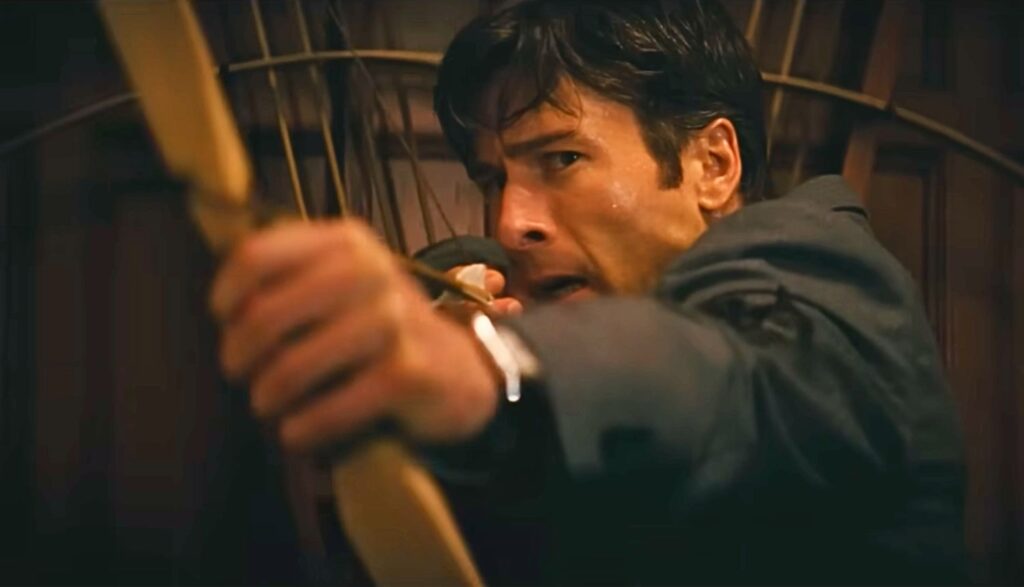
How to Make a Killing centers on Becket Redfellow, the estranged grandchild of billionaire Whitelaw Redfellow, who learns that if he slays the seven heirs in line for the family fortune, he’ll inherit it all himself. The movie warns about the love of money, encouraging the pursuit of love itself instead. But the dark comedy also comes with plenty of violence, sensual moments and crude language.
Four hours from execution, a priest visits inmate Becket Redfellow.
Becket earned the death penalty for murder, and it’s his final chance to confess his sins. Well, Becket’s not too interested in the confession part, but he’ll be happy to tell his tale.
It all started when his mother, Mary, became pregnant at 18. Her father, multibillionaire Whitelaw Redfellow, gave her a choice: have an abortion or else be disowned from the family. Mary couldn’t bear to sacrifice her child for luxury, so she left her father’s estate to raise her son.
Mary raised Becket as best as she could, adapting to the life of a hard-working single mother. Coming from a life of luxury, Mary would scrounge up her earnings to give Becket some small tastes of that high-class life.
Mary also told Becket of his estranged Redfellow heritage. Because her father had an irrevocable trust, Becket was still in line to inherit the family’s fortune. However, since he was also the youngest of the Redfellows, he’d have to wait until the seven heirs older than him died before he could see a penny of it.
Unfortunately, Mary was the first one to pass away. As she lay on a hospital bed—dying from a sickness that might have been prevented had her family sent some money to pay for the cure—she looked a young Becket in the eye and uttered her final words.
“Something was taken from you,” she said. “I want you to promise me something: Promise me you won’t quit until you have the right kind of life.”
The other Redfellows did not attend Mary’s funeral. They declined to take in Becket. He wound up in the foster care system, dreaming and hoping that one day he’d be able to make good on his promise to his mom.
Years later, Becket works in New York City tailoring suits. He checks the paper each day for news of any Redfellow deaths that might put him one step closer to his fortune. And every day, the answer remains none.
That’s when Julia, Becket’s childhood crush, walks into the store. The two reconnect. Becket asks her out for a drink. Julia declines, flashing her engagement ring.
But then Julia asks about the Redfellow fortune, and whether Becket has come any closer to getting it. He shakes his head. Julia leaves, uttering a final comment as she walks out the door:
“Well, call me when you’ve killed them all.”
It was said in jest. But the sentence stews in Becket’s head. The Redfellows abandoned his mother. They allowed her to succumb to a disease. Their apathy forced him to be raised by strangers instead of family.
And so, Becket starts to think:
“There are seven Redfellows. If I were to prune a few branches of the family tree, where would I start?”
As mentioned, when 18-year-old Mary discovers she is pregnant, she’s given the choice to have an abortion. Instead, Mary selflessly chooses to save her son’s life, leaving behind the status and comfort of her father’s multibillion-dollar fortune to become a working single mother.
One of the Redfellows on Becket’s kill list is Warren, his uncle. While most of the Redfellows are snobby, selfish elites, Warren is a kind man. When Becket meets him at a funeral, Warren apologizes for never reaching out to him or Mary—stating that he had always meant to and severely regrets allowing the mother and son to struggle. In apology, Warren provides Becket with a job at his brokerage firm, and the two become close—to the point that Becket cannot conceive of killing the man.
Later, Warren offers Becket some advice. He says that his pursuit of money has left no one but Becket by his side. Because of this, Warren warns Becket that money will not fulfill him, and he encourages Becket to pursue love instead.
Becket falls for a woman named Ruth. When he expresses his thoughts on money to her, she reminds him that she loved him even before he became wealthy or moved into a nice home. Ruth acts as a juxtaposing desire in Becket’s life, forcing him to wrestle with the question of whether being wealthy is what he really wants in life.
In prison, Becket is provided with a Catholic priest to give his confession. He turns down the confession, but he tells his story to the man, and we occasionally jump back to the two throughout the film. In one instance, Becket alleges that the Bible says, “The journey of 1000 miles begins with a single step,” but he is corrected by the priest.
During a funeral, someone quotes John 14:6. Later, someone else reads Psalm 23.
One of the Redfellows, Steven, is a prominent charismatic preacher who fears his name is getting sullied by the media. (He’s been involved in many scandals on account of his money-laundering practices.) “I always tell myself it’s nothing J.C. didn’t have to deal with—hating me because of my father,” Steven says. Becket jokes that if he has to kill Steven, perhaps it’s God’s will. Becket tells the priest that Steven’s church did not want to undergo another investigation, quipping, “I’m sure you know all about that.” In Steven’s office, audiences can hear the song “Be My Escape” (by Christian band Relient K) playing in the background.
Becket and Ruth both say that they think they’re going to hell.
In a couple of instances, characters talk about conscience and how—if one ignores his conscience for long enough— “you may never hear it at all,” never needing to worry yourself over right or wrong. This sentiment seems to parallel the warning in Romans 1:28: “And since they did not see fit to acknowledge God, God gave them up to a debased mind to do what ought not to be done.”
Becket’s story begins as a baby conceived via teen pregnancy.
Men and women wear very revealing swimwear at a pool party. A couple of women wear dresses that reveal cleavage.
When Becket first meets Ruth, she’s dating his cousin Noah. Noah brags that Ruth saw famous rapper Cardi B naked once. Ruth jokes that Noah (who is a professional photographer) may try to photograph Becket naked. When Becket and Ruth discuss classic literature, Noah mocks them for having a “virgin off.” There’s another joke made about cutting off male genitalia.
Becket kisses Ruth while she’s still romantically involved with Noah (though she admits that she was going to break things off with Noah anyway). As her and Becket’s relationship grows, Becket invites her to cohabitate with him.
As a boy, Becket crushes on Julia, and the two share a kiss. After they bump into each other as adults, Julia teases him in a sexually charged manner: She calls him after returning from her honeymoon; she urges him to ask her out despite her new marriage; she makes suggestive remarks while visiting him in his office and more.
[Note: This section contains spoilers.]
Given that this movie is premised on slaying relatives, we see a number of people bite the bullet before the end of the film.
Becket’s first kill occurs when he finds an inebriated relation on a boat. He uses a rope to tie the man’s leg to an anchor; then he sends the man to a watery grave. Another man dies when a bomb (created by Becket) explodes.
Someone dies in a plane crash. A couple of people are poisoned. And some die of heart attacks. One man is killed with a bow and arrow, and we see an arrow impale his throat. Someone survives being shot with a shotgun. These latter incidents involve a bit of blood.
A man kills himself offscreen with a letter opener, and we see his bleeding body when he’s later discovered.
Mary’s father tries to bully the 18-year-old girl into having an abortion. (She decides to keep her child.) When the teen who impregnated Mary sees his child, he has a pulmonary embolism offscreen—and, a decade later, Mary succumbs to a sickness, too.
We hear the f-word roughly 30 times, including one instance paired with “mother.” The s-word is used 15 times. We also hear the crudities “a–,” “b–ch,” “d-ck,” “d–n,” “h—” and “b–tard.” God’s name is used in vain nearly 15 times, including two instances paired with “d–n.” Jesus’ name is likewise used in vain twice. A man refers to a preborn baby with dehumanizing language.
Men and women drink beer, wine and liquor. Others smoke cigarettes. A man becomes visibly inebriated. Someone compares existence to “drunk girls as a party.”
Noah claims that a place was constructed using “recycled tampons.”
Were there a section of Scripture that summarizes How to Make a Killing, it’d be 1 Timothy 6:9-10:
“But those who desire to be rich fall into temptation, into a snare, into many senseless and harmful desires that plunge people into ruin and destruction. For the love of money is a root of all kinds of evils.”
And honestly, How to Make a Killing seems to support these verses.
On the surface, this Glen Powell-led dark comedy is a simple film dealing with family betrayal, careful planning and creative killings. But a few moments in the movie note its true feelings about its subject matter.
Perhaps the most impactful is when Powell’s character, Becket, is encouraged by his uncle to pursue a life of love over a life of money. The man speaks from personal experience, having enjoyed the luxuries of the world and found himself empty and alone. He doesn’t want his nephew to go down a similar path. Likewise, other characters espouse ideals of self-sacrifice and the recognition that money is fleeting.
Now, I won’t say whether Becket heeds their warnings. But scenes like these (sparse as they may be) showcase the biblical warning—that while the desire for riches may make one physically secure, it often comes at the expense of everything that truly matters.
Of course, that subtle message doesn’t detract from the movie’s many content concerns. Violence, obviously, stands at the forefront of How to Make a Killing. Some sensual moments and heavy crude language may also cause you to revoke your trust in the film.
So while there’s a surprisingly biblical message a viewer may glean from How to Make a Killing, audiences would have to invest in some unsavory content to see it.

Kennedy Unthank studied journalism at the University of Missouri. He knew he wanted to write for a living when he won a contest for “best fantasy story” while in the 4th grade. What he didn’t know at the time, however, was that he was the only person to submit a story. Regardless, the seed was planted. Kennedy collects and plays board games in his free time, and he loves to talk about biblical apologetics. He’s also an avid cook. He thinks the ending of Lost “wasn’t that bad.”