

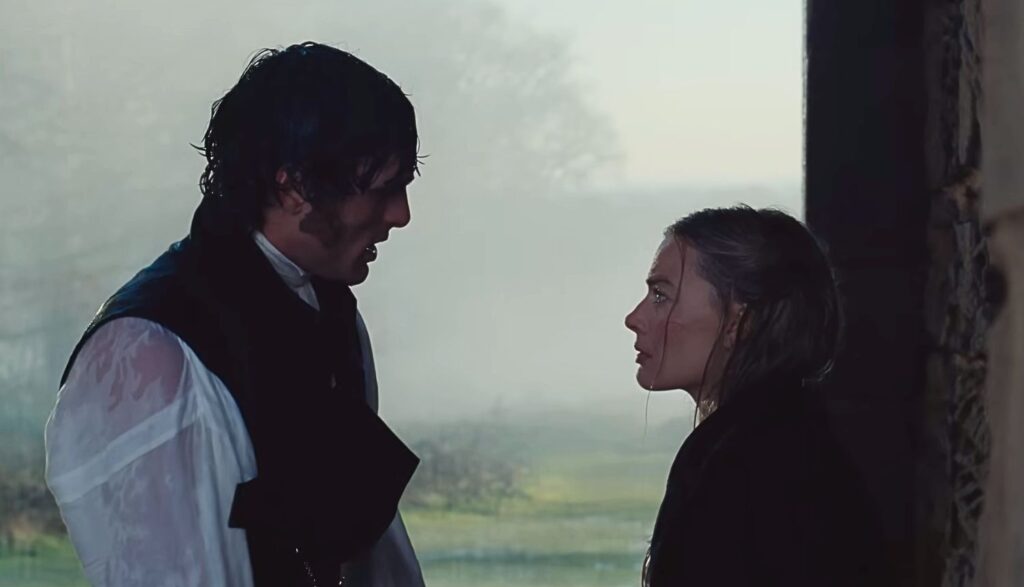
When Catherine’s long-lost love, Heathcliff, returns home, she engages in an extramarital affair with him. And ultimately, their love brings about their mutual destruction. Intensely sensual (but clothed) sex scenes, foul language, domestic abuse and a graphic miscarriage that results in death further doom this adaptation of Emily Brontë’s Wuthering Heights.
Catherine and Heathcliff have been in love since they were children—ever since Cathy’s father brought the orphan boy home to be her “pet.”
But love wasn’t enough to keep them together.
Cathy’s father gambled away everything they owned—everything but Wuthering Heights, their home in the English moors. Cathy worries that if she marries a destitute Heathcliff, they’ll be paupers. Still, she wonders if it their love might be worth it anyway.
Unfortunately, Heathcliff doesn’t know that. When he overhears Catherine discuss her situation with her companion, Nelly, all he catches is that Cathy would be “degraded” by marrying him.
So Heathcliff leaves without saying goodbye, determined to make his way in the world and return to Catherine a more worthy man.
Unfortunately, Catherine doesn’t know that. So she marries someone else, someone who can take care of her and her dilapidated father.
When Heathcliff returns, years later, Cathy is pregnant with her husband’s child. She’s built a stable life with him.
And that should’ve been the end of it. Heathcliff and Cathy should move on with their lives and be happy for one another.
Instead, they allow jealousy, spite and selfishness to drive them, engaging in a raucous extramarital affair that can only end in tragedy.
Because if they can’t have each other, then they might as well make themselves and everyone around them miserable.
Catherine eventually marries a man named Edgar, who obviously loves her. And even after he learns that Catherine’s having an affair with Heathcliff, his love holds strong.
When Heathcliff is first brought to Wuthering Heights, Catherine is told he’ll be her “pet”—and she indeed treats him as such for a while. But eventually their relationship blossoms into a more meaningful friendship, and Heathcliff tells Cathy that he would endure any torture to spare her pain.
Nelly, Catherine’s companion (essentially a hired friend), refuses to entertain Cathy’s more selfish whims. She frequently holds her accountable in an attempt to temper Cathy’s immature outbursts. Her sternness is perhaps ill-advised at times—and some of her actions are certainly self-serving—but she really does seem to have Cathy’s best interests at heart.
At one point, Catherine randomly says that she’d be miserable if she were in heaven—to which Nelly responds that Catherine isn’t “fit to go there.” Someone mentions being “damned” after beginning an extramarital affair.
We see crosses on necklaces and graves. Catherine wears several large, garish, bejeweled crosses as brooches.
A nun scolds some boys at a public hanging for mocking the dying man. The prayer “If I should die before I wake” is embroidered on a blanket. Someone reads from Matthew 11 at a funeral.
There’s no nudity, but this film contains a veritable montage of clothed but intensely sensual sex scenes. Oh, and they’re all carried out by a married and pregnant Catherine with Heathcliff. But more on that in a moment.
Joseph and Zillah, two servants in the Earnshaw (Catherine’s family) household, have sex in the barn one night. Their encounter is masochistic in nature, and Joseph puts a horse’s bridle on Zillah’s head. Cathy—who up to this point in her life has never experienced anything sexual–sees the beginning of this encounter from the loft above through a gap in the floorboards, but Heathcliff covers her eyes and mouth to keep her from seeing or making noise (lying on top of her back as he does so). Still, we hear and see a few flashes of everything Joseph and Zillah are doing.
The next day, aroused by what she saw the night before, Cathy brings herself to climax out on the moors. Heathcliff spots her, and, forgoing all further attempts at innocence, licks the hand she used on herself.
The couple doesn’t see each other for a while after that due to a misunderstanding. Catherine marries her wealthy neighbor, Edgar, in Heathcliff’s absence.
We see Cathy and Edgar have sex a couple of times, and it’s implied that it’s a regular part of their marital activities—albeit one that Catherine doesn’t seem to take much pleasure in. When Cathy isn’t pregnant a year into her marriage, her father mocks her, implying that her husband might be sterile. Eventually, the couple does conceive. And when Edgar hears the news, he delightedly insists on letting his wife rest in her own bed, since she wouldn’t get much sleep if she shared his.
When Heathcliff returns, he and Cathy begin their affair, and we see them having sex repeatedly. When he learns about Catherine’s pregnancy, he turns it darkly sexual. And Cathy plays along, aroused by Heathcliff’s jealousy and spurring it along. Elsewhere, Cathy presumably pictures Heathcliff while having sex with her husband, making him cover her eyes and mouth as Heathcliff did in the barn.
Isabella, Edgar’s ward, falls in love with Heathcliff. And both Heathcliff and Catherine use this information to spurn each other. When Cathy eventually rejects him, Heathcliff goes to Isabella’s room to seduce her. He undresses Isabella (off-screen), and we don’t see it, but it’s implied they have sex. We later see more instances of Heathcliff roughly beginning to undress Isabella before the camera cuts away.
A man is hanged, and the film sexualizes his death as he gasps for air (a bag over his head). Some young boys present at the public hanging note that he has an erection as he passes. Afterward, we see one couple making out and another clearly engaging in sexual activity beneath their clothes. Someone later wonders if a woman will be hanged in her skirts, which would be “indecent.”
Women wear corseted dresses that boost their cleavage. And more than once, the camera lingers on their chests as they breathe heavily. A woman purposely pulls her dress sleeves off her shoulders in a seductive manner. We see Heathcliff shirtless on several occasions, the scenes often purposely sexualized.
Isabella makes a pop-up memory book for Catherine. One of the images is a rose that looks like female genitalia. Another is a mushroom with a particularly long stalk that resembles male genitalia.
A young Heathcliff and Cathy lay next to each other in a bed one night. And Heathcliff rolls over to wrap his arm around Catherine’s waist.
A maid in the Earnshaw household mocks Nelly, calling the girl a “b–tard” whose father paid to have her hidden away with the Earnshaws.
After a man is publicly hanged, onlookers celebrate and cheer, many—including a young Catherine—enthralled by the spectacle. Peddlers sell dolls with nooses. Others put on a marionette reenactment. We later hear that a woman will be hanged.
A young Heathcliff is brutally manhandled by someone who may or may not be his father (Heathcliff himself never tells). The movie strongly suggests that Catherine’s father is physically abusive to his daughter and his staff; he’s certainly verbally abusive toward them. In one scene, he holds a man in a headlock with one arm while holding a woman in headlock with the other.
Heathcliff and Catherine—at a time when the two were just friends—arrive home late one evening due to a heavy rainfall. Heathcliff takes the blame for their tardiness to spare Cathy her father’s wrath. And Mr. Earnshaw is indeed incited to violence. Heathcliff orders Nelly to take Catherine away as Earnshaw charges. Nelly obeys, holding back Cathy as the girl sobs over her friend’s fate. We hear Earnshaw beating young Heathcliff through the door. And later, we see blood seeping through Heathcliff’s shirt where he was whipped.
As an adult, scars still cover Heathcliff’s back from where he was struck as a child. Catherine occasionally punches Heathcliff, but never hard enough to cause real damage. Several different characters throw and break objects in anger.
After carrying on their affair for quite some time, Heathcliff gets turned on while talking about killing Edgar, and this frightens Cathy when she realizes he’s being serious. She ends their affair for her husband’s sake. (Heathcliff’s sexual encounters seem rough and almost violent.)
Heathcliff then marries Isabella—a ploy to make Cathy jealous. When he first approaches Isabella, he essentially tells her that he’ll be abusive and neglectful toward her, since he’s really in love with Cathy. But Isabella, perhaps too excited by the prospect of being with Heathcliff to realize that he means what he’s saying, acquiesces.
We don’t see the newlyweds having sex, but each leadup to sex becomes more violent than the last. (Heathcliff encourages a male servant to watch them during one encounter.) Heathcliff manipulates Isabella’s affections, eventually chaining her up like a dog on all fours and forcing her to literally bark and pant at his feet. (The poor woman knows that Heathcliff is being horrible to her, but she’s too besotted to seek help.)
A woman neglects to care for herself while pregnant due to depression—though it’s implied that some of her behavior is a grab for attention. Her refusal to even eat eventually leads to a miscarriage. And because the baby doesn’t pass naturally, she develops sepsis. She eventually succumbs to the infection, and when she dies, she bleeds out from her womb, every ounce of blood in her body seemingly pouring out at once.
Catherine asks Nelly to lace her corset tighter and tighter in one scene. Nelly warns Cathy that she won’t be able to breathe, but Cathy insists. And sure enough, Cathy has lesions on her skin from the laces later that evening. In another scene, Isabella meticulously drives a needle into her palm. At one point, Heathcliff tells Catherine he would cut his own throat if he truly believed she didn’t care for him. Catherine then tells him he should do it.
Someone cradles a woman’s blood-drained and lifeless corpse. A woman recounts all the deaths that occur in Shakespeare’s Romeo & Juliet. We hear someone sprained her ankle. Someone kicks a corpse in anger and is later praised for showing restraint by only doing it twice.
Isabella owns a large dollhouse, complete with dolls of herself and Catherine. When Catherine angers her, she poses the dolls in a gruesome death scene, wherein her doll stabs Cathy’s in the back with a knife. Elsewhere, Cathy roughly grabs Isabella by the hair in anger.
We hear a pig screeching as it’s being slaughtered; it’s paired with a splash of blood on the wall. And later, we see the pig hanging from a rafter as servants drain the creature of blood.
There are six uses of the f-word. We also hear instances of “a–hole,” “b–tard,” “b–ch” and “d–n.” God’s name is frequently taken in vain.
Mr. Earnshaw is a drunkard, and his household frequently comments on his drinking habits. He eventually dies from this: We see his body lying between two towering piles of empty bottles and vomit smears the floor near him.
Heathcliff smokes a pipe in one scene.
Catherine and Heathcliff are verbally abusive to each other, frequently yelling. They’re also verbally abusive to the people around them, often saying cruel things.
Cathy is spoiled, entitled, selfish and prone to dramatic outbursts. She and Heathcliff both act poorly out of envy and spite, both too proud to apologize or admit their true feelings for each other. Nelly, well-acquainted with Cathy’s immaturity, often rolls her eyes at the woman and offers retorts with harsh words.
Mr. Earnshaw boasts about saving Heathcliff from an abusive guardian, but he himself is abusive to the boy. We learn he gambled away his family’s fortune, leaving Catherine with nothing. Once married to Edgar, Cathy sends her father money regularly, but he gambles that away, too.
People lie. A dog uses the bathroom inside after its owner leaves it locked in a room. Someone uses leeches as a medical treatment.
Based on the greatest love story of all time.
That’s what the trailer for director Emerald Fennell’s Wuthering Heights boldly declares.
Well, no offense to Ms. Fennell, Miss Brontë (the author of the 1847 eponymous novel) or any of the other creators of this film adaptation, but the story of Catherine and Heathcliff is not the greatest love story of all time.
Not even close.
If you’ve read the book, then you know that Catherine and Heathcliff are each too proud for their own good. They’re also incredibly abusive to each other—verbally and sometimes even physically. And that cycle of abuse carries over to their respective children, too.
In this movie, that abuse is toned down. And neither of them has a child, either, so we’re at least spared those troubling depictions of child abuse. But the film is troubled all the same.
We do witness plenty of domestic abuse. As a child, Heathcliff is beaten by Catherine’s father. As an adult, he’s abusive to his own wife.
Heathcliff and Catherine frequently bandy about insults even as they carry on their extramarital affair—an affair that the film relishes to depict. We don’t see any nudity in Wuthering Heights, but even clothed, leads Margot Robbie and Jacob Elordi put on quite the steamy show.
Furthermore, the movie takes a departure from the book in the manner of Catherine’s pregnancy: In the movie, Catherine’s poor choices result in a miscarriage. And she dies from sepsis shortly after. Whereas Emily Brontë’s Catherine merely goes into early labor and dies shortly after her daughter is born. And unfortunately, that means unwitting viewers of the film version will be treated to a horrific miscarriage scene.
Oh, and one other big book difference here: the swearing. Emily Brontë and her sisters never once used the f-word in their novels, but apparently Fennell thought that’s just what this adaptation needed.
Visually, this is a stunning movie. Musically, it adds a modern beat that conveys emotion well. But those are pretty much the only nice things I have to say about 2026’s Wuthering Heights.

Emily studied film and writing when she was in college. And when she isn’t being way too competitive while playing board games, she enjoys food, sleep, and geeking out with her husband indulging in their “nerdoms,” which is the collective fan cultures of everything they love, such as Star Wars, Star Trek, Stargate and Lord of the Rings.