


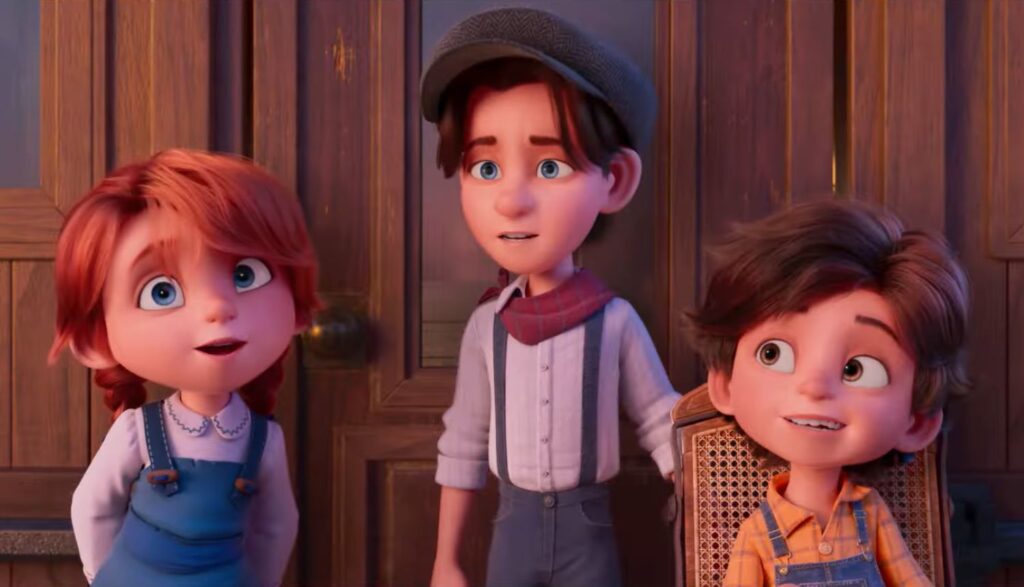

Buffalo Kids follows siblings Tom and Mary—and their friend Nick, who has cerebral palsy—as they travel West in search of a family. The film is a sweet, animated story that emphasizes the importance of friendship, family and the need to look past physical differences. Content stumbles include some Native American spirituality and toilet humor.
Tom and Mary have just arrived in New York City. After losing their father, the young siblings emigrated from their native Ireland to start a new life in America with their Uncle Niall.
Niall lives in California, but he promised to meet the children in New York once they arrived by boat. Tom and Mary wait for their uncle, but he never shows.
The siblings decide that, if Niall can’t come to them, they will go to him.
California is a long way from New York City, though. So, Tom and Mary sneak aboard a train headed west, falling in with a group of orphaned children who are being taken to adoptive families.
On the train, they meet Miss Eleanor (the governess in charge of the orphans) and Nick, a young, nonverbal boy with cerebral palsy.
As their train trundles across the American frontier, Tom and Mary (and Nick) have no idea of the adventures that await them—full of outlaws and dangers but also new friends and fun. And maybe, just maybe, a family.
Go west, young kids.
Tom and Mary have their sibling squabbles, but their love for each other is never in doubt. They lean on each other in the wake of their father’s passing.
Tom is dedicated and responsible—as the older sibling, he takes his job of watching over and protecting Mary seriously. Mary is a constant light of positivity, treating others with kindness and respect, and she never seems to get discouraged, no matter the obstacle.
The siblings befriend Nick, looking past his differences and demonstrating his inherent value. Despite Nick’s physical limitations, he is thoughtful and brave, furthering that message.
The kids (as well as other characters) display heroism and self-sacrifice throughout the film, protecting each other from the dangers of the American West.
Miss Eleanor cares deeply for all the orphaned children in her care, especially Nick. She helps Tom and Mary when they’re in need. A Cheyenne tribe shows generous hospitality to Tom, Mary and Nick.
Couples adopt orphaned children, and we see the joy that comes from these new families.
The Cheyenne people put on a welcome ceremony for the children, which involves praying to the “spirits” and a ritual dance around a bonfire. During this ceremony, Nick has a vision of himself dancing with Mary in a spiritual plane under a constellations of stars. Later, he has another vision where he is standing before an ethereal buffalo.
Mary tells Nick that she can “read cards” to see his future. It’s done in a playful context with Mary using her “ability” to encourage Nick, but it’s still something that parents may want to note.
The chief of the Cheyenne tells the children, “May wisdom and the stars guide you.” Some Native American carvings represent supernatural spirits, like the Thunderbird.
Tom develops a crush on Red Moon, the granddaughter of the Cheyenne chief. Mary says she thinks Red Moon likes Tom, as well. It’s clear that a man and woman have feelings for each other—someone refers to them as “lovebirds.” Another man shares a passionate (and comedic) kiss with his wife.
Buffalo Kids is intended for a younger audience. As such, what violence occurs is bloodless and often cartoonish. Characters wrestle and punch each other. Some are knocked senseless with a shovel or well-thrown stone.
That said, a few characters seem to meet their ends. For example, some outlaws tumble off a high cliff during a chase scene. The film doesn’t dwell on the fact, but it also doesn’t show those individuals landing safely in the branches of a conveniently placed tree, either, leaving audiences to draw their own conclusions. Another character is seemingly crushed under heavy bags of gold.
Tom, Mary and Nick encounter many dangers along their journey. They nearly fall from the top of a moving train. They’re attacked by coyotes, and someone is bitten. Outlaws carrying pistols and whips threaten the children. One dastardly character holds Mary hostage.
People are held prisoner and forced to work in a goldmine. Eventually, their captors plot to kill them to conceal their crimes. (The prisoners are rescued.) Outlaws hold up a train at gunpoint.
A villainous character uses “d–n” three times which, given the young audience this movie is intended for, felt particularly jarring. God’s name is misused once in conjunction with “dang.”
Someone calls the Cheyenne people “savages.”
Someone comments that he “picked the wrong day to quit drinking.” Eventually, we learn that he’s talking about coffee, not alcohol, but the intent of the joke will be pretty clear to older viewers.
Buffalo Kids includes some extended sequences of toilet humor into its mix. Mary eats wild green berries which give her intestinal distress. She staggers off to the bushes accompanied by rude noises. Later, the kids use the berries to incapacitate a group of outlaws. We hear more rude noises as the men clutch their stomachs and hurry toward some outhouses.
Tom and Mary sneak aboard a train without paying for tickets, and they hide when the train attendant comes through the cabin. They later leave the train to pet a wild buffalo, a dangerous act that the film even warns against during its credits.
Nick’s initial, would-be adoptive parents reject him when they see his physical disabilities, but he is eventually adopted into a loving and understanding family. Others call him “weird” and “useless.” (You can read more about adopting children with special needs at Focus on the Family.)
A few characters lie. Tom and Mary reference the passing of their parents.
Buffalo Kids is a sweet, animated story that emphasizes the importance of friendship and family. And there’s a nice message here about adopting children with special needs.
The film, directed by Pedro Solís García, feels like a spiritual brother to his previous 2014 short film, Cuerdas. Like Cuerdas, Buffalo Kids is built around the friendship between two children, one of whom has cerebral palsy. And both stories are inspired by the relationship between García’s real-life children, Alejandro and Nico.
In Buffalo Kids, Mary immediately accepts and befriends Nick, despite his physical differences. She (and eventually Tom) sees the beauty of the boy’s soul and acknowledges his inherent value. And, through their love and acceptance, Nick—as unlikely as it may seem—becomes a hero.
Parents will want to note the film’s use of Native American mysticism, some moments of peril and extended sequences of toilet humor. But for families who can navigate those minor stumbles, Buffalo Kids is a heartfelt story featuring a fun, colorful Western adventure that will entertain young audiences.
Bret loves a good story—be it a movie, show, or video game—and enjoys geeking out about things like plot and story structure. He has a blast reading and writing fiction and has penned several short stories and screenplays. He and his wife love to kayak the many beautiful Colorado lakes with their dog.