
Silent Night, Deadly Night brings the controversial slasher film of 1974 back to audiences, albeit with a few changes. In this remake, an entity directs the “protagonist” to slay people who’ve done terrible deeds. There’s little point to this movie being made, and there’s a whole lot of gore and crude language that hurts its case further.
In Dexter, the titular character has an overwhelming bloodlust. Rather than take it out on the innocent, he quenches his murderous desires by slaying people he deems evil enough to deserve it.
That’s pretty much what’s going on in Silent Night, Deadly Night. But in this case, the bloodlust of our killer—Billy—is seasonal, and it’s wrought by an entity who alerts him to his victims’ crimes.
It all began when Billy was a mere tot. He watched as Charlie, a man dressed in a Santa outfit, shot and killed both of Billy’s parents. Before she died, Billy’s mom stabbed Charlie in the throat with her high-heeled shoe, so Charlie bled out, too. And because the movie needed the plot to continue, Billy chose to touch the killer’s hand, which somehow transferred Charlie’s consciousness into Billy’s head.
Years later, at 17, Charlie taught Billy his role—one that Charlie had played himself: to kill bad people (but only during the first 24 days of December—for unexplained reasons). Charlie can sense when people who’ve done terrible things are nearby (like how he knew Billy’s parents had murdered Billy’s grandpa for money), and he projects their crimes into Billy’s head. Then, Billy kills them, and he places some of their blood into an Advent calendar.
According to Charlie, someone will die whether Billy kills them or not—so he might as well ensure that it’s a truly wicked person who dies instead.
That’s how it’s been for the last ten years: Charlie detects evil; Billy snuffs it out—moving from town to town to keep away from police.
But then Billy meets Pamela, and by golly, he finds her cute. So, he gets himself a job in the small town where she works to get to know her better.
And it turns out that this particular town is loaded with bad people. So Billy finds an excuse to stay a little while.
A man puts his own life at risk while trying to save a child from a kidnapper. At one point, Billy attempts to stop killing people.
Charlie (the entity living inside Billy’s head) comes with some supernatural abilities: He needs Billy’s eyes to see things, but he’s also somehow able to tell—through Billy’s eyes—what crimes people have committed. When Charlie detects a particularly bad person, he flashes depictions of those crimes into Billy’s brain. In addition, Charlie can speak to Billy telepathically. And once he’s seen a wicked person, he has a sort of tracking power that allows him to guide Billy to the target’s location.
A flashback showcases how Billy acquired Charlie: When Charlie was alive, he hunted wicked people. When he dies—and Billy grabs his hand—Charlie’s consciousness transfers into Billy in a display of red lightning.
There seems to be some kind of pact backing Billy’s slaughter: He’s required to kill people each day of December leading up to Christmas, filling up an Advent calendar with their blood. Charlie tells him that if he misses a day, an innocent person will die instead—so they might as well control who dies by slaying people who have committed horrible crimes. However, this claim doesn’t bear fruit: When Billy does miss a day, we’re told a child goes missing, and Charlie connects the incident to Billy’s refusal to kill. A day or two later, however, Billy rescues the kid from a kidnapper, so it’s unclear if there is any truth to Charlie’s claim.
Two of Billy’s victims claim to be Christians: One woman, a white supremacist Nazi (with the uniform to prove it), hosts an “I’m Dreaming of a White Power Christmas” party, where she states that Christmas is “still a white Christian holiday.” Another target, a foster parent, wears a Christian cross but abuses the children in her care. Obviously, both say and do things that directly contradict Christian values.
Billy claims that “doing a bad thing is different than being a bad person.” Notably, he does not define what a bad person is, and he apparently determines who is bad based on the bad things they did—so we’re not sure what to make of that.
We hear a variety of Christian Christmas carols play in the background of some scenes. A young Billy asks if his grandpa is in heaven.
[Spoiler Warning] When Billy succumbs to a mortal wound, Pamela grabs his hand, and Billy’s consciousness transfers into her head. Following an apparent “one entity per person” rule, Charlie vanishes into some sort of afterlife.
Three days after meeting, Billy and Pamela passionately kiss and have offscreen sex. We next see them cuddling, presumably naked, under the covers. At one point, Pamela accuses Billy of checking out her rear, which Billy denies.
A woman kisses her boyfriend on the cheek. Someone describes her past self as “a bit of a slut.” We see Billy in his boxers. A woman encourages Christmas party guests to “make out under the mistletoe.”
Silent Night, Deadly Night revels in gore and death, so we see plenty of people reduced to the red stuff by the end of the movie.
Billy’s weapon of choice is an axe, which he uses to split open a man’s head in visceral detail. He cuts into many others with it, too. He also attacks people with a box cutter and a hammer—but he draws the line at using guns, since he thinks they make the user effeminate. He decapitates a woman, and another woman loses her leg. We see the remains of someone’s face that Billy smashed in. Someone loses their entrails. Billy impales a woman on mounted deer antlers. Billy also kills an entire group of people with his axe before setting the building on fire. We see a montage of other murders he’s committed using a variety of methods.
When Billy kills someone, he puts a drop of their blood into his Advent calendar, which is covered with old blood from previous kills. We’re told Billy’s done this for 10 years—and given that he kills at least one person each of the first 24 days in December, the movie purports that Billy’s kill count is at least 240 people.
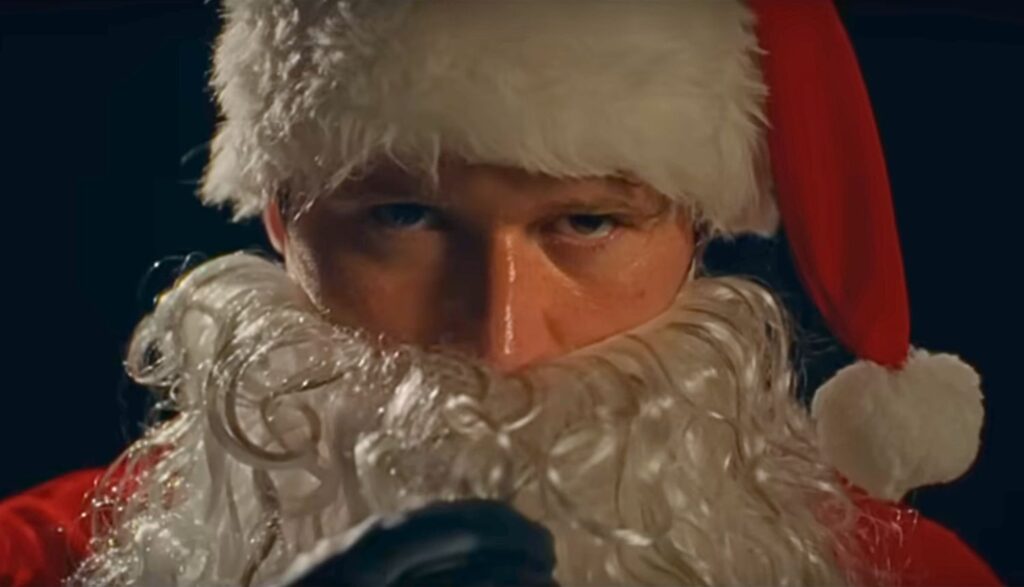
When Billy dons a Santa suit to pretend to be the jolly man for children, he struggles to not kill the kid on his lap with a hidden box cutter (due to his sadistic bloodlust; the kid hadn’t done anything horrible). After getting shot, Billy performs surgery on himself to pull out the bullet.
We see flashes of what Billy’s victims did to incur his wrath: One man stabs his wife to death (followed by police finding her decayed skeleton). A woman shoots people for target practice. Another woman beats children with a baseball bat, and one of them falls down the stairs to his death.
A woman bites off a man’s nose. People stab each other. A man shoots and kills two people, but one of his targets stabs him in the throat with her pointy heel, so he dies, too. A couple poisons a man so they can obtain his money. He vomits blood as the poison takes effect.
We’re told that a police officer punched his girlfriend in the face, and so she broke up with him. Later, when the woman is brought into an interrogation room, the officer uses his power to force her to allow him to sniff her hair. Someone kidnaps children and keeps them locked up in a hidden ball pit.
We hear the f-word about 40 times, including a couple of instances preceded by “mother.” We hear the s-word seven times and a crude word referencing female genitalia once. As for other crudities, we hear “a–,” “b–ch,” “h—” and “fag.” God’s name is used in vain nine times, and Jesus’ name is likewise used in vain five times.
We learn that a foster mom drugged the children in her charge. We other drugs and drug paraphernalia scattered on a table. People drink wine and liquor. Billy smokes.
Someone apparently hasn’t dressed up as Santa “since the pooping incident.”
When it first released in 1974, Silent Night, Deadly Night was the adult equivalent of “Hey, if you give me a quarter, I’ll eat this dirt-covered worm.” It was pointless. It reveled in being transgressive and gross. And it was done merely for shock value, disgusted faces and money.
This remake is much of the same (though accounting for inflation, that 1974 quarter is worth about $1.75 now). Well, that, and the movie dares to pose the “bold” question: “What if the worm was, like, a really bad guy?”
In this way, sure, I suppose the new iteration is marginally better than its predecessor: Instead of slaughtering a lot of innocent people, Billy only targets those his internal entity dubs as evil—which shifts the focus from pure psychopathy to a weird vigilantism. Indeed, it offers no moral gray area regarding his victims’ actions: This guy stabbed his wife to death and hid the body; that woman is a literal Nazi (hat and all) and shoots anyone who isn’t white; this lady beat foster children to death and got away with it.
Yeesh.
Look, obviously Silent Night isn’t exactly intending to fire on all philosophical cylinders—so we won’t delve into the kiddie pool morality it posits. The closest this film ever gets to a message is when Billy opines that “doing a bad thing is different than being a bad person.” That statement immediately makes one wonder where Billy and Charlie truly draw the line between action and nature. It seems that not even the director knows, which is probably why his victims are some of the worst people you could find (which Billy judges based on them doing bad things. Oops.).
Let’s just call a spade a spade: Silent Night, Deadly Night is for people who like death and gore. And the film’s shift to a vigilante perspective is a sheepish attempt to justify the director’s decision to remake it.
But no matter how you try to dress it up that eating worms is actually fun, I’m still just going to think it’s strange to do so in the first place.

Kennedy Unthank studied journalism at the University of Missouri. He knew he wanted to write for a living when he won a contest for “best fantasy story” while in the 4th grade. What he didn’t know at the time, however, was that he was the only person to submit a story. Regardless, the seed was planted. Kennedy collects and plays board games in his free time, and he loves to talk about biblical apologetics. He’s also an avid cook. He thinks the ending of Lost “wasn’t that bad.”