
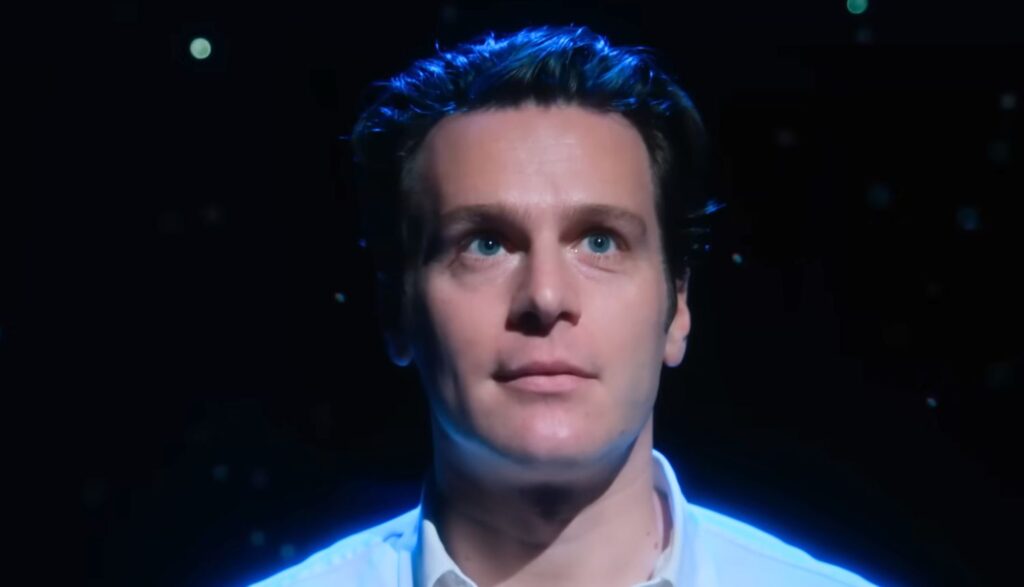
Merrily We Roll Along tells a cautionary tale about the dangers of fame and fortune, and how the pursuit of worldly success can come at the cost of family and friends. Fans of the original production won’t be disappointed here (since it’s just a filmed production of the stage play), but should note that this story includes suggestive situations, some harsh language and plenty of drinking and smoking.
Frank Shepard loves success. And he’s had a lot of it.
The Broadway-composer-turned-Hollywood-producer is basking in the glow of his latest commercial hit. He’s gained so much along the way: Money. Fame. A glamourous life.
To the outside observer, the charismatic Frank has it all.
But Frank knows better. The pursuit of that worldly success has come at a steep cost: Family. Creative integrity. Self-respect.
And his old friends. The best friends he ever had.
How did he end up here? Frank would trade all of his successes to make things the way they once were. With Beth. And Mary. And Charley.
If only he could go back …
Merrily We Roll Along centers around the friendship shared between Frank, Charley and Mary, fellow creatives looking to make their mark. The friends lean on each other throughout their lives, ever-present support in both good times and bad. And Charley and Mary often try to steer Frank toward a better path when they fear he may be going astray (in both his marriage and career). As this play-turned-film takes place in reverse chronological order, we see their relationships improve as we travel further into the past—to simpler, more idealistic times.
Though Frank’s poor choices tear his family apart, it’s clear he still loves his first wife, Beth, and their son. A woman reconciles with her parents prior to her wedding. Charley seems to have a happy marriage, and he and his wife have four children.
Song lyrics talk about the Pope blessing mankind and the infrequency with which prayers are answered. A man in a clerical collar officiates Frank and Beth’s wedding—in a cabaret club, it must be noted.
Mary (perhaps jokingly) asserts that she became an alcoholic after her first taste of Communion wine. Meditation is mentioned. Gussy, Frank’s second wife, says, “Fate brought [them] together.” She also says that her first husband “worshipped” her.
People say, “Thank the Lord” and “God knows.”
The sexual content contained in Merrily We Roll Along is not visually explicit, but it’s often central to the plot. Many of the moments depicted in Frank Shepard’s life revolve around his relationships and infidelity.
Frank and Beth get married, a decision that’s spurned on by the fact that Beth is already pregnant. Frank calls their marriage the “most important moment in [their] lives,” and he and Beth share a few kisses. It seems they have a loving marriage—but it’s not to last.
Frank cheats on Beth with Gussy, who is also married during the affair. Gussy seduces Frank in one suggestive song and says she “wants” Frank before heading off-stage. Frank follows her while unbuttoning his shirt. Later, while married to Gussy, Frank carries on with another mistress, which includes caressing the woman’s backside.
Mary is in love with Frank and pines for him, though she never acts on her feelings. We see the aftermath of divorce proceedings between Frank and Beth.
Mary mentions that she’s going to write for Playboy (the adult magazine). Gussy has been married several times. A man tells a groom-to-be that “unless the girl is pregnant” he should call off his impending marriage.
Suggestive comments are made. A few women wear revealing clothing. A man holds up metal cups to imitate a bra. Song lyrics discuss Frank’s desirable life, with a “gorgeous wife” and a “son who’s straight.” A man briefly wears a ballerina’s tutu as part of a performance.
Frank attacks a reporter. A wife throws iodine in the eyes of her husband’s mistress. We hear about the death toll of American soldiers in Vietnam.
Gussy is prone to dramatic phrasing that references self-harm. Characters refer to the legalization of abortion in the 1970s.
One f-word is used. Jesus’ name is abused three times, and God’s name is misused nearly 30 times, occasionally paired with “d–n.” We hear additional uses of “h—,” “b–ch” and “a–.” A woman is called a “slut.”
A recurring mantra that Frank, Charley and Mary say together includes the word “d–n.”
Mary is an alcoholic and has a self-described addictive personality. When we first meet her, she is drinking to excess. As the story moves backwards, we see some of the moments that led to her struggle with alcohol.
Other characters reference and imbibe a variety of alcoholic drinks. A few characters smoke cigarettes. One person observes a partygoer smoking marijuana. The sedative medication Librium is mentioned.
New York City cabaret clubs are called “saloons.” Someone refers to alcohol as “hooch.” Some people are said to provide “vapors,” which could be meant to imply drugs.
Despite the love Frank has for his son, when we first meet Frank’s character in 1976, we hear that the father and son have become estranged and have little to do with each other. Charley and Frank have a very public falling out: Charley calls Frank a greedy sellout, and Frank cuts Charley out of his life entirely.
In the wake of Frank’s divorce, his friends (including Charley and Mary) try to spin it in a positive light, calling it the “best thing that ever could have happened”—rather than rebuking the selfish choices that led to the end of Frank’s marriage.
Gussy tells Frank that “what you want” is what matters, not “what you think you should want.” We hear that the problem with old friends is that they don’t want their old friends to change. Someone says that “living well is the best revenge.”
Beth’s parents do not approve of Frank and even bribe him to call off his and Beth’s wedding. Someone jokes about the poor state of their bathroom. Mary calls Frank’s glitzy, vapid friend group “junk.” One of Frank and Charley’s early collaborations is a political satire that skewers former presidents Dwight D. Eisenhower and Richard Nixon.
Stephen Sondheim’s Merrily We Roll Along premiered on Broadway in November 1981 to a less than positive response. But in the years since, the play has enjoyed something of a critical and commercial rejuvenation. This film, directed by noted theater veteran Maria Friedman, is part of that revival.
This version of Merrily We Roll Along isn’t an adaptation of Sondheim’s play—it is the play, filmed onstage in front of a live audience.
I won’t pretend to know much about musical theater, but I found the film’s talented lead trio (Jonathan Groff, Daniel Radcliffe and Lindsay Mendez) to be effective and engaging. The music, while not (as one character from the play might say) the most “hummable,” is often clever and fun. And the story confidently communicates the wise and well-worn message that fortune and fame won’t bring happiness—that success is hollow without the love of family and friends.
The tale that’s told here is quite sad. But it feels better than it perhaps should thanks to the reverse chronological order in which it presents events. Hollow despondency reverts to hopeful idealism. Frank longs “to go back” to the way things were. In a way, he ends up getting his wish.
Theater lovers who hold dear the Merrily We Roll Along play won’t be disappointed with this film—it’s literally the play, albeit with more camera closeups.
Still, viewers will want to consider the film’s (and play’s) content concerns—including suggestive situations, language and frequent alcohol use—before merrily rolling along to movie theaters to watch this one.

Bret loves a good story—be it a movie, show, or video game—and enjoys geeking out about things like plot and story structure. He has a blast reading and writing fiction and has penned several short stories and screenplays. He and his wife love to kayak the many beautiful Colorado lakes with their dog.