House of the Dragon
If the idea of a Game of Thrones prequel had you groaning preemptively, you were right in doing so.
Allow me to take you back in time. It’s the late ’90s. You climb out of bed Saturday morning. You pour a bowl of cereal that the TV tells you is part of a balanced breakfast. Your biggest concern is whether you’re up early enough to watch your favorite cartoon.
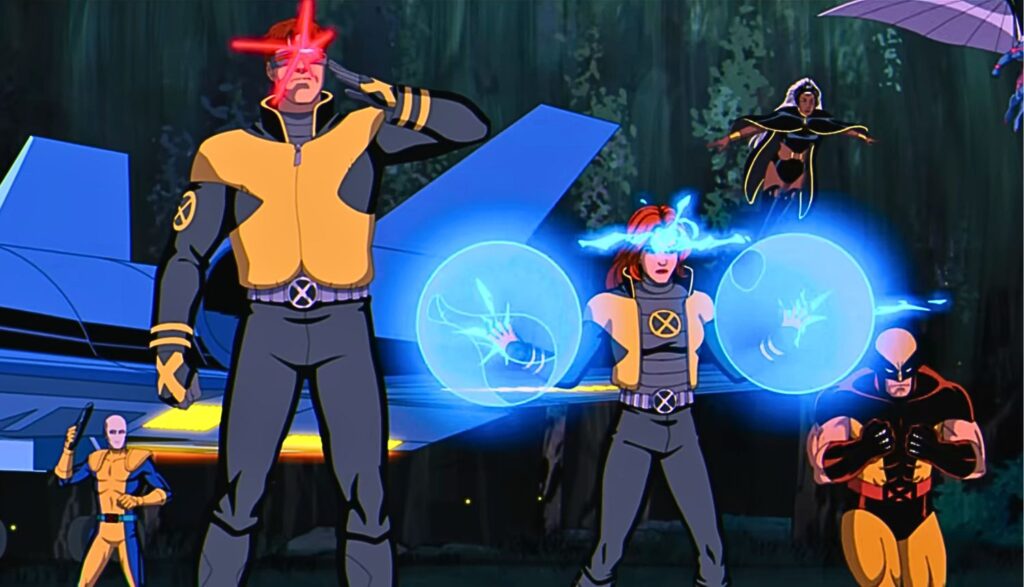
Disney+ and Marvel’s animated series X-Men ’97 likewise invites its viewers to take a stroll down memory lane. A revival of X-Men: The Animated Series, which ran from 1992 to 1997, X-Men ’97 picks up where the old series left off. With its plotlines borrowed from both Chris Claremont’s 1975-1991 comic run and the current run of comic books, this X-Men iteration attempts to recapture the show’s original’90s vibes—leaning into a retro artistic approach and bringing back the original voice cast to reprise their roles.
The story in X-Men ’97 begins after the team loses their beloved Professor X. The mantle of leadership at the professor’s Institute—a school and safe-haven for mutants—temporarily passes to Cyclops, who works fervently to continue Professor X’s efforts in defending both mutants and humans. Although Cyclops’ loyalty to the X-Men is strong, his devotion to his wife, Jean Grey, is stronger. Jean is pregnant, and the couple plans to leave the X-Men to raise their new baby.
Their plans unravel when Magneto enters the fray.
Old friend of Professor X and the Institute, Magneto severed ties with the X-Men over a strong difference of opinion. While Professor X advocated for peaceful relations between humans and mutants, Magneto believed that mutants should rule over humans—and he believed in taking violent measures to accomplish his goal.
As such, the X-Men are shocked when Magneto claims that Professor X entrusted him with leadership over the Institute and the X-Men.
Despite their original mistrust, Professor X’s will confirms Magneto’s assertions, and Magneto seems to demonstrate a change of heart as well. When an anti-mutant group violently protests a United Nations trial, Magneto saves the humans involved. He explains that he desires to honor Professor X’s legacy by fighting for the peaceful coexistence of humans and mutants.
While it seems the X-Men have a new ally, anti-mutant sentiments and conniving supervillains continue to threaten the heroes at the Institute.
Like in most comic book-related stories, X-Men ’97’s primary concern is its violence, especially (without giving too much away) portions of episode five. Though the retro ‘90s animation soften some of the on-screen blood, characters regularly find themselves in perilous situations, narrowly escaping explosions, enduring punches and darting away from flying bullets. To that end, some don’t make it, either. Furthermore, the heroes themselves use violence and superhuman abilities to win fights. Storm has the power to control the weather. Jean can read minds and move objects telekinetically. Rogue can absorb the power of anyone she touches. (While X-Men ’97 doesn’t go into detail about the source of these powers, in other iterations of the franchise, the mutants have a genetic trait that distinguishes them from normal humans.)
Additionally, minor profanity such as “d–n” is occasionally used, and there are brief references to alcohol. And while we’ve not seen evidence of this yet, media reports say that the shapeshifting mutant Morph reportedly identifies as queer and nonbinary—a term that wasn’t even used in 1997. (Creators say that, given the character can transform between male and female and back again at will, the terminology fits Morph, and it always has.)
Those issues are significant, of course. But compared to its live-action counterparts, which feature completely unclothed mutants and gruesome violence, X-Men ’97 presents a much tamer exploration of the franchise. Nevertheless, families will want to consider these issues carefully before joining the mutants on their quest to save the world.
(Editor’s Note: Plugged In is rarely able to watch every episode of a given series for review. As such, there’s always a chance that you might see a problem that we didn’t. If you notice content that you feel should be included in our review, send us an email at letters@pluggedin.com, or contact us via Facebook or Instagram, and be sure to let us know the episode number, title and season so that we can check it out.)

When the X-Men save a new mutant, Roberto Da Costa, they discover that an anti-mutant organization possesses dangerous weaponry. Plagued with personal and professional predicaments, Cyclops endeavors to protect his team and Professor X’s legacy.
The episode features several fight scenes in which characters throw punches, shoot people with guns and narrowly escape explosions. In one scene, characters fall out of an aircraft after an explosion. A news broadcast reveals that a character has been assassinated, and the X-Men discuss that a character is in danger of being murdered. A teenaged boy gets kidnapped, and his abductors push him and threaten him with weapons. Wolverine jokingly threatens someone with his claws.
Each of the X-Men possess superhuman abilities. Storm has the power to control the weather and states that she is “mistress of the elements.” Jean is telepathic and telekinetic, and she performs a “psychic scan” to read someone’s mind. During this scene, she has an intense vision involving her preborn child and a graveyard.
There is a use each of “d–n” and “jeez.” Additionally, characters call each other names including “witch,” “punk” and “dirtbag.” Wolverine does not respect Cyclops’ authority, and both men make pejorative remarks to one another.
A male character is seen wearing a crop top, and the X-Men (male and female) wear form-fitting uniforms. During a mission, the X-Men go to a nightclub where people are seen kissing, dancing sensually and caressing one another. Wolverine drinks a bottle of alcohol at a bar.
The X-Men are skeptical about Magneto’s intentions to honor Professor X’s legacy. But when he agrees to answer for his past offences at the United Nations, they realize he may indeed have reformed. Meanwhile, Jean goes into labor while the X-Men defend the United Nations trial.
Moments of violence occur frequently throughout the episode. Characters shoot guns and narrowly escape explosions. A character gets punched in the face several times and bleeds as a result. A mutant uses his powers to trap several people against a wall. In a perilous scene, a Ferris wheel collapses and almost crushes the people inside. Anti-mutant protesters claim that they want to kill Magneto. One character is gravely injured from a gun blast. A mutant uses his powers to destroy a building.
A mutant named Rogue uses her ability to absorb other people’s powers to take a doctor’s medical knowledge. After she uses her power, the doctor passes out. A character asserts that Storm is “the closest thing to a goddess” that the world has.
Characters call each other names including “pig,” “demon” and “jerk.” We also hear the words “blasted” and “darn.” In one scene, a mutant named Morph carries a six pack of beer.
Facing an impending battle against the villainous mutant Apocalypse in 3960 A.D., Cyclops and Madelyne choose to reveal themselves as the parents of Nathan Summers, the child destined to defeat Apocalypse.
Our protagonists blow up a couple dozen robotic adversaries. We see a field filled with dead mutants. Enemy mutants use their powers to cause Cyclops and Madelyne’s flesh to dissolve in painful-looking blisters. (They appear fine in the next scene.)
A woman describes how she foresaw that the X-Men were fated to die. She intervened by displacing them in time, sending them to pivotal moments in Apocalypse’s life to stop him. She explains a prophecy that states Nathan will defeat Apocalypse and save the world. And she says that she herself originally hails from another timeline so hellish that the postapocalyptic world they’re currently in would be called heaven in her world.
Robots describe Apocalypse as their lord and savior, who “was, is and will always be.” A group of mutants are called the Four Horsemen. Characters possess and use supernatural powers. A woman describes a spaceship that some believe was built by gods. Storm describes the sun as the source of all creation. Someone utters, “by the goddess!”
A man and woman kiss. We hear a few crudities, including “h—,” “d–n” and “b–tard.”
Kennedy Unthank studied journalism at the University of Missouri. He knew he wanted to write for a living when he won a contest for “best fantasy story” while in the 4th grade. What he didn’t know at the time, however, was that he was the only person to submit a story. Regardless, the seed was planted. Kennedy collects and plays board games in his free time, and he loves to talk about biblical apologetics. He’s also an avid cook. He thinks the ending of Lost “wasn’t that bad.”

If the idea of a Game of Thrones prequel had you groaning preemptively, you were right in doing so.

In PBS’ Patience, a young woman with autism helps solve murder cases for the City of York Police.
Avatar: The Last Airbender, Netflix’s live-action remake of the Nickelodeon cartoon, has some good lessons and some troubling elements.

Sugar, the name of Apple TV+’s film noir drama, might sound sweet. But this series starring Colin Farrell has an acrid bite.