TV Series Review
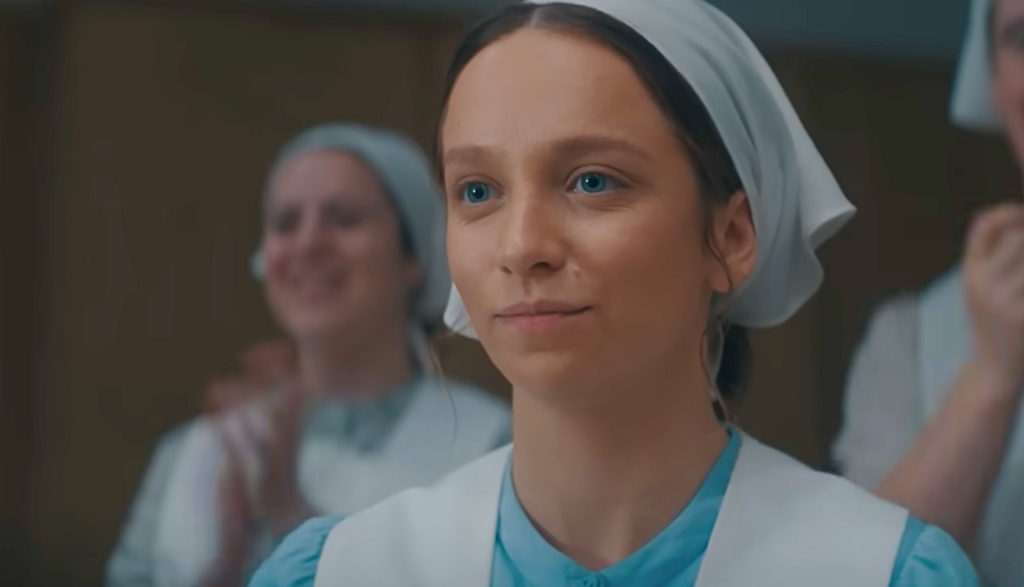
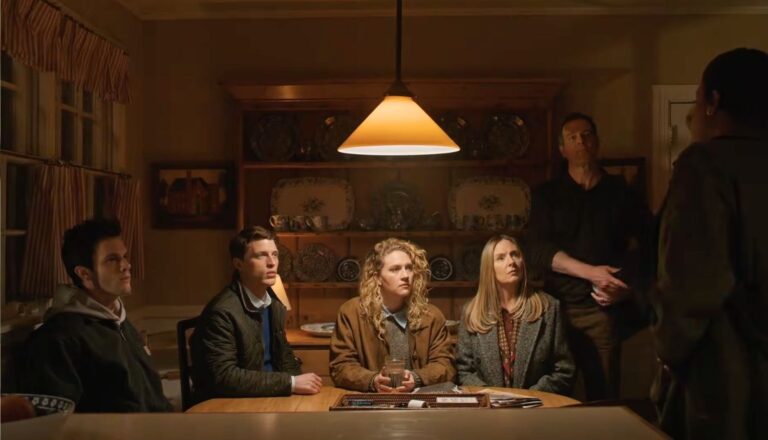
The Fellowship of the Divine is the kind of community that ensures none of its members go hungry or without a roof over their heads. They gather together in fellowship for meals, and they worship together.
But what they don’t do is engage with the world. Sure, they use things like landline phones—but that which the world creates is sinful and corrupting. It’s why, when Mrs. Phillips discovers young Grace reading a comic book at a picnic, she scolds the girl, telling her that if she reads unclean things, she’ll go to hell.
Grace is terrified of such a thought—especially when a massive storm blows in and a boy tells her that it’s the Rapture. Scared she’s lost her salvation, Grace runs from the storm and falls into a river. She begins to drown.
It’s her mother, Rosie, who finds her, but she’s not quick enough to save her daughter. Luckily, a man dives into the water and pulls Grace to shore. But then, he vanishes.
Rosie’s husband, Adam, and his brother, Isaac, arrive next. Grace is safe from the waters, but hypothermia is beginning to set in. Desperate to save Grace’s life, Isaac pulls a smartphone from his pocket and calls for an ambulance—much to Adam’s surprise.
Grace recovers in the hospital. But while the community is pleased with her safety, they’re horrified when Adam reports Isaac’s phone—a “pipeline of pornography and sewage to our souls.” They lock him in a room for a time of reflection and repentance. Later, they force-feed him liquor until he’s inebriated as a kind of cleansing.
Rosie is disturbed about all of this and more. Isaac used his phone to save Grace’s life. Isn’t that a good thing?
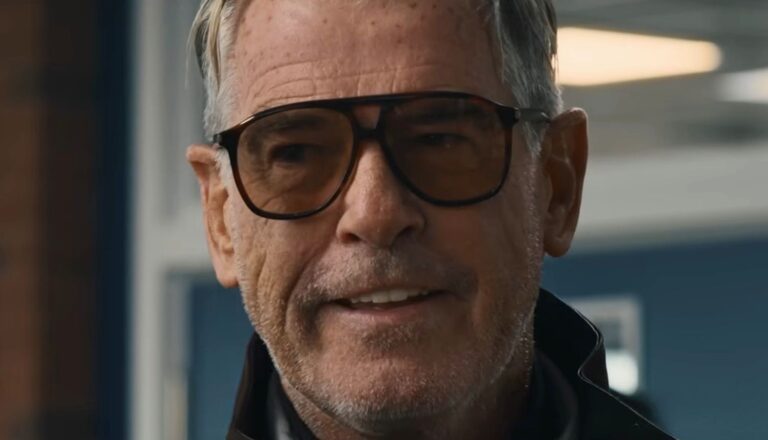
More than that, Rosie cannot stop thinking about that man from the woods. He’s “unchosen,” yes, but he saved Grace’s life. So when he shows up again, calls himself Sam, says he’s in trouble and in need of help, Rosie believes she must help him, no matter what the rest of the Fellowship says.
No matter how dangerous he may very well be.
The Cultic Whiplash
“Over two thousand cults exist in the United Kingdom,” the miniseries opens. “Some are closed communities, but many, like this fictional one, live in plain sight.”
As written in Walter Martin’s The Kingdom of the Cults, Dr. Charles Braden once defined a cult as “any religious group which differs significantly in one or more respects as to belief or practice from those religious groups which are regarded as the normative expressions of religion in our total culture.”
Showrunner Julie Gearey doesn’t state that Unchosen’s Fellowship of the Divine cult is based on any real-life one—but she did pull inspiration from the stories of real-life former cult members.
The Fellowship of the Divine then, like many cults, blends a wide variety of beliefs, some commonplace within Christianity, some heretical. It includes a sense of the apostolic succession of the Catholics, the real presence of Christ in the Eucharist of the high church denominations, the entire sanctification of the Nazarenes, the premillennial rapture of the dispensationalists, the selective use of technology of the Amish—all stitched together with a variety of legalistic and abusive cult beliefs to which no significant group holds.
“You will prove to Jesus that you are worthy of heaven,” one Fellowship leader says. Another describes the rules and regulations of the cult’s elders as the very words of God. And to avoid the corruption of the world, they remind their congregation that “separation is our sole principle.”
Cults often arise through charismatic leadership that is able to twist the words of Scripture to their benefit—or else dismiss it as insufficient. They follow after the example of Satan in the wilderness, who likewise took Scripture and tried to trick Jesus with it (Matthew 4). It is no wonder even Scripture itself warns of men who would do such things (Galatians 1:8, 2 Peter 2).
And Christians should therefore be against such evil things, not only for the shame those cultic beliefs bring upon Christianity but also for the way people are abused by them—with effects that can last long after escaping.
Those effects can be theological, too. Since cults like this fictional one hold radical views mixed in with the orthodox, when someone leaves a cult, they often don’t just throw out the radical—they get rid of all of it, swinging to the complete other side of that spectrum.
We see this happen in the show: The Fellowship holds that a man should remain faithful to his wife (an orthodox Christian belief), but in one instance, they become so concerned that a husband is in unrepentant sexual sin that they force-feed him liquor to get a confession out of him (obviously a radical belief). When the man does confess that he has been seeing another woman, he leaves the cult because of its radical actions. And he also abandons his wife so that he can continue to pursue his affair, believing that if the cult got its intense, legalistic framework wrong, then perhaps having an affair isn’t a sin, either. (Likewise, Rosie chooses to begin an affair under a similar pendulum swing.)
The Worst PR for Kool-Aid Ever
Like many cults, Unchosen’s Fellowship of the Divine has its own hidden sins and secrets. Leaders engage in the domestic and sexual abuse of their wives and others. When members of the congregation speak against such cruelties, their leaders twist Scripture in order to silence them into submission. In one related example of abuse, a man compels another man (who struggles with his sexuality) to perform oral sex on him in a display of power. Most of these instances occur offscreen, but it is more than evident what is happening.
There are other content issues outside of the Fellowship’s beliefs and hypocrisies that viewers may wish to avoid, including rear nudity, onscreen (obscured) sex, violence, abuse, murder and heavy crude language.
And that all makes Unchosen a show that many families wouldn’t want to choose for themselves.
(Editor’s Note: Plugged In is rarely able to watch every episode of a given series for review. As such, there’s always a chance that you might see a problem that we didn’t. If you notice content that you feel should be included in our review, send us an email at letters@pluggedin.com, or contact us via Facebook or Instagram, and be sure to let us know the episode number, title and season so that we can check it out.)