TV Series Review
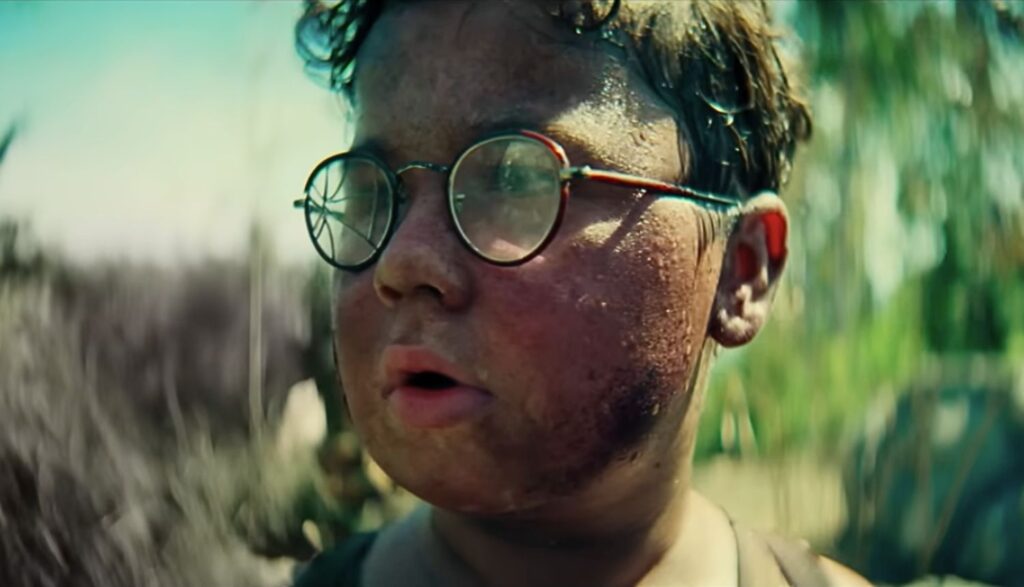
Nicholas reaches for his glasses. They’re half-buried in mud. Beads of sweat stain his aching forehead, brought on by the tropical heat.
He walks aimlessly. A hunk of plane debris reaches to the sky, stuck fast into the ground near him. But there is another boy. He seems to be the same age as Nicholas—12 at most.
His name is Ralph. For all the worries Nicholas should be feeling about crash-landing upon some remote island, the chubby boy says he’s just glad to not be called “Piggy” by his bullies anymore. Ralph laughs at the name. Piggy does not.
They find a conch, and Nicholas knows the shell can function like a horn, if you blow into it right. He’d do it, but he’s got asthma. Ralph takes the lead.
Soon, plenty of others show up. They’re all boys. Some are tweens like them—10 to 12 years old. Others, the “littluns,” are scarcely 6 or 8. None of the adults survived the crash.
It isn’t long before Ralph reveals the “Piggy” nickname. They think it’s funny, so it sticks.
One of the other big kids, Jack, claims they need a leader, hoping they’ll all vote him in. They do not. Ralph becomes chief instead—so Jack pivots, dubbing himself the leader of the hunters, comprised of a group of choir boys who follow Jack’s every order.
On Piggy’s advice, Ralph begins dividing the kids into groups for building shelter, starting a signal fire and finding food. But such tasks and assemblies are boring, adult stuff. Most of them want to have fun.
Soon, a littlun with a birthmark on his eye whispers that he’s seen something in the island jungle. A terrible enemy. A beast.
No one has seen it. But more and more of them are starting to feel its gaze and sense its presence. It’s lurking just out of sight. But it is always getting closer.
And it may be more inside of them than they’d like to admit.
Sucks to Your Classic Story
William Golding’s book Lord of the Flies (derived from a literal translation of the demon name Beelzebub) is a popular public school assignment for middle school readers. It’s also a popular choice for screen adaptations: The eponymous 2026 Netflix release is the third attempt at such since the book’s release in 1954.
And if one can overcome the sometimes-nauseating, fish-eye lens shots and artistically inflated scenes, this four-episode miniseries brings plenty of the book’s most impactful moments straight to screen. (Though book purists won’t appreciate a few creative changes.) And the actors behind the story’s main four characters, Ralph, Jack, Piggy and Simon, do a magnificent job with their roles.
Perhaps disappointing is the inclusion of character backstories, which flesh out the characters, providing a reason why such might descend into savagery (and perhaps offers an excuse as to why we would not). This contrasts from the book; the lack of backstory makes the story have a more universal application.
This seems to miss the point of Golding’s story—that the “beast,” that savage sin, is inside us all, not merely those with traumatic histories. As Golding himself describes it through introspective survivor Simon, the beast is “mankind’s essential illness.” And when we are stripped away from the rules of civilization, that beast is allowed to fully bears its fangs. It is unfortunate, too, that Simon’s realization of this truth is such a small piece in this story (his pivotal conversation with the pig head lasts but a few minutes).
And as anyone who read the book should surely know, adapting its contents means adapting some disturbingly dark moments, too—and given it’s been over 70 years since the book’s release, I don’t feel too bad spoiling some of those moments.
Piggy’s death is extended beyond the book’s description, such that his skull gets cracked by a stone onscreen, and he suffers a slow, bloody, upsetting death for added dialogue and impact. Simon dies in a brutal display of spear-wielding that is only partially depicted onscreen, but we nevertheless later see his bloodied body washed away by the tide. And a variety of adult human and pig corpses in varying stages of decay are spotted in bloody detail throughout the four episodes. Some have also alleged that this adaptation implies Simon is gay, though such interpretations rely on assumption rather than any stated fact (read our episodic review of the third episode for more specifics on that).
Netflix’s Lord of the Flies effectively brings forth the savagery into which the island descends with a realism that is common to a modern series and honest to the events of the book. But the show is nevertheless visceral enough that many won’t want to watch in the first place.
(Editor’s Note: Plugged In is rarely able to watch every episode of a given series for review. As such, there’s always a chance that you might see a problem that we didn’t. If you notice content that you feel should be included in our review, send us an email at letters@pluggedin.com, or contact us via Facebook or Instagram, and be sure to let us know the episode number, title and season so that we can check it out.)