A Band Called LoveSong: The Music and Movement of the Jesus Revolution
Prime Video’s ‘A Band Called LoveSong’ gives us an in-depth documentary examining one of the most influential Christian bands in history.
Elle Woods isn’t a very difficult girl to please. She likes iced coffee, the month of July and when people dress kind of tennis-y even if they don’t play tennis. And she has the perfect plan to dominate the 11th grade:
Step 1: Solidify her friendships with the coolest senior girls so that her reputation will be firmly in place when those girls graduate.
Step 2: Join the cheer squad. Duh.
Step 3: Execute the most perfect first kiss with the most perfect guy, “Hot Josh.”
Oh yes, everything is shaping up Elle.
That is, until her family gets wrapped up in a plastic surgery scandal.
When a celebrity’s nose job doesn’t set correctly, Elle’s plastic surgeon dad, Wyatt, takes the heat. And if the family lived anywhere but Los Angeles, Wyatt probably could have shrugged off the career upset without too much social backlash.
But this is Bel-Air. The people here take their liposuction like they take their caviar: religiously. So Elle’s parents decide to lay low for a while. They pack their bags and head to Seattle—”the city that God and Gucci forgot.”
It’s a rough transition for the whole family, but Elle is determined to adapt. She’ll trade her sunshine for rain, pink for black, Cosmopolitan for “zines.” But her plans for a perfect junior year? Gone like last year’s shoes.
A new plan seems elusive. Unfortunately, fitting in isn’t as easy as Elle had hoped. Within her first week at Rainier West High School, she manages to get labeled a “slut” by a mean girl, develop a crush on the boyfriend of the one girl willing to be her friend and get a member of the support staff fired.
Elle tries to make things right, but it seems that the more she tries to fix her mistakes, the more mistakes she makes. And the more she tries to fit in, the more her classmates seem to hate her.
“Seattle isn’t a costume. And pink isn’t a personality,” she’s told.
But this is Elle Woods we’re talking about. She won’t give up. She’ll prove she’s not just a pink-loving, dog-toting blonde who cares about fashion: She’s a pink-loving, dog-toting blonde who cares about people, too.
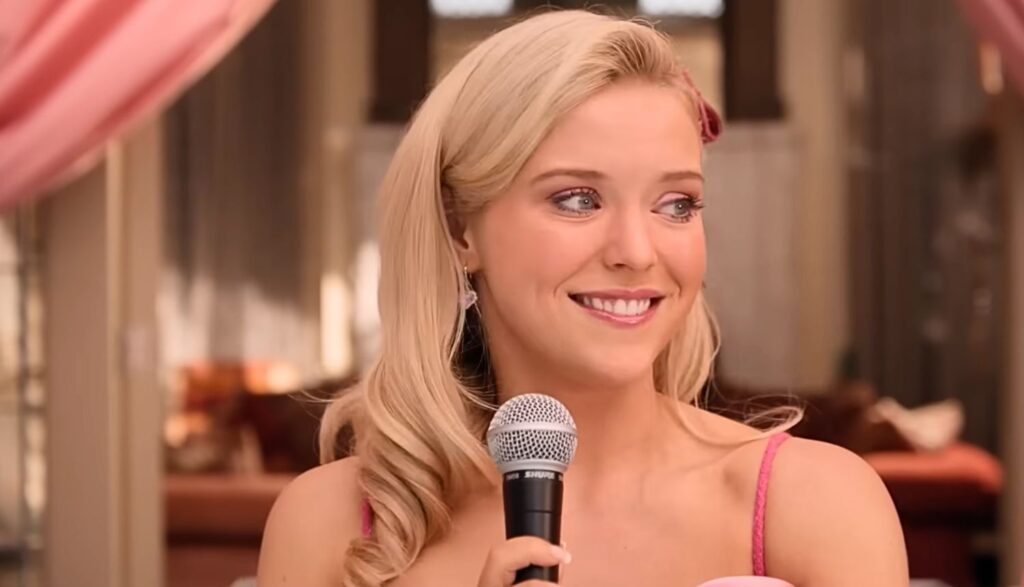
Prime Video’s Elle acts as a prequel to the Reese Witherspoon-led Legally Blonde franchise. Actress Lexi Minetree, in my opinion, does a great job here of portraying the iconic blonde. Elle (the character and the series) practically radiates positivity.
But even though Elle Woods herself tries to curate a squeaky-clean image, her new school (and new show) are little less than pristine.
Language in Elle is relatively mild, but we do hear some adults executing double entendres. Elle occasionally wears miniskirts and bikinis, and we sometimes see teenage couples making out. One of Elle’s new friends, Liz, goes by the nickname “Lizbian” because she’s a lesbian. And Elle’s mom, Eva, quickly makes friends with a gay couple across the street—who also happen to be the parents of Elle’s new crush.
Because this is a show about high schoolers, we get plenty of teenage drama, including plenty of bullying. And because this is a show set in the ’90s, we also get a dose of typical ’90s feminism and social justice, which may not align with some families’ values.
Fans of Legally Blonde will probably enjoy this look at a pre-Harvard Elle. It offers depth while still remaining true to the character we know. But parents should still exercise caution since even a teenage, pre-first-kiss Elle still comes with some more adult problems.
(Editor’s Note: Plugged In is rarely able to watch every episode of a given series for review. As such, there’s always a chance that you might see a problem that we didn’t. If you notice content that you feel should be included in our review, send us an email at letters@pluggedin.com, or contact us via Facebook or Instagram, and be sure to let us know the episode number, title and season so that we can check it out.)
In the wake of a plastic surgery kerfuffle, Elle and her family move to Seattle, and Elle does her best to fit into her new surroundings.
In one scene, Elle wears a pink bikini. She also sometimes wears short shorts and belly-baring tops. We see several women and teen girls wearing miniskirts. The camera focuses on one teen’s backside as she hides a birthday card behind her. A couple of girls call their classmate “Hot Josh.” Elle says she plans to have her first kiss with Josh. A teenage girl says that when her dad forgot her birthday, she took advantage of his guilt so that she could have boys in her bedroom with the door closed. Elle’s parents kiss.
Elle loves the magazine Cosmopolitan, and she reads an article about “women who can’t experience intimacy.” Another woman calls Cosmo her “bible,” and Elle agrees with her. Elle and Eva both love the soap opera Days of Our Lives, and they discuss the exorcism of a character from that show who has been possessed. Elle proudly says she’s a Gemini, and she talks a bit about astrology. Someone wears a cross necklace. We hear mention of the game Dungeons & Dragons.
Elle’s mom nearly hits a skateboarder with her car.
Adults drink alcohol while teens drink mocktails at a party. Some students are labeled as “stoners.”
God’s name is misused a handful of times. Someone tosses out the term “social suicide.”
Elle gets mocked and bullied by her classmates in Seattle. The Woodses’ and their friends embody extravagance. (That said, Elle at least seems grateful for her privileged lifestyle.) People talk about plastic surgery gone wrong. Elle and her mom, Eva, make some negative comments about the fashion and beauty choices of others. Elle and her L.A. friends gossip about their classmates.
In typical teenage fashion, Elle can be a bit overdramatic. When her parents tell her they may have to live in Seattle for a few years, she laments that’s her “whole life.” Elle’s friends encourage her to prey on her dad’s guilt for making her move. When Elle inadvertently reveals that a school staff member has broken several rules (albeit to help out kids in need), that person gets fired.
Elle learns that the students at her new school value social justice and taking care of the planet. One guy tries to raise funds for the school’s support staff, who aren’t paid livable wages. The girls on the cheer team don’t cheer for boys’ sports, they cheer for themselves—their own brand of feminism. When Elle’s parents get her a dog, she asks her mom if she shopped for the dog or adopted it. Eva tells Elle that she technically adopted: Their neighbors were getting rid of the pup because his fur didn’t match their new remodel.
Elle’s mom and dad try to support their daughter through the transition to Seattle. Her old friends encourage her, too. A member of the school’s support staff, Donna, is kind to Elle on her first day. Elle learns that Donna cares deeply about the students at the school, often helping out kids in need. For instance, she uses the school’s petty cash to pay for the lunch of a boy whose parents forgot to enroll him in the school lunch program due to their divorce.
Emily studied film and writing when she was in college. And when she isn’t being way too competitive while playing board games, she enjoys food, sleep, and geeking out with her husband indulging in their “nerdoms,” which is the collective fan cultures of everything they love, such as Star Wars, Star Trek, Stargate and Lord of the Rings.

Prime Video’s ‘A Band Called LoveSong’ gives us an in-depth documentary examining one of the most influential Christian bands in history.

Netflix’s ‘Little House on the Prairie’ is a wholesome watch that tastefully hints at its content concerns rather than show them onscreen.

Given the violence, sexual content and foul language, navigating this spy thriller is nearly as dangerous as life in the CIA.

The latest TV series in the sprawling Pokémon franchise comes with familiar charms—and familiar issues.