


Content Caution

HeavyKids
HeavyTeens
MediumAdults

Credits

In Theaters

Cast

Home Release Date

Director

Distributor

Reviewer

Kennedy Unthank

Tow recounts the true story of a woman who engages in a lengthy legal battle to reclaim her car after a towing company continues to raise the cost to purchase it back. While Amanda’s struggle certainly elicits compassion from viewers, some of the sexual content and crude language may be too high a fine to pay.

  • Previous
  • Next

Movie Review

To most, it’s just a ’91 Toyota Camry. To Amanda, it’s everything.

She needs her car for her job. She’s been job hunting for some time, and she’s just gotten hired at a veterinarian. But they require her to use her car for the position.

She needs her car for shelter. She’s been living in it for the last seven months, and it’s the only consistent way for her to keep a roof over her head.

She needs her car to see her daughter, Avery. Amanda damaged her relationship with Avery some time ago, and she’s been trying to reconnect ever since. And the only way Amanda will be able to see Avery over Christmas is if she can drive to her.

But someone stole Amanda’s car. And though the police located it not long after, Kaplan Towing Service still had to clear it from the street. It sits in their lot, collecting dust.

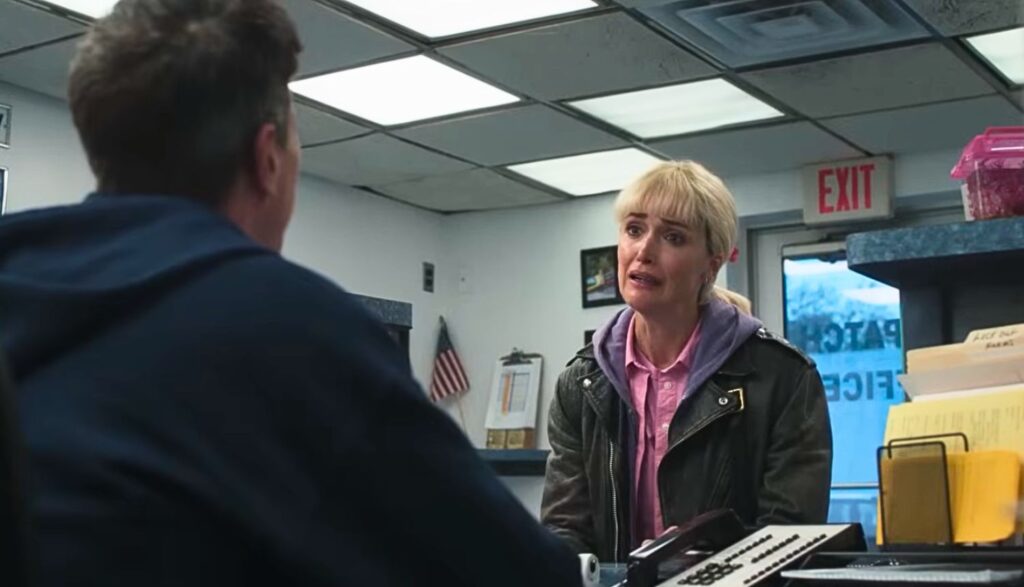
And when Amanda goes there to pick the car up, she’s met with a fine to get the car released: $273.20, with an increasing fee for every day they have to store it.

“I have to pay that to get my stolen car back?” Amanda asks, bewildered. “Are you serious?”

But Kaplan is serious. And Amanda doesn’t have that kind of money to her name. She loses her job, her shelter and her access to her daughter all in one fell swoop.

But Amanda isn’t one to give up. She’s going to fight this in court.

And she’ll get her ’91 Toyota Camry back—no matter how long it may take.


Positive Elements

Amanda spends the movie attempting to reconnect with Avery, whom she was separated from a couple of years ago. And when she loses her car, she loses the only means by which she could afford to travel to Avery. So other than regaining her housing, Amanda’s struggle to reclaim her car is, in part, to rekindle her relationship with her daughter.

Still, Amanda’s journey forces her to confront some of the deep-rooted problems she’s been hiding away. She’s never opened up to her support group about her struggles with alcohol, drugs and abuse, for instance—and she eventually finds the courage to do so. She also refuses to describe herself as “homeless” due to the stigma around the word. However, she later realizes that if she’s honest about her circumstances, she can become a source of hope for change for anyone in a similar situation by demonstrating how even though she’s genuinely working hard to change her circumstances, the legal system has let her down.

Most people write Amanda off. But a few try to help as best they can. Kevin, a lawyer at a nonprofit firm, spends months alongside Amanda in an attempt to help her get her car back. Barbara, the leader at a homeless shelter, helps Amanda overcome her struggles by encouraging her to open up to her support group. A street paper offers jobs to homeless people as paper distributors to help them earn a little bit of money. And the movie showcases how the church provides resources to help people.

Spiritual Elements

Amanda finds a Lutheran church that offers beds for the homeless. Barbara makes many comments referencing God—including some that aren’t found in Scripture, such as “the Lord helps those who help themselves.”

In a discussion with Amanda, who doesn’t believe in God, Barbara says that God laughs when He hears our plans—to which Amanda responds that “for a guy who doesn’t exist, that’s pretty rude,” and she’ll be sure to tell God that when Barbara has them pray next. Barbara paraphrases Jesus’ statement in John 8:32, saying “the truth shall set you free” to encourage telling the truth—which, in biblical context, is actually about how coming to faith in Jesus sets us free from sin and death. When Amanda returns to the shelter late one night, she uses Jesus’ name in vain, and Barbara responds that “Jesus is asleep, Amanda, as is the rest of His flock.”

Amanda attends an Alcoholics Anonymous meeting at another church. A sign in a church reads “but for the grace of God.” Amanda jokes that she’d like to be reincarnated as a dog.

Sexual & Romantic Content

We hear a reference to oral sex. A woman says she is having casual sex with a man, and she makes a crude joke about the clothing she wears for these encounters. We see two women wrapped in towels, and later, one man in a towel.

A homeless man tells Amanda that she’s able to sleep on “his” bench so long as she pays him—either with money, booze or sex. When Amanda asks if anyone has taken him up on that last option, he responds “not yet, but [he’s] hoping.”

The leader of the homeless shelter tells Amanda to not watch pornography while there, as they’re “on the Lord’s Wi-Fi.”

Whenever Amanda references her daughter, she uses the pronoun “they” instead of “her.” Similarly, a pregnant woman says that she’ll “let the baby decide” what its gender is once born—and when the baby boy is born, she says, “He’s a boy until he’s old enough to decide.”

Violent Content

A woman says she attempted suicide via drug overdose, and later, she considers jumping off a bridge.

Someone punches Amanda in the face, leaving a visible injury on the nose.

A woman reflects that, while addicted to drugs, she once woke up in a “crack house” with a man’s genitals in her mouth.

Crude or Profane Language

We hear roughly 50 uses of the f-word and around 25 instances of the s-word. Other crudities include “a–,” “b–ch,” “d–n,” “h—,” “ho” and “whore.” God’s name is used in vain 13 times, including seven instances paired with “d–n.” Jesus’ name is likewise used in vain six times.

Drug & Alcohol Content

Amanda and others admit to a variety of drug and alcohol addictions, including opioids, cocaine, steroids and amphetamines. We hear about most of these struggles at Alcoholics Anonymous meetings. Despite her participation in the program, we do see Amanda drinking vodka until inebriated. She also frequently smokes cigarettes.

Other Noteworthy Elements

A woman says she robbed a pharmacy for opioids. Amanda steals a man’s bike.

Someone claims that being homeless is “about as bad as being black or brown in this country.”

Amanda jokes about the difficulty of using a rectal thermometer on a dog.

The movie showcases a company that extorts its customers, putting compassion behind profit.

Conclusion

How much is a ’91 Toyota Camry worth? Well, it depends on who you ask. For Amanda, the answer is priceless.

She has no particular allegiance to the make or model. But the car is her home. And it’s the only way she’ll be able to travel to see her daughter again.

Tow is based on the true story of the real-life Amanda Ogle, who fought for a year against the towing company that refused to return her car and imposed thousands of dollars of fines to get it back. And all of this only happened as a result of someone stealing her car to begin with.

That injustice is the focal point of the film, and it’s easy to root for that to be resolved—even if Amanda’s not the most tactful in the way she goes about it. And hopefully the movie elicits a bit more compassion for those struggling through similar circumstances.

Still, Tow contains some messy content issues: Crude language is heavy and frequent, and sexual references are blunt and uncensored. And despite the nice messages in the film, those content concerns might be too high a fine to pay.

Kennedy Unthank

Kennedy Unthank studied journalism at the University of Missouri. He knew he wanted to write for a living when he won a contest for “best fantasy story” while in the 4th grade. What he didn’t know at the time, however, was that he was the only person to submit a story. Regardless, the seed was planted. Kennedy collects and plays board games in his free time, and he loves to talk about biblical apologetics. He’s also an avid cook. He thinks the ending of Lost “wasn’t that bad.”