


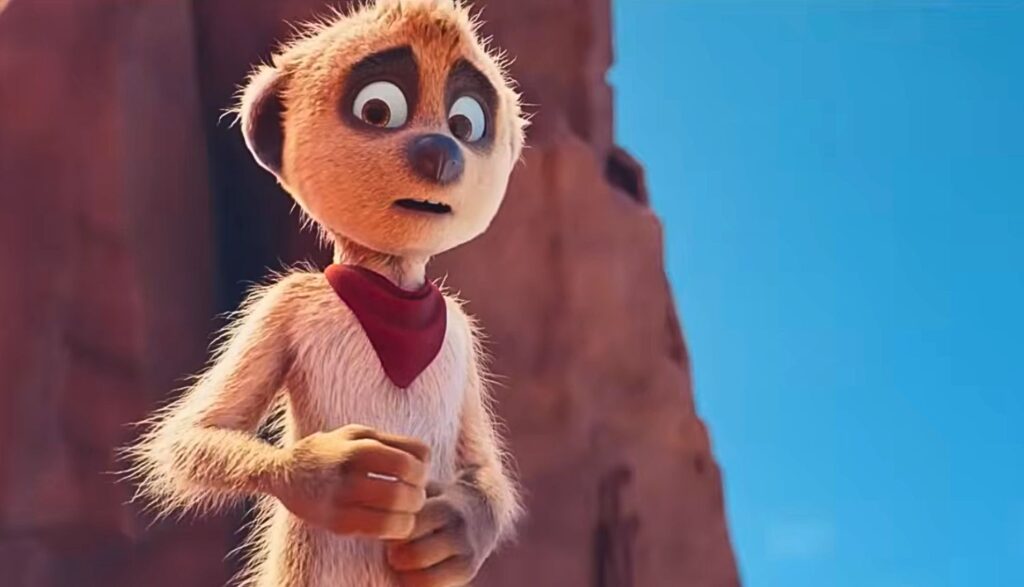

When his grandfather gets sick, young meerkat Tafiti treks across the desert to find a magical blue flower that might heal him. Along the way, he befriends a bush pig named Bristles, who helps Tafiti learn some important lessons about setting aside prejudices.
Meerkats know that there are many dangerous animals living in the savanna. In fact, there’s nothing but dangerous animals. That’s why young Tafiti and his meerkat family stick to their own kind. Because even seemingly nice animals—like butterflies—can still put you in danger by distracting you.
Tafiti is a bit tired of keeping to himself. He’s bored with meerkats. He wants to go out and make friends.
But when opportunity presents itself in the form of a bush pig named Bristles, Tafiti heeds the words of his Grandpapa: He tells the friendly swine they can’t be friends, and he marches on home.
That’s when an eagle decides to attack. The bird of prey swoops down and snatches up Bristles in his claws. Tafiti jumps in to save the pig—and when Bristles is safely on the ground, Tafiti offers to help him patch up his wounds, too.
Grandpapa is furious when he finds out about Tafiti’s good deed. After Grandmama kindly applies some herbs to Bristles’ wounds, Grandpapa sends him away. Unfortunately, the bush pig is attacked again—this time by a snake.
Grandpapa and Grandmama manage to fend off the beast, but not before it sinks one of its fangs into Grandpapa’s arm.
The venom works slowly but effectively. He won’t survive ‘til the next rain, Grandmama tells Tafiti. And then Grandpapa, in a fevered state, tells Tafiti that the only thing that can save him is the mystical blue flower that grows on the other side of the desert, far from their savanna home.
Grandmama warns Tafiti that the flower is just a legend and that nobody has ever returned from searching for it.
But Tafiti can’t just sit by and watch his beloved Grandpapa die. He has to do something. So that night, after everyone is asleep, Tafiti sets off across the desert.
Ultimately, Tafiti is a film about friendship and acceptance. Bristles follows Tafiti into the desert, and Tafiti initially distrusts the pig. That’s mostly due to prejudice. (He’s been told his whole life that other animals will either eat him or cause him to be eaten by distracting him.) And as the two dive into the wilderness—with Bristles determined as Tafiti himself to find a cure for Grandpapa—Tafiti begins to find Bristles annoying as well.
However, through their shared adventure—and getting to know one another better—the two form a friendship. They save each other’s lives. Tafiti realizes that he shouldn’t judge other creatures for their differences. And they come to care for one another as family. This unlikely friendship serves as a catalyst for Tafiti and other meerkats to accept other animals.
Tafiti and his family are very loving and caring toward each other. Although Grandmama distrusts Bristles, she still tends to his wounds. Friends help and encourage each other in times of need. Tafiti and Bristles share their very limited water with a family of pelicans in the desert, even though they’re practically dying of thirst themselves.
An antagonist’s heart is softened by the friendship of Tafiti and Bristles. As a result, he changes his ways and helps the two friends. Other characters apologize for hurtful words and misdoings.
The blue flower has some mystical healing properties. When animals consume the flowers, blue sparkles fill the air.
When the friends wake up surrounded by fog, one of them wonders if they’re in heaven. Bristles thanks the rain and the clouds at one point.
An elephant and an elephant shrew fall in love at first sight. They act lovey-dovey toward one another, grossing out their friends.
When melons burst open, jackals covered in the juices start licking each other—and several appear to greatly enjoy the sensation.
Tafiti and Bristles indeed face many dangerous creatures—including a pack of jackals; a big, toothy fish; a cobra; and the aforementioned eagle (who tauntingly follows them through the desert, hoping to eat them once they die of natural causes).
The pair also faces several natural dangers. Both nearly perish from thirst and heat exhaustion. Tafiti almost drowns after falling into an underground cave filled with water. When they reach a salt pan, the friends realize they’ll burn to a crisp if they try to cross during daylight. (Bristles’ tail catches fire when it touches the salt, and other animals suffer some burns from contact, too.) They wait for nightfall, but Bristles falls asleep before they reach the end. Tafiti goes back to help him, but he passes out too. They’re narrowly rescued from the sun’s searing rays by an unexpected travel companion.
The meerkats have a fear of being eaten by other animals. Grandpapa almost dies from his snake bite. An elephant slaps an eagle out of the air. We see several animal skeletons scattered on a beach—all victims of thirst, since they couldn’t drink the ocean’s salty water. The friends are chased by hungry animals a couple of times. Bristles gets a black eye during a fight with a snake.
None, but “stupid” is a repeated term throughout the film.
Melon juice has a euphoric effect on some jackals that consume it.
At one point, Bristles rockets himself out of a hole with flatulence. Desert beetles slurp fog dew off their own bodies for hydration. When Bristles licks one, it slaps him away, disgusted. The beetles are similarly grossed out when Tafiti and another animal drink the dew off Bristles’ body to survive.
Prejudice plays a role in this film (though it’s remedied). Characters are sometimes rude or mean to each other. A few lie or act selfishly at times. Tafiti deceives his Grandmama so that he can sneak out to search for the blue flower.
Based on the book series by German authors Julia Boehme and Julia Ginsbach, Tafiti: Across the Desert will definitely evoke feelings of The Lion King’s Timon and Pumbaa. But besides the main characters being a meerkat and bush pig (with the meerkat being much smarter than the bush pig), this is a very different—and sweet—story about friendship.
Tafiti has some nice lessons about accepting people who don’t look or sound or act like us. It teaches about the importance of friends—how they can help us, encourage us or even just share the journey with us.
The perilous moments in this film are juxtaposed with eyerolls and gags—often from the creatures presenting the danger themselves—making them feel more silly than scary. And other than repeatedly calling each other “stupid,” there’s not much language to worry about either.
Tafiti isn’t particularly moving, but it isn’t problematic either. It’s just a nice little film that your own young meerkats can appreciate.
Emily studied film and writing when she was in college. And when she isn’t being way too competitive while playing board games, she enjoys food, sleep, and geeking out with her husband indulging in their “nerdoms,” which is the collective fan cultures of everything they love, such as Star Wars, Star Trek, Stargate and Lord of the Rings.