


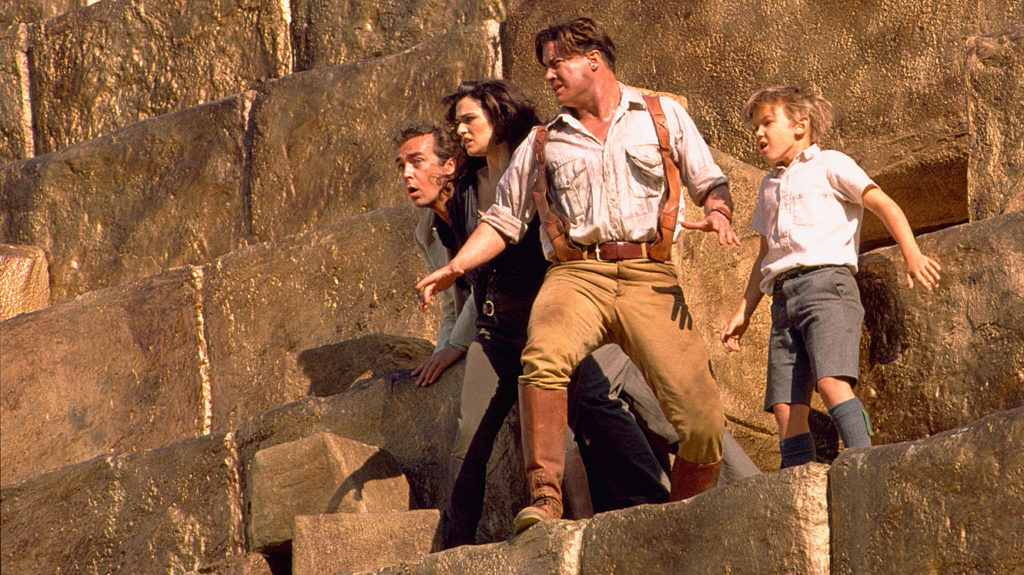

The Mummy Returns brings Egyptian theology back to the forefront as Rick and Evelyn O’Connell battle against Anubis’ evil forces. Heavy supernatural moments and mostly bloodless violence stain the film’s image (as does heavily dated CGI).
When The Mummy Returns first released in 2001, it took $70 million in its opening weekend. And now, the sequel has been reawakened for another return to theaters.
Equally violent and more spiritually bankrupt than the original, this installment finds trigger-happy adventurer Rick O’Connell and darling Evelyn married with an 8-year-old son. The year is 1933. The plot? Bad guys want to wake the dead and bring unspeakable evil into the world. Can these devils be stopped?
The O’Connells’ first order of business is to find their son, kidnapped by old nemesis Imhotep as part of a quest to resurrect and control an army of jackals. The special effects come fast and furious. Rotting, reanimated corpses. Waves of scorpions, flesh-eating scarabs and voracious pygmies. Collapsing tombs. It’s a headache-inducing, visceral barrage that seems determined to keep audiences from pausing long enough to realize how ridiculous it all is. Nonstop violence includes stabbings, shootings, dismemberment and Imhotep sucking the life out of people.
Worse than the body count is the film’s theology. Reincarnation is a central story point as visions of a past life lead Evelyn to realize that she was the princess Nefertiri. Power comes from sorcery and occult chants (a reference to the “good book” leads one hero to consult a book of the dead in order to bring another back to life).
In the climax, Rick and Evelyn’s marriage is more than affectionate; it proves to be a formidable, selfless force. Nice thought. If only it hadn’t been shrouded by two hours of darkness.
When Alex gets kidnapped, Rick and Evelyn stop at nothing to save their son. And many people risk their lives to stand up against evil forces and to protect the world.
The story begins with the Egyptian god Anubis making a deal with the Scorpion King, causing an oasis to spring forth from the desert in exchange for the Scorpion King’s soul. And we see Anubis take the Scorpion King’s soul early on in the movie. The Scorpion King’s army is made up of jackal-like creatures made from the dust—and other supernatural creatures like mummies and pygmies join the fight, too. Later, Anubis takes away a man’s supernatural powers.
Evelyn experiences dreams and visions that guide her throughout the movie, and it’s later revealed that this is because she is the reincarnation of an ancient Egyptian princess. Likewise, Meela—a mysterious woman assisting Imhotep—is the reincarnation of Imhotep’s ancient lover. However, Imhotep tells Meela that she’s only the same in body, and he later summons his love’s soul from the Underworld into Meela’s body.
The Book of the Dead plays a key role in the story, resurrecting a couple of people. The user must recite the spell in ancient Egyptian for it to work. After a woman is resurrected in this way, she asks if anyone would like to know what heaven looks like.
A magical bracelet guides Alex to locations across Egypt. Imhotep’s powers allow him to levitate things and bend water to his will.
Someone tells Rick that Rick’s tattoo is sacred and marks him as a “warrior for God.” A man compels others to sacrifice themselves for him, telling them that they’ll “be rewarded in heaven.”
A man describes many things as cursed, fearful of “waking the gods.” Someone describes the events of the film as “preordained thousands of years ago.” A man utters, “What in the name of Anubis?” A man calls out for God to help him.
We see the Underworld, and it is filled with thousands of people clawing up at the exposed entrance.
Someone references the Bible.
Two women fight for others’ entertainment, and they’re dressed in bikini-like garments that accentuate their breasts and all but reveal their rears.
A couple of women wear dresses that expose cleavage. A couple of men are seen shirtless. Rick and Evelyn passionately kiss a few times. Imhotep and Meela kiss, too. We see a woman’s discarded underwear draped over a dresser door. Someone admits that a woman he was planning to sleep with is married.
Dozens and dozens of people die before the movie’s end, though there is very little blood in the movie. We see ancient armies clash, and people die by the sword. And later, an army of jackals fight against an army of men. People are shot, stabbed and more.
A woman kills herself with a blade.
A man’s flesh gets eaten off his hand, leaving only bones—and he’s later pulled apart. A few men die when Imhotep sucks the flesh from their bodies; we see one instance of this onscreen, and we find the disturbing corpses of others later. Two men get thrown through the air to their deaths. Many men get stabbed offscreen. Pygmies shoot people with blowguns.
A few people die by flesh-eating scarabs, and we see the bugs crawling just under their skin as they’re eaten alive. A woman gets consumed in a sea of scorpions. Someone gets bitten by a deadly snake.
Some men drown in quicksand. Others collapse in the heat of the desert. Some burn alive. We constantly come across mummified remains, some of which later spring to life. We see ancient heads stuck on spikes.
The Scorpion King munches down on a live scorpion. Rick crushes scorpions under his feet. Someone shoots down a falcon. Mummies and other mythical creatures get shot and stabbed, bursting into powder as they perish. Someone gets pulled into the Underworld.
Some people suffer slices from swords, leaving small bloody marks. A man fantasizes about killing a child.
We hear the crudities “a–,” “d–n,” “h—” and “b–tard.”
God’s name is used in vain roughly 10 times, including a couple of instances paired with “d–n.” Likewise, Jesus’ name is used in vain once (and a couple more times if you include “cripes,” a British euphemism for “Christ”).
None.
None.
In the Mummy series, things have a tendency to die and fall into cobweb-filled darkness before returning to life.
Well, someone must have used the Book of the Dead on The Mummy Returns, since it’s back in theaters (as of March 2026) once more for its 25th anniversary. And just as bad things come from resurrecting the servants of ancient evils, so too do some content issues rise from the sand.
Most notably, Egyptian theology is taken as spiritual truth in this franchise—and demonic forces like Anubis play pivotal roles in the story. Reincarnation, likewise, plays a key role in the plot.
Violence, too, often shows up here. And while there is little-to-no blood, some deaths can be quite disturbing—whether it’s from those carnivorous scarabs or Imhotep sucking the skin of a man’s face like an overcharged vacuum. A couple of scenes feature women dressed in revealing outfits, as well.
These will all be heavy considerations for anyone thinking of waking up this dead movie for their own families.
Kennedy Unthank studied journalism at the University of Missouri. He knew he wanted to write for a living when he won a contest for “best fantasy story” while in the 4th grade. What he didn’t know at the time, however, was that he was the only person to submit a story. Regardless, the seed was planted. Kennedy collects and plays board games in his free time, and he loves to talk about biblical apologetics. He’s also an avid cook. He thinks the ending of Lost “wasn’t that bad.”