


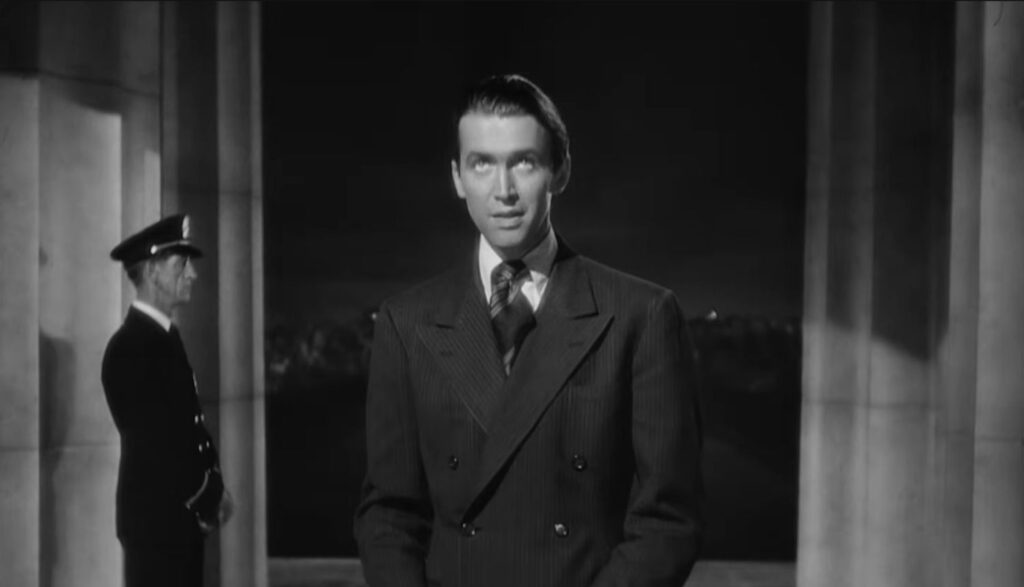
An idealistic small-town youth leader is appointed to the U.S. Senate. And he tumbles into a massive political corruption scheme that he seemingly has no power to stop. Jimmy Stewart and fellow cast members are brilliant in this film that affirms love of country and fighting for the little guy. The film contains some drinking, smoking and some implied violence against kids.
Senator Sam Foley has died.
Now, under normal circumstances, Foley’s passing would have been quickly overlooked by his Washington colleagues. He was a relatively unknown junior senator with no real clout. Even his fellow state senator, Joseph Harrison Paine, barely knew the man.
However, this is a rare situation: the Deficiency Bill is coming up for a vote. Senator Paine and others had been working on, uh, finessing certain sections of that bill for a long time now. Let’s just say there are a number of people who are very concerned and a lot of under-the-table money at stake. And every vote is crucial.
So, Paine and the whole political machine behind him fly into action at the announcement of Sam Foley’s demise. They’ll need to get the State’s moronic governor, Hubert “Happy” Hopper, to appoint someone quickly. And it’ll need to be someone pliable: preferably someone who won’t even bat an eyelash at being told how to vote.
Unfortunately, the pliable choice that Paine and political kingmaker Jim Taylor come up with is immediately shot down by local state committee members. Everyone knows that the guy they chose is a dolt. Then, through a number of conversations, the name of Jefferson Smith is brought up.
Jefferson is a local leader of the Boy Rangers. Even Happy Hopper’s own sons know and admire this man. Jefferson’s a salt-of-the-earth type—definitely not a man of politics. Not only that, but Jefferson Smith puts out a local newsletter that’s read by more than a million kids.
That’s when Governor Happy gets his first bright idea ever. Those million kid readers all have parents. Happy kids means happy parents. Happy parents means a potentially happy, well, Happy in the next election cycle.
When Jim Taylor hears the news, he’s furious. But Senator Paine thinks the bumbling governor may have stumbled onto something. He once knew Jefferson’s now-deceased father. He was a good man, a good news editor and a good friend from back when they both could be called, well, “good men.” And the fact is that Jefferson Smith is an idealistic sort. He’s naive, boyish. And he looks up to Paine.
This just might work out.
On the other hand, Jefferson Smith might just be idealistic enough to believe that Washington D.C. is supposed to work to help the people of the United States. He might earnestly admire the Founding Fathers, the Constitution, the Red, White and Blue.
And that could be a problem.
Jefferson is indeed a guy who loves his country. He teaches his Boy Rangers about U.S. history and all the great men and women that contributed to the founding of our nation. So, when he arrives in Washington D.C. for the first time, he is awed by the monuments and buildings and everything they represent. He can’t help but wander off to take a local tour of the city.
The film takes time to show us the monuments and sights of Washington D.C. from Jeff’s perspective—helping us feel his love for this country and the people who fought to establish it and keep it sound. In fact, Jeff is so inspired that, thereafter, everything he does is in an effort to do the right thing by the people back home.
Jeff’s Washington assistant, Saunders, is far less enamored with the things of Washington. She was hired by Senator Paine to keep Jeff, essentially, on a leash. However, Jeff’s enthusiasm eventually reaches her. Not only is she swayed by his earnestness, but she comes to admire him as a senator and love him as a man. In fact, she begins to help the politically naïve guy with savvy tips and tricks.
Jeff tells Saunders: “Liberty is too precious a thing to be buried in books. People should hold it up in front of them every single day of their lives and say: ‘I am free to think and to speak. My ancestors couldn’t. I can, and my children will.’”
Jeff’s kindheartedness even begins to impact Senator Paine. Even though Paine is too deep in a corrupt plan to turn back from his illicit ways, it’s obvious that Jeff reminds him of the person he used to be.
The Boy Rangers as a group sincerely love and admire Jeff. Upon his appointment, some of the kids march in with a gift and tearfully present it to him. And later, when Jeff gets in trouble with the political machine that controls the state government, the kids all rally and even put themselves in danger to help him.
Jeff decides to sponsor a bill for a national boys camp. “If we could just get the poor kids off the streets, out of the cities for a few months in the summer and let them hear something about nature and American ideals,” Jeff declares, saying it could change everything.
Slowly Jeff’s choices begin to positively impact certain groups of people. Even though Taylor’s political machine falsely paints him as corrupt in the press, some stand by the young senator. And even though Jeff can only take small self-sacrificial actions, they still impact some good people in positive ways. In fact, that’s one of the film’s themes: Small positive choices can make a difference.
The Senate body prays together for wisdom, strength and justice. At one point in the film, someone comments on Jeff’s struggle against powerful political forces, comparing it to the story of David and Goliath. In a tense moment, Saunders turns to a reporter friend and says, “Pray, Diz. If you know how.”
Governor Happy Hopper uses a flip of a coin to help him make an important decision. And when the coin lands on its edge near a newspaper article, he counts that as a supernatural sign.
Saunders and a Washington reporter named Diz Moore both have a cynical view of the world they live in. And they’ve developed a close relationship because of that shared worldview. (In fact, it’s implied that they may have dated.) Diz states that he wants to marry Saunders. And after getting quite drunk one night, Saunders almost takes him up on the offer. However, Jeff’s earnestness and open-heartedness changes Saunders in positive ways. She helps Jeff fight for a just cause. And she eventually states that she loves him.
Jeff meets Senator Paine’s pretty daughter, Susan, and is immediately smitten. But she isn’t very kind or sincere. In fact, she laughs at Jeff behind his back.
We hear that Jeff’s beloved dad was shot in the back and killed when Jeff was young. When Jeff’s words and actions are taken out of context and used by the press to make him look like a fool, he tracks down the offending reporters and punches them in the nose for their lies.
Jim Taylor orders union members to stop any positive news from leaking out in Jeff’s home state. Union thugs slap kids and steal their papers, and they spray a group of marching teens and tweens with firehoses. A union truck causes a car driven by teens to crash. (We don’t see anyone seriously hurt.)
As Jeff rallies individuals to stand against Senator Paine’s graft-loaded bill, Taylor warns Paine: “If he starts to convince the senators, you might as well blow your own brains out.” And later, it’s implied that Paine takes those words to heart. We hear a loud bang and then see men struggling with the frantic Paine.
Eventually, even Senator Paine is impacted by Jeff. He tells Jim Taylor, “This boy is different. He’s honest.” But Taylor fires back, “Either he falls in line with us … or I’ll break him so wide open, they’ll never be able to find the pieces.”
There’s nothing nasty in the language, but Jeff does call out some euphemistic interjections such as “doggonit,” “darn it” and “holy mackerel!”
Several individuals are seen casually puffing cigarettes in various locations throughout the film. And a number of people drink mixed drinks and wine in bars and casual settings. In fact, Saunders and Diz go to a bar to “drink over” a particularly troubling situation. Saunders ends up getting quite tipsy. There are also casual comments made about a missing person probably showing up drunk.
Early on, the world-jaded Saunders flirts with the idea of quitting her job rather than “playing straight for [Jeff’s] phony patriotic chatter.” Instead, she takes some behind-the-scenes steps to make Jeff look foolish. Later on, Senator Paine offers her a bonus and a “big opportunity” if she just sticks it out and does his bidding.
Jeff goes into his new role as senator with an earnest drive to be open, honest and helpful. But reporters and others label him as little more than “an honorary stooge.”
After attacks from the press and those he respected, Jeff is so dispirited by the true nature of Washington that he quietly sobs in the shadow of the Lincoln Memorial.
I think that Mr. Smith Goes to Washington should be required viewing for every American citizen.
Thanks to director Frank Capra’s filmmaking mastery, this movie is able to stir up emotional feelings of patriotic appreciation for the images and symbols of our nation and the great achievements they represent. And at the same time, the film is warm and funny.
On the acting front, Mr. Smith Goes to Washington is a true standout. The film gathers headliners of the day—Jimmy Stewart, Jean Arthur, Claud Rains and Edward Arnold—all into one film. You would, frankly, be hard-pressed to find a better cast or a better set of compelling characters.
All in all, this is quite simply a wonderful film with a pretty inspiring story about pushing back against a power-hungry establishment and standing up for the little guy. The only content concerns here are characters with glasses of booze in their mitts and cigarettes on their lips—both of which were perfectly acceptable in family rooms across the land in 1939.
Oh, and along the way, Mr. Smith also delivers a bonus civics lesson on how government works … and sometimes, doesn’t.

After spending more than two decades touring, directing, writing and producing for Christian theater and radio (most recently for Adventures in Odyssey, which he still contributes to), Bob joined the Plugged In staff to help us focus more heavily on video games. He is also one of our primary movie reviewers.