


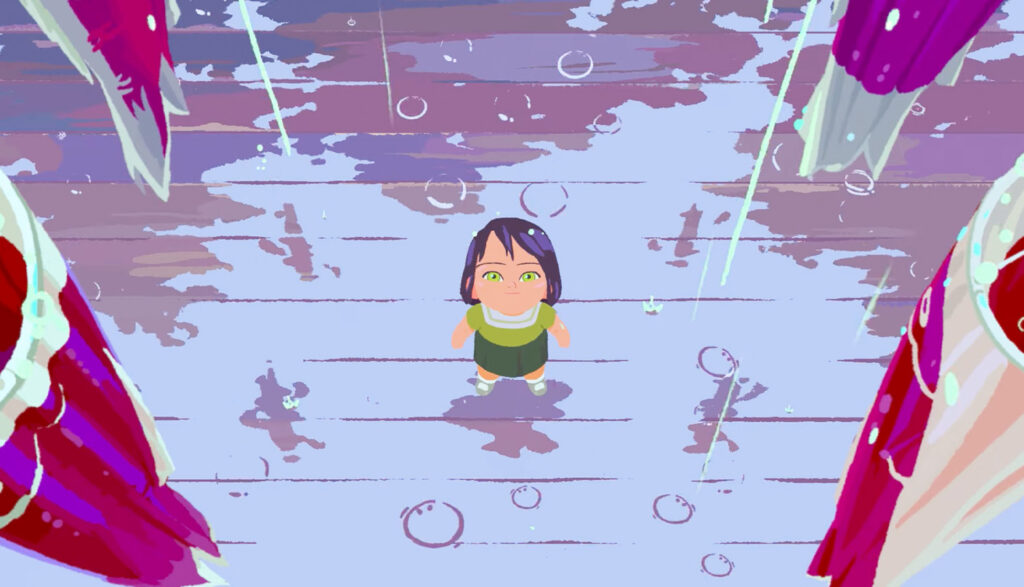
Little Amélie or the Character of Rain expounds upon the challenges of growing up from the perspective of a toddler who believes she is God—and eventually realizes that she is not. It’s funny, heartwarming and beautifully animated. But the messages will be difficult for younger kids to grasp, and older kids will need some parental guidance to truly understand what this film says about navigating loss and embracing life.
When little Amélie was born, the doctor told her parents she’d be a “vegetable.” The infant girl was alive, but there was no life behind her eyes.
But that news didn’t faze Amélie’s parents. They were optimistic. So they took their baby home, introduced her to her older brother and sister and spent the next two and a half years waiting to see if she’d ever respond to their kisses and hugs, their pokes and prods.
Then, one day, miraculously, Amélie moved on her own.
Then she fell over.
Then she tried to talk.
And then, she screamed.
Amélie had been conscious of what was occurring the whole time. She simply didn’t care. But something had changed within her. She had been endowed with a “gaze,” as she calls it. She finally had life behind her eyes.
Only Amélie had spent so much time in a vegetative state—doing nothing more than swallowing, digesting and ejecting—that she now couldn’t do the things other toddlers could do. She couldn’t walk. She couldn’t talk.
That frustrated young Amélie. So she screamed some more.
For six months, Amélie screamed. She threw objects and tantrums.
Then, one day, Amélie’s grandmother arrived.
Though Amélie’s parents were at their wits end with the child, Granny had nothing but patience to offer (and a bit of Belgian white chocolate). And through Granny’s love—and perhaps the joy of chocolate—Amélie finally felt like she had been truly born.
From that moment, Amélie progresses in leaps and bounds. She learns how to walk, even run. She learns how to talk, too—in complete sentences, for that matter.
But as the toddler soon learns, just because she can move around and communicate—just because she finally feels alive—doesn’t mean that she understands life.
No, in order to understand life, you have to live it. And that’s something that Amélie hasn’t quite figured out yet.
Little Amélie shares some heartwarming messages about life and growing up. It encourages viewers to live life to the fullest. And it offers up some important truths about navigating loss.
Amélie’s family clearly loves her, though they can grow exasperated with her behavior at times. But even when she screams, even when they’re at a loss for how to handle her outbursts, her parents never lose their temper with her.
Still, it’s the love of Amélie’s grandmother that transforms the child. Granny pushes through Amélie’s early stubbornness with some of her own, refusing to back down until the little girl changes her attitude.
Similarly, after Granny leaves Japan to return to her home in Belgium, Nishio-san (a Japanese woman hired by Kashima-san, the family’s landlord, to manage the property and keep it clean) forms a bond with Amélie. She returns Amélie’s anger with kindness. She teaches the little girl about Japanese culture. And she helps Amélie cope with the death of a loved one.
Nishio-san, we learn, lost her family during World War II—as did Kashima-san. However, whereas Kashima-san blames Amélie’s family for what happened to hers (Amélie’s family is from Belgium, a country that was part of the Allies that fought against the Axis-aligned Japan), Nishio-san recognizes that Amélie’s parents were children themselves when the war happened. They’re not responsible for the deaths of her loved ones. And she implores Kashima-san to let go of her anger and sadness.
Kashima-san does forgive, eventually, even acting to save a member of Amélie’s family from drowning. We see that Amélie’s parents are sympathetic to Kashima-san’s pain. A woman comforts her husband as he cries after learning that his mother has passed away. Amélie’s parents console her after someone she loves is forced to leave.
[Spoiler warning] Amélie and her siblings squabble, as siblings are wont to do, but it’s all rather innocent—something they’ll surely laugh about when they get older. But Amélie initially holds a grudge against her brother, André, because he picks on her. In fact, when she starts talking, she refuses to say his name. This annoys André (and possibly hurts his feelings), but when Amélie winds up in danger, he immediately alerts some adults, allowing them to save the girl from harm. After André sees that Amélie is going to be all right, he cries in relief. And Amélie, learning that André was the one who raised the alarm, thanks him by finally saying his name—resulting in the siblings’ first hug.
[Note: Spoilers are contained in this section.]
When the movie opens, Amélie narrates: “In the beginning, there was nothing. Nothing except God.” As she speaks, a spot of light appears on a black canvas. The camera zooms in to reveal that this light is an embryo. Amélie continues to introduce us to this being, stating that “God wasn’t interested in anything. God didn’t even care about being God.” And it’s revealed that the embryo is Amélie, and Amélie believes that she is God.
I don’t necessarily want to give away too much of the story’s plot, but Amélie spends the majority of the film under this belief. And certainly, some external events occur that seem to line up with Amélie’s internal diatribe. For instance, when she first comes out of her vegetative state, an earthquake shakes her family home. Elsewhere, she’s told that the first part of her name, Ame, means “rain” in Japanese. And when Amélie notices a correlation between the times that it rains and the times that she’s happy, she concludes that this must mean she is the rain—that the clouds themselves are responding to her emotions.
From Amélie’s perspective, many things seem to bend to her will, reinforcing the idea that the child has some control over natural occurrences—and the film somewhat propagates that message in its artistic manner, juxtaposing what Amélie thinks is happening with what’s actually happening. For instance, Amélie glows and levitates off the ground the first time she eats chocolate. Elsewhere, she seemingly parts a sea (much like Moses), though that illusion quickly breaks when she takes one step too deep.
By the film’s end, Amélie begins to understand that she is not in control of the universe. And she eventually concedes that no, she is not God.
Early on, Amélie describes people who are alive as people who have a “gaze.” And for the first two and a half years of her life, because of her vegetative state, Amélie believes that she doesn’t have a gaze—and therefore isn’t alive. It’s not entirely clear what rouses Amélie from her vegetation, but she claims that it was some sort of accidental evolution.
When a girl nearly dies, she imagines herself hovering somewhere between life and death. She speaks to the spirit of her deceased grandmother, who tells her that she doesn’t belong there. And the girl manages to return to the real world.
At one point, Amélie becomes entranced by a vacuum cleaner because it “takes everything” and “leaves nothing.” She thinks this “pure and simple annihilation” must be a divine gift—and that therefore, the vacuum must be her (God’s) brother.
Nishio-san teaches Amélie about yōkai, supernatural monsters in Japanese folklore. When asked about death, Nishio-san says that the memories of her loved ones continue to guide her through life. She believes that they are still with her, in a way, and “talking” to them soothes her.
Amélie’s mother wears a bikini at the beach, and we see other characters in swimsuits.
Nishio-san recounts her memories from World War II. She was just a child at the time, but she remembers bombs falling, including one that landed right next to her. It buried her, and she had to dig her way out of the rubble. Once she did, she realized that her family had been killed. We later learn that Kashima-san lost her own husband and son during the war, too.
A little girl nearly drowns when she wanders into the ocean, out of the sight of her parents. We see her struggle under the waves and begin to sink. However, somebody pulls her out, saving her life. Later on, a child falls face-first into a pond, hitting her head. Again, someone comes to the rescue, but the child is taken to the hospital, and we see her head wrapped in bandages where it was cut open.
A toddler throws a wooden block, which breaks a window. Amélie tries to bite someone early on. Amélie kicks André in the shin, so he shoves her to the ground.
None.
A woman drinks a glass of wine. Someone proposes a toast with champagne in celebration.
Amélie throws several tantrums before she learns how to communicate (and quite a few after). A boy picks his nose. Amélie’s siblings argue quite a bit. André picks on his little sisters, “torturing” them.
When Amélie learns that carp are symbolic for boys and that May is considered their month in Japan, she grows jealous, asking why girls don’t have a month or a symbol. However, after seeing some carp in real life, Amélie concludes that the Japanese were correct to pick such an unattractive animal to symbolize the “uglier” gender.
“When you are 3, you see everything and understand nothing,” Amélie chimes in Little Amélie or the Character of Rain.
We see everything in this Oscar-nominated film through the eyes of a toddler.
Like many children, when Amélie doesn’t understand something, she reaches her own conclusions. She seems to fill in the gaps with her imagination. As such, Amélie spends a good portion of the film believing that she is God, and that claim isn’t refuted until the end.
However, Amélie’s conclusions are at least somewhat understandable. When you’re little, you try to make sense of the world—life and death, love and hate, joy and anger, peace and war—however you can. If Amélie had come from a Christian home and attended church, perhaps she would have deduced a little sooner that the world does not, in fact, revolve around her. But as it stands, I think she did the best she could with what she was given.
Parents who have personally endured the rearing of a toddler will likely find a lot of humor in Little Amélie. But older kids will probably need a little hand-holding to navigate the film’s lessons about loss and growing up. Younger kids will enjoy the beautiful colors and animation, but truthfully, a lot of Little Amélie’s messages will go straight over their heads.
So while I wouldn’t pile the whole fam into the car to see this movie on the big screen, I think a thoughtful family movie night may spark some interesting discussions about the challenges of growing up and navigating losses in life even as we embrace a more hopeful future.

Emily studied film and writing when she was in college. And when she isn’t being way too competitive while playing board games, she enjoys food, sleep, and geeking out with her husband indulging in their “nerdoms,” which is the collective fan cultures of everything they love, such as Star Wars, Star Trek, Stargate and Lord of the Rings.