


Through three stories that take place in three distinct ages of humanity, we see people loving and sacrificing for one another. In the Blink of an Eye lauds these very human elements as keys to humanity’s ongoing survival. And it asks its viewers to consider the choices they’re making. There is some sexuality and violence in the story mix, as well as a humanistic worldview.
Thorn and Hera live in 45,000 B.C., an era that will someday be labeled the “Paleolithic Age.” Their remains will be studied and given the label of “Neanderthal.” But that means nothing to them. They simply are. They have a young child and a baby. And there is another child growing in Hera’s womb.
The responsibility for those children makes life difficult, since just gathering enough food can be a challenge at times. But the children also make life good. They bring joy. They give Thorn purpose. He can’t help but watch the members of his family and feel something good swelling in his chest. It makes him smile.
In 2025, Claire is an anthropologist who excavates and studies the fossilized remains of people just like Thorn and Hera. In fact, she generally has a better relationship with those rock-encased bones than she does with the other graduate students and scientists around her. It’s not that she can’t communicate with people—I mean, she is quite brilliant—she just rarely wants to.
Sure, Claire will get a little inebriated at a university party and jump into a bit of panting intercourse. That’s OK in her book. She’d just rather the partygoers and sexual partners left afterward without talking. I mean, if possible. The whole interacting with people thing can be a pain. It tends to make her frown a lot.
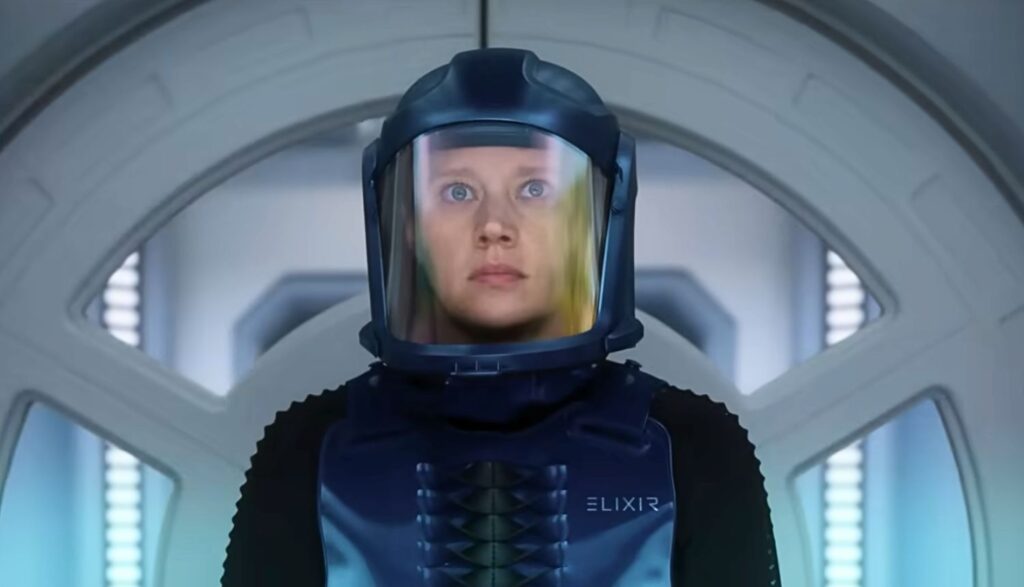
In the year 2417, the things of man have changed a great deal. The world is dying. That’s why Coakley has taken on a deep space mission. In fact, she’s already more than a hundred years into her space journey with the goal of finding a new home and a new beginning for mankind.
Coakley and her artificial intelligence companion, Rosco, have another 126 years to go. When they arrive at the new world, they’ll populate it with vegetation and a new crop of people. There are already human embryos stored onboard in incubators, just awaiting birth. And thanks to her own genetic restructuring, Coakley will live to see it all. It’s all so wonderful that it makes her sigh in expectation.
But it’s all about to go wrong.
In every age, and with every person, something unexpected is about to turn their lives upside down. They will all lose. They will all grieve. And they will all need to find a way to press on.
That’s how life works.
[Note: This section contains spoilers]
It’s obvious that Thorn and Hera love and find great joy in their children. They worry over their kids and do all they can to protect them. And the family members emotionally mourn every human loss. When anyone dies, the Neanderthals show their grief by marking the passing with a paint-covered handprint on a nearby wall. In fact, years later, a family member returns to that wall to look at the prints, revisit memories of loved ones and memorialize another passing with her own handprint.
Claire finds out that her mother is very ill. And even though it’s a difficult decision, she abandons her work and steps away from her fellowship to care for the ailing woman. A guy named Greg, who Claire has been dating on and off, comforts her and supports her decision. The two grow close through long-distance conversations, but Claire eventually pushes him away because of the difficulties that often come with long-distance relationships.
But Greg refuses to turn away. “I can see a future with us,” he tells her. “What does it look like?” Claire asks doubtfully. “Good. Worth it,” Greg declares. The two stay together and eventually marry.
Coakley learns that the oxygen-supplying vegetation onboard their ship is dying. In order to save the frozen supply of embryos, she is willing to sacrifice herself. But the AI, Rosco, volunteers to sacrifice itself so that the computer room can be used as a life-saving greenhouse. That loss is devastating to Coakley. “You were my only friend,” she tearfully tells the AI.
A group of Homo sapiens give food to the struggling Neanderthal family and invite them to join the safety of their tribe. This generosity not only welcomes in the family but later leads to Thorn’s daughter binding herself in commitment to a young Homo sapien man and starting a family of her own. Thorn has the great joy of seeing his grandchild born.
With all of those choices and others, the film makes the point that the love we have for others combined with our personal choice to sacrifice for those we love are key elements in human survival.
The film opens with a burst of light followed by microscopic growth representing the creation of life. But that spontaneous “happening” isn’t attributed to anything spiritual.
Thorn and Hera have sex under an animal skin in their cave. The camera then cuts to Claire and Greg attempting to do the same thing in Claire’s bed. However, Claire and Greg fail in their attempts and blame their inability on inebriation. When Greg leaves, Claire pulls a vibrator out of her drawer and puts it under her covers. Days later, we see them in bed once again, post-coital. This time they talk about how much more successful they were. (In all cases, the couples remain at least partially dressed and covered. No nudity.)
Years later, a now-married Claire and Greg accidentally stumble upon some porn on their teen son’s laptop. (We don’t see any images.) They talk about how to address the topic of masturbation with him.
Thorn takes a hard fall on a rocky surface which causes internal bleeding in his chest. He coughs and struggles, and it’s obvious that the growing subdermal injury is excruciatingly painful. Hera takes a sharp stone and cuts Thorn’s side so that the blood can drain. Thorn and his family flee a group of Homo sapien hunters, believing they will try to kill them.
There’s one use of “d–n” in the dialogue.
College-age adults drink beer and other inebriating beverages at a party. People talk about being drunk. Claire drinks a glass of wine at home.
An unexplained disease on Coakley’s ship kills the plants that produce oxygen. Two of Thorn’s family members die from unexplained reasons.
Director Andrew Stanton—the filmmaker who helmed Pixar classics such as WALL-E and Finding Nemo—has once again taken an interesting dramatic tack. In the Blink of an Eye tells a story that intercuts, back-and-forth, between specific people in three different ages of man: a family in the Stone Age, an asocial anthropologist in the modern age and a genetically altered scientist in the future.
As their stories play out, we see how these individuals are indirectly linked. The problems and hurdles they each face are their own, but at the same time, they all experience very similar human feelings of loneliness, love and grief. They all suffer. They all succeed and fail. And Stanton’s movie suggests that it’s their shared humanity—their love and sacrifice—that keeps them moving forward, ever grasping for what makes life worth living.
Though viewers might watch and wish they could spend more time with the life of one character or another, the dramatic hopping and skipping helps make the story compelling. And it asks us to consider what we will do with our own lives that figuratively come and go in the blink of an eye.
However, Stanton’s dramatic perspective is a very humanistic one. He presents a sexually casual worldview. And his film declares that mankind’s perseverance over life’s challenges comes purely through its own ingenuity and grit. The story doesn’t even bat an eyelash in the direction of faith. God’s love and comforting hand don’t factor into this cinematic world’s equation.

After spending more than two decades touring, directing, writing and producing for Christian theater and radio (most recently for Adventures in Odyssey, which he still contributes to), Bob joined the Plugged In staff to help us focus more heavily on video games. He is also one of our primary movie reviewers.