



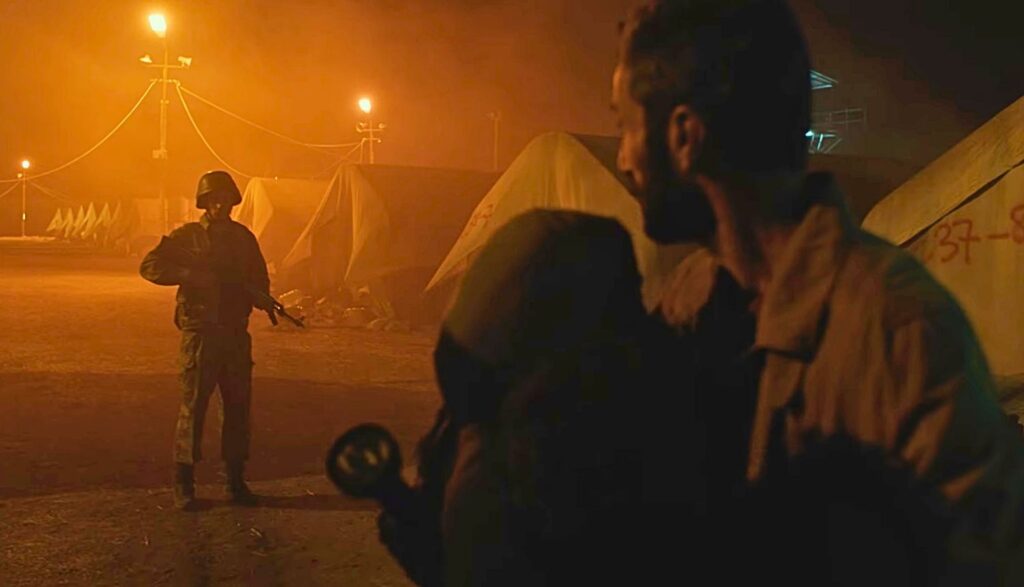
I Was a Stranger follows the stories of refugees as they struggle to escape 2016’s war-torn Syria. The film aims to remind viewers of the humanity of refugees—and to keep that humanity in mind when discussing immigration issues. Those horrible circumstances come to life onscreen as we watch men, women and children die as a result of war and their travels.
When civil war comes to Aleppo, Syria, Amira continues to do what she’s always done: Care for people.
As a doctor, Amira tries to save lives, whether they’re rebels or Syrian soldiers. As she works on keeping a rebel teen alive, she also considers how to remove the shrapnel wound from a government soldier on the next table over.
The wounded soldier, however, has no such care for the rebel’s life. He demands the teen’s death—lest Amira be labeled a traitor alongside him. Amira refuses to capitulate to the gun pointed at her face; she’ll continue to help everyone who wanders into her hospital.
It seems Amira is punished for her compassion. That night, bombs fall on her family’s home. Only Amira and her daughter, Rasha, survive.
They are but two of many refugees forced to flee for their lives—lives that have flipped upside down in a mere moment. And they, like their fellow refugees, are forced to make desperate choices. They ride in the trunk of a car; they purchase the transportation services of uncaring human traffickers; they board an overcrowded raft with limited life jackets as it heads into a storm.
They must take these chances; make these impossible choices. Refugees flee home for a reason—and to return home means death.
As mentioned, Amira chooses to operate on individuals representing both sides of the conflict rather than allowing anyone to die. When one side threatens her for doing so, she stands her ground. Later, Amira works to keep her daughter safe, too.
Amira’s not the only one keeping children safe: When asked to execute an innocent woman and her daughter, a soldier refuses blind loyalty and chooses to turn on his superior to protect them instead. A woman gives up her life jacket so that another family’s young girl can wear it instead. And a father works to keep his three children safe, even risking his life to provide them with resources.
A man jumps into dangerous waters in an attempt to save someone from drowning. He and his crew often navigate the area in search of others making similar life-threatening voyages so that they can assist them.
I Was a Stranger likely gets its name from Matthew 25:31-46 (which we unpack further in the review’s conclusion).
A man thanks God that someone survived a deadly incident. When trapped in a boat during a storm, people cry out to God for mercy and help. A woman prays for protection. While there is no indication to which God they are praying, a cross on a wall indicates that at least some of them may be Christian.
A human trafficker makes the sign of the cross with his son while praying. We see Christian crosses hanging on the walls of a couple locations.
When recounting the story of how his wife had to give birth to his daughter at home rather than the hospital because of a flood, a father jokes that “God didn’t want to share her with the world.” A man states that someone is so helpful, “God Himself would call on [him] if He needed to be rescued.”
None.
A bomb hits an apartment building, killing most inside or burying them under concrete rubble. Amira and her daughter, Rasha, survive the explosion but are bloodied, stuck under the debris and must be rescued by men searching for survivors.
Amira operates on a couple different people as nearby explosions loose dust from the ceiling. A wounded soldier threatens to kill Amira. During the scene, a bloodied crying boy is passed to another doctor for surgery.
Soldiers burst into a woman’s home and, after beating her down, drag away her young prepubescent son, who they’ve deemed a traitor for scribbling pro-rebel sentiments. The boy is lined up with men and women (also deemed traitors) to be executed. Though the gunshots happen offscreen, we catch their bodies falling to the ground. People cradle the dead bodies of their friends and family after the execution, and dead bodies are covered by sheets. We see other men shot and killed onscreen. Soldiers kick a rebel before tossing him in the back of a van. They beat men and women with the butts of their guns. A man throws a woman to the rocky ground.
Women fight over limited life jackets. People fall out of a boat during a storm, and two children drown. A boat captain suffers nightmares regarding the people he wasn’t able to save from drowning in such circumstances—he notes that, after the death toll reached 1,000, he stopped counting.
We see dead bodies on the ground.
We hear three instances of the s-word, and someone calls a Black man the n-word in another language. A man uses Jesus’ name as an expletive. A Syrian soldier makes antisemitic remarks.
People drink wine and liquor. Characters smoke cigarettes and roll-ups.
As the movie opens, moviegoers read a speech dubbed “The Stranger’s Case,” in which Sir Thomas More condemns a mob for attacking immigrant workers, the camera opens on a long shot of Chicago’s Trump Tower—most likely intended to connect the speech to the administration’s immigration policies.
A man shows little care for desperate families placed under his charge. A young girl is forced to abandon her puppy.
We see a shirtless man pull his pants down to stuff money in his underwear. We hear a man urinating.
It does not take long to understand I Was a Stranger’s point, which should be clear the moment the movie starts with “The Stranger’s Case” (the same name as the movie’s original title). It begs listeners to consider the compassion they would hope for from other countries were they thrust by unwilling circumstance out of their homes.
While I Was a Stranger offers no grandstanding pulpit speech on modern-day immigration debates, it’s not exactly subtle on the matter, either: It isn’t hard to interpret, for instance, the film wagging a disapproving finger as it holds a long sweeping shot past Trump Tower. Likewise, the worries of a couple of Greek characters, concerned that some in the influx of refugees might be violent, are handwaved away.
This movie from Angel is silent on policy recommendations; it offers little active advice on how care should be provided. Instead, I Was a Stranger’s approach is far simpler: that the refugee’s Imago Dei must remain at the forefront of our thought on the issue.
No matter how you fall upon that discussion, it’s an important point to remember. Despite all of the noise on the issue, care for the orphan, widow, stranger and refugee is not ultimately a conservative or liberal issue; it is a Christian one. It is they who God consistently demands Christians care for throughout Scripture, including in the passage from which the movie took its title, I Was a Stranger, which derives from Jesus’ warning in Matthew 25 regarding the final judgment:
“For I was hungry and you gave Me no food, I was thirsty and you gave Me no drink, I was a stranger and you did not welcome Me, naked and you did not clothe Me, sick and in prison and you did not visit Me.’ Then they also will answer, saying, ‘Lord, when did we see You hungry or thirsty or a stranger or naked or sick or in prison, and did not minister to You?’ Then He will answer them, saying, ‘Truly, I say to you, as you did not do it to one of the least of these, you did not do it to Me’” (Matthew 25:41-45).
How one treats the vulnerable is how one treats Christ Himself—and that, while discernment is necessary, the possibility of evil has never justified refusing mercy to the innocent. Motivated by the Imago Dei and in valuing others above ourselves, Christian ethics has never allowed for the question of whether we help; it only allows for the question of how we offer that help.
As we follow the refugees in I Was a Stranger, we witness plenty of the horrible things they’ve experienced—moments that parents may not feel their children are ready to see. The film itself is steeped in grief and tragedy affecting man, woman and child with little true resolution. And from a content perspective outside of that aforementioned violence, we also hear some crude language that’s become increasingly common in Angel movies. Angel movie’s have been tackling heavier topics, and that has come with corresponding content concerns. And while many of those films have been well made (Sound of Freedom and Sketch, for instance), they have peeled a bit of the company’s family friendly sheen away.
And it’s not just the movie’s violence that makes I Was a Stranger difficult to watch. The movie deals with its core subject with scenes that are stark and unrelenting in their bleak nature. And the frequency of those moments can leave viewers feeling quite sad.

Kennedy Unthank studied journalism at the University of Missouri. He knew he wanted to write for a living when he won a contest for “best fantasy story” while in the 4th grade. What he didn’t know at the time, however, was that he was the only person to submit a story. Regardless, the seed was planted. Kennedy collects and plays board games in his free time, and he loves to talk about biblical apologetics. He’s also an avid cook. He thinks the ending of Lost “wasn’t that bad.”