


Mabel Tanaka wants to save a glade from the mayor’s development plans. To accomplish this, she “hops” into a robotic beaver to convince the animals themselves to take back their home. Hoppers encourages viewers to take better care of nature, but its messaging is a bit weak in comparison to other Pixar films. And the comedy relies more on outlandish plots and obnoxious behaviors than actual wit.
Mabel Tanaka and Mayor Jerry are perpetual thorns in each other’s sides.
Mabel, a 19-year-old environmentalist, wants to preserve nature—particularly the glade that she and her grandma used to frequent when she was little. Jerry, the mayor of Beaverton, wants to tear the glade down to construct the Beaverton Beltway—a highway that will shave a whole four minutes off Beaverton citizens’ commutes.
Mabel says that if the glade is destroyed, hundreds of animals will lose their homes. But Jerry claims he has precedent: The animals won’t lose their homes because there are no animals anymore. They all moved out when the resident beaver—a “keystone” species whose dam adapts the ecosystem to suit hundreds of other species—left.
Mabel only has 48 hours to prove Jerry wrong. And she’s just about to give up when she stumbles across the technology that might save the glade: hoppers.
Hoppers are robots that look exactly like animals. They’re controlled by human operators who “hop” into the bots through a sort of brain-transfer device. This allows scientists to observe animals in their natural habitats without raising suspicion.
Hoppers never interact with real animals, Mabel’s told. They’re designed for surveillance only.
But Mabel can see another option: If she could use a hopper to find a beaver and convince him to move back into the glade, then all the other animals would return to the glade, too. She could stop Jerry!
Never mind what might happen if the animals realize that Mabel’s hopper isn’t real.
Anger, Mabel learns—even justified anger—doesn’t provide answers. If Mabel wants to make a difference, she shouldn’t resort to heckling and vandalism. Rather, she should take the time to talk to her opponents, find common ground and, when possible, work together.
Mabel’s grandma goes a long way to cool Mabel’s temper. She sympathizes with a young and angry Mabel, telling her granddaughter that she used to get frustrated, too. However, Mabel shouldn’t let her emotions control her. Instead, Mabel should immerse herself in nature: “It’s hard to feel mad when it feels like you’re a part of something big,” Grandma Tanaka intones. She spends a lot of time teaching Mabel about plants and animals, encouraging her granddaughter to take care of them.
Hoppers inspires viewers to treat animals kindly. It seems to end on a hopeful note—one where humans and animals can coexist peacefully and cooperatively.
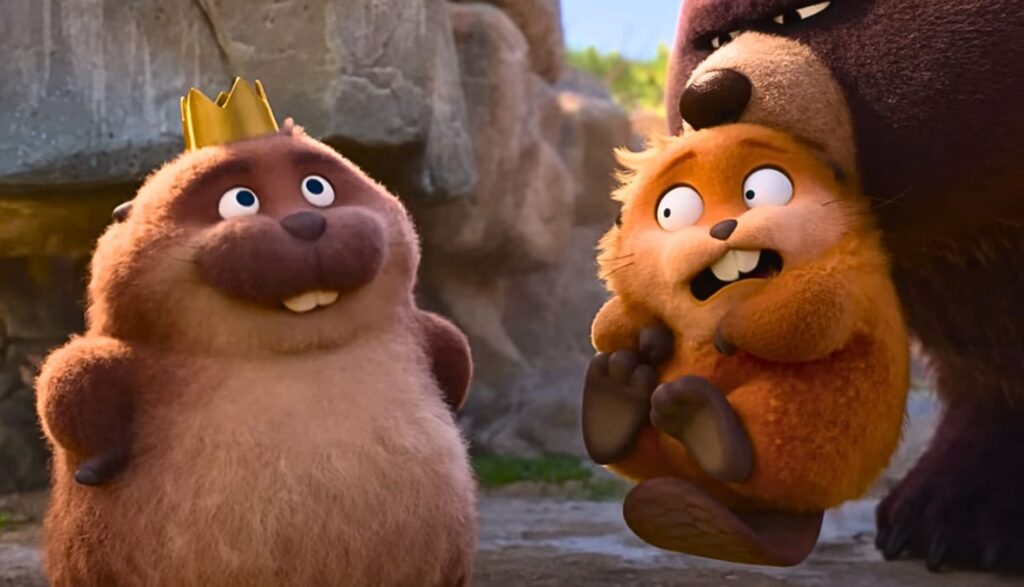
As a hopper—one that looks like a beaver—Mabel meets George, a real beaver who is (in this neck of the woods, anyway) king of the mammals. George is a persistent optimist. Although humans have been encroaching on animal territory for years, he doesn’t believe it’s malicious. Instead, he chooses to believe the best in everyone, always willing to forgive and always willing to give second chances. And he thinks that if the animals can simply find a way to communicate with the humans, then they can reach a compromise that benefits everyone. (George’s capacity to forgive provides two characters the opportunity to fix their mistakes and right some wrongs.)
We learn that when Mabel got older and her parents had to move away, Mabel moved in with her grandma in order to take care of her.
Several characters act sacrificially.
Mabel helps an elderly gentleman with several household chores, hoping that he’ll sign a petition to end the beltway construction. Due to a miscommunication, the man writes down his grocery list instead of his name, but Mabel doesn’t hold it against him. She even sends someone to deliver the groceries later on.
Animals are treated as sentient beings with intelligence on par with human understanding.
In one scene, animals gather around a beaver dam and begin to bow and chant together. At first, it seems like they’re worshipping King George, but it turns out he’s just leading them in morning calisthenics.
At one point, George mistakenly thinks that Mabel (in her beaver disguise) likes him romantically, and he tactfully turns her down even as she insists that he misread her intentions.
When a caterpillar forms a cocoon, the insect orders other animals to watch him “pupate,” but one animal covers the eyes of another, as though it were something inappropriate. Afterward, someone says, “That was gross.”
We see someone’s silhouette as he dances in the shower. Animals take Mayor Jerry’s clothes to use as a disguise, leaving him in a tank top and boxers. An animal that has “hopped” into a human robot rips open the bot’s shirt to reveal chest hair, asking why humans cover up their “plumage.”
Mabel causes some trouble in the animal kingdom when she stops a bear from eating a beaver. Although the animals all know each other, they also respect the fact that they all have to eat: It’s not personal, it’s just nature. Because of her interference—which makes things “awkward”—the bear doesn’t eat the beaver. But as the story continues, we do see a bird snatch up a worm mid-sentence (and we hear the worm screaming as it’s carried away).
Mabel’s human instincts cause even more problems when she tries to convince the leaders of the animal kingdoms (mammal, bird, fish, amphibian, reptile and insect) that they need to reclaim their territory by scaring Jerry and the other humans. Instead, the animals decide they need to “squish” the humans. Mabel tries to stop them, but she accidentally squashes (and kills) the insect queen, a butterfly who is flapping in her face. After that, the animals pursue Mabel and George, intent on exacting revenge.
One character does get eaten. Several other characters are nearly squashed or swallowed. A woman threatens somebody with a taser. Humans blow up an uninhabited beaver dam with dynamite. A car crashes, but its passengers survive. Birds lift a shark out of the ocean to eat someone (but their plan is foiled). Characters take several near-fatal tumbles.
Poisonous snakes and frogs manipulate human scientists with the threat of death. The scientists help the animals create a human hopper robot. That robot is controlled by an insect bent on killing all humans (and non-insect animals). It crawls creepily like a bug at one point. And the rubber mask that serves as its face is occasionally torn off, with eerie results.
Students pet, poke and prod their class pet, a turtle. It’s not malicious, but they pull on his legs and flip him over on his back, and he’s unable to turn his shell upright. A young Mabel, witnessing this, “rescues” him and her school’s other class pets, planning to set them loose. She’s ultimately caught, but not before she bites a teacher’s hand and pulls the school’s fire alarm.
Mabel’s grandma tells her that when she was 12, she punched a girl in the face. But she admits that was wrong, and she’s since learned to control her anger.
A forest fire threatens the city of Beaverton, but animal characters sacrifice their own home (a beaver dam) to douse the flames.
A bird caws, “Flap around and find out”—a euphemism for a much more profane idiom. We hear the word “gosh.” Someone tells Mabel (who’s in her beaver disguise) to get her “fuzzy little behind” back to the hopper lab.
None.
Mabel gets into multiple arguments with Beaverton’s mayor. She and Jerry yell at each other a lot. She’s even carried off by police at one point. Mabel claims that Jerry is illegally clearing a glade that serves as a home to many animals. And she turns out to be right.
Jerry, we learn, is indeed doing something shady (and probably illegal) to drive the animals away from the glade so that the state will clear him to build the beltway there.
Multiple animals try to imitate a high-frequency sound for Mabel (since humans can’t hear it), which is played for humor but rather obnoxious.
When Mabel is young, she tries to free all the class pets. She gets caught and yelled at by her teachers, and we learn this isn’t the first time she’s pulled this stunt.
The film gives the sense that humans are selfish and always prioritize their own needs and desires over those of other creatures. Mabel feels like she’s the only exception to that rule. And she’s tired of fighting for the animals on her own.
Ironically, Mabel herself can be self-serving. Her efforts to save the glade stem more from her desire to preserve her grandma’s memory (who passes away during the course of the film) than from a desire to protect the animals that live there. In fact, Mabel wasn’t initially aware that the animals had abandoned the glade.
Mabel barges into a college class to pester the professor with questions—and we learn that Mabel was actually supposed to be in that class but that she was skipping. Later on, she steals technology from that same professor and ignores warnings not to upset the natural order of the animal kingdom.
Some birds purposely defecate on a car window.
George tells Mabel his rousing family history, in which his dad banished him, tried to start a new family and was nearly usurped by George’s uncle before he finally begged George to return.
In Genesis 1, God commands humanity to “have dominion over the fish of the sea and over the birds of the heavens and over every living thing that moves on the earth.” But dominion doesn’t mean destruction. We are called to be stewards of the earth. But Pixar’s Hoppers reminds us that we often forget that calling.
Mabel is angry because she feels like she’s the only one who cares about the animals of Beaverton. I mean, is the uprooting of hundreds of animals really worth an extra four minutes off your commute? She’s tired of fighting this fight alone.
Of course, Mabel’s not alone: She’s just the only person going about it with signs and pickets.
Ultimately, Mabel figures that out. Bulldozing over people in order to stop actual bulldozers isn’t all that effective. Rather, she learns that talking to people about their differences—understanding where they’re coming from and trying to find a compromise that suits everyone—is far more effective than yelling at them.
That’s a nice message, as far as it goes. But to be honest, it’s not very well-delivered. It gets muddled in Hoppers’ outlandish plot—one where an insect decides that he’s just going to kill all the humans and non-insect animals and turn the world into a giant hive. And certainly parents will want to help their children walk through the environmental issues in Hoppers: Each family may define stewardship differently, and moms and dads will need to be mindful of how their own take on biblical stewardship may differ from the movie’s environmental messages.
And while the content concerns here are minimal, the comedy just isn’t that great—certainly not by usual Pixar standards. It relies far too heavily on obnoxious behaviors—ones that little kids are sure to mimic at home, much to the chagrin of their parents.
Families won’t have to look out for Hoppers, but they won’t really have to look forward to it, either.

Emily studied film and writing when she was in college. And when she isn’t being way too competitive while playing board games, she enjoys food, sleep, and geeking out with her husband indulging in their “nerdoms,” which is the collective fan cultures of everything they love, such as Star Wars, Star Trek, Stargate and Lord of the Rings.