



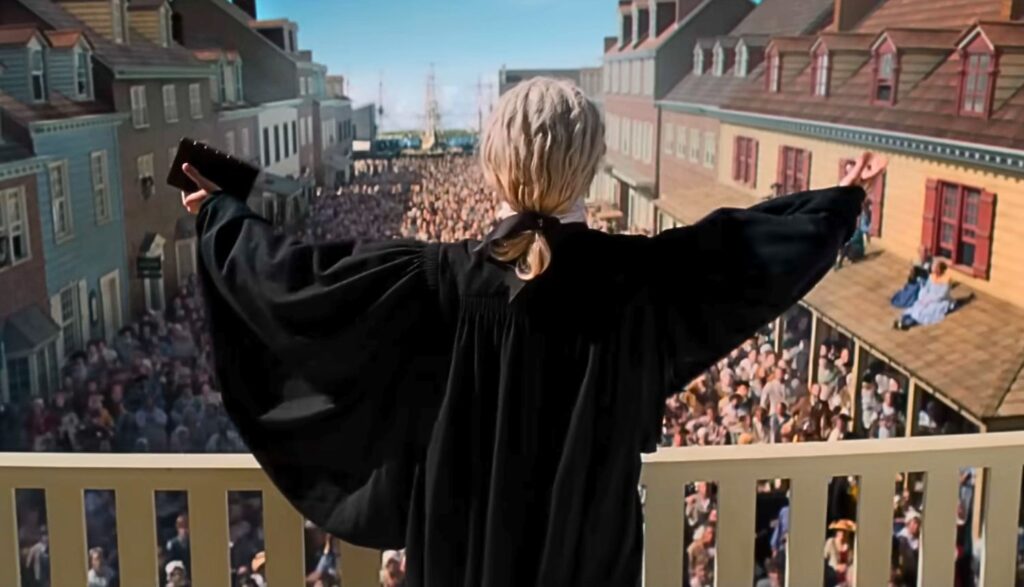
A Great Awakening tells the stories of both Benjamin Franklin and George Whitefield as they meet and become friends despite differing religious beliefs. The story masterfully brings Whitefield’s preaching to life, compelling the movie audience alongside the film’s characters to faith in Christ. A few moments of onscreen violence are the only consideration for parents with young kids.
“It was wonderful to see the Change soon made in the Manners of our Inhabitants; from being thoughtless or indifferent about Religion, it seem’d as if all the World were growing Religious; so that one could not walk thro’ the Town in an Evening without Hearing Psalms sung in different Families of every Street.”
So writes Benjamin Franklin about a strange new preacher visiting the American colonies from England, the Reverend George Whitefield.
No one has heard such a voice as his before. George’s voice carries over his audience with passion and zeal unheard of among Anglican preachers. Benjamin estimates the man’s voice could be heard by 30,000 people at once.
“Let us proclaim freedom to the captives,” George booms. “Whom the son sets free is free indeed! Arise, O sleeper, awaken!”
In 1739, Benjamin hears the man’s voice for the first time while working in his print shop in Philadelphia. He watches as the whole city becomes enraptured by the power behind George’s voice. When George finishes, the people burst into a spontaneous hymn.
But Benjamin does not join them. He is a deist, and there simply isn’t enough evidence for him to believe in Jesus Christ.
Still, he cannot deny that George’s words seem to be gripping the soon-to-be fledgling nation. And as a printer, Benjamin knows that gripping words make for the sale of plenty of papers.
“What did you make of Mr. Whitefield’s message today?” someone asks Benjamin.
“I plan to make a lot from it,” Benjamin quips.
And as Benjamin befriends George and prints his gospel message of liberty throughout the colonies, the people begin to stir. The colonists awaken—and not solely to the freedom offered by Christ but also to the idea of liberty from England.
After teaching a young George everything he knows, George’s mentor provides him with the ability to go to Oxford University to learn more. While there, a man named William Seward watches as his university fellows pick on George for his lazy eye and for coming to Oxford as a servitor (a lower-class student who receives free accommodation by acting as a servant to his fellow classmates). Despite being of a higher economic class, William sticks up for George, refusing to join in his humiliation. He later joins George in his preaching.
George’s position on slavery is complicated (something we’ll discuss in a later content section). But he does allow Black men and women to hear the Gospel, treating them as spiritual equals in salvation. He also condemns some of the American colonies for their cruelty toward their Black slaves. And on a similar note, George likewise preaches to people that many pastors have neglected, such as coal miners and the poor.
A Great Awakening does a fine job of showing rather than telling how men like George Whitefield influenced the American Revolution, even unintentionally. It demonstrates how these men helped to root the United States in Christian ideas and principles through their relationships with some of its non-religious founders, like Benjamin Franklin.
Implicit in the film is a tale of Christian unity. Despite George Whitefield holding an opposing view on Calvinism from friends Charles and John Wesley, the trio nevertheless work together in their common goal of preaching the gospel.
Benjamin warns his grandson about the power of the press, with its ability to soothe or stoke fears in the general public through misuse of how a headline is framed.
Despite not wanting to be a preacher, George is called into the service when Charles and John Wesley (who later founded Methodism) invite him to join their “Holy Club,” a Christian group at Oxford University. Charles and John tell George that, no matter their economic class, they are all equal in God’s eyes, and so they wash George’s feet. He joins them as the group ministers to some prisoners, and George is moved to compassion when he reads John 3 to them. George and one of the prisoners cry together over the call of Jesus to be born again as its truth grips their hearts, and George longs to know Jesus.
Still, George becomes obsessed with earning God’s love. Toward that end, he pushes himself into self-imposed asceticism, fasting for a month and praying incessantly, almost to the point of death. He’s rescued from this downward spiral by John, who tells him that Satan is deceiving him. John reminds George that God was “well pleased” with Jesus prior to any mighty work Jesus did.
“So why then was His Father so proud?” John presses. “Because He was His Son. Because He loved His child. Don’t you see? It’s not you, it’s Christ in you!”
George then repents of his striving and gets baptized.
We then see George preach many sermons. In one instance, he stands before coal miners, begging them to come out of the mines just like Jesus called to Lazarus in John 11. When a man tells George that his sins are too grievous for God to love him, George comforts the man, reassuring him of God’s abounding forgiveness. George baptizes many coal miners, and as he does so, the baptismal water runs black as the soot is washed from their bodies (which seems to symbolize the cleansing of their sins).
In another instance, a pastor with a droning voice speaks to a congregation just before George preaches. The pastor insults George, saying that he’s sorry to see George there, to which George retorts, “so is the devil.” After criticizing the lazy monotony of a church who “speaks of real things as if they were imaginary,” George gives a powerful sermon. He tells the congregation that neither their works nor their name in a church registry matter, for even the religious Nicodemus was told he must be born again (John 3). Instead, their names must be written in the Book of Life (Revelation 20:15).
George eventually visits the American colonies, where his reputation precedes him, causing a great crowd to gather in Philadelphia. He delivers a sermon to thousands who later burst into a spontaneous hymn. He spends most of his time traveling around the country preaching.
George is juxtaposed by his friend, Benjamin. Whenever George references Christianity in passing, Benjamin is quick to distance himself from such religious language. That’s because, as mentioned, Benjamin is a deist—one who believes in a God who created all things but no longer intervenes. And while Benjamin appreciates Christianity as a path for people to become more virtuous (even calling himself a “friend to all churches but a member of none”), he nevertheless denies the divinity of Christ and His salvation.
Benjamin instead devises a chart of 13 virtues to which he tries to hold himself, believing his good works will save him. George argues against Benjamin on this point.
George and Benjamin debate Christianity throughout their lives, culminating in a final confrontation by George to convince Benjamin of the beauty of the gospel. After asking Benjamin what he makes of Jesus, Benjamin states that he believes in a deity who has given humanity the right and resources to do good, “and he waits to see if we will.” But George reminds Benjamin that a simple belief that God exists is not enough, as “even the demons believe” in God.
“Everything comes down to what you make of Jesus Christ,” George pleads.
At one point, Benjamin confronts George on his support of slavery. Benjamin also places his aversion to Christianity on his Puritan father’s cold nature. In response, George pleads with Benjamin not to allow George’s flawed life or Benjamin’s cold religious upbringing to distract him from what God has done on the cross.
Later, Benjamin, inspired by George’s words, compels the Constitutional Convention to appeal to God in prayer, to ask God to guide their hand over the constitution—the character quotes the entirety of Benjamin Franklin’s real-life speech verbatim.
When George asks why church bells ring during a storm, Benjamin tells him that the people believe it will appease God so as to not strike their homes with lightning. And when George points out that such a belief cannot be found in Scripture, Benjamin laughs that the two finally agree upon something. Speaking of lightning, Benjamin calls it “fire from heaven,” and George compels him to consider Who the source of lightning is.
People sing the Charles Wesley hymn “Love Divine, All Loves Excelling.” In addition, a crowd sings an original hymn written for the movie titled “Awaken Us Today.”
The film also showcases how God builds people up in their skills to ultimately glorify Himself.
Prior to his calling to become a pastor, George jokes that pastors constantly call on God to help them. Likewise, Benjamin finds pastors to be “half-wits” and boring. Benjamin’s father tells him that he had wanted Benjamin to become a preacher—and as the man’s 10th child, Benjamin was meant to be his tithe to God.
Someone jokes that Benjamin’s Poor Richard’s Almanack is regarded by some as a lost book of the Bible. A man describes George’s voice like a “trumpet from heaven.” Another man, upset by George’s charismatic preaching style, claims that George must be using witchcraft to compel such a response to his sermons. While describing the horrific conditions at Valley Forge, George Washington calls it “our Gethsemane.”
We hear an impressive number of references to various Bible verses, including 1 Samuel 17; Psalm 139; Isaiah 60:1-3; Matthew 3:17; Luke 15:11-32; John 3, 8:36 and 11; Romans 2:4; Ephesians 5:14; James 1:17 and 2:14; and Revelation 3:5 and 3:16.
A man references Benjamin having an affair—we earlier see the woman placing her hand on Benjamin’s thigh as they watch a play. Benjamin boasts about inventing the first flexible catheter.
Not everyone appreciates George’s preaching. At one point, men throw stones at him, striking him in the face and leaving him bleeding and spitting blood—but he endures to finish his sermon.
An exhausted and sickly George collapses to the ground at one point. As a youth, George tries to earn God’s love through heavy fasting and prayer. He nearly perishes during a fast after refusing to eat for a month.
We are informed that someone was stoned offscreen by an angry mob and later died of his wounds. George Washington recounts the deadly circumstances of Valley Forge.
The only insulting word we hear is a use of “idjit.”
People drink wine.
George condemns the cruelty of Southern states against Black slaves, but the movie notes that George still used slave labor to run his Georgian orphanage—and Benjamin calls George out on this point. While George advocates for the spiritual equality of enslaved people and condemns harsh treatment of slaves, he does not support their physical emancipation.
“The irony, proclaiming liberty while standing on the backs of slaves,” Benjamin scoffs as he debates George’s support for slavery.
Benjamin attends a satirical play which makes fun of George for his preaching. Some cruel students mock George for his lazy eye. Someone jokes that America’s new paper money could be best used as toilet paper.
George dies offscreen.
Every so often, a movie comes along that, after watching, I immediately commit myself to buying once it comes out on DVD. A Great Awakening is one of those movies.
Now, I’ll admit that I’m a bit biased. I love Christian history and learning about the lives of the great men who came before us in preaching the faith. So a movie about George Whitefield is right up my alley.
But A Great Awakening is truly a great film, recounting the life and legacy of George Whitefield primarily through the reflections of friend and deist Benjamin Franklin. The movie weaves through Whitefield’s large impact on the American colonies.
“There was a revelation before the Revolution, and that was George Whitefield and the Great Awakening,” director Joshua Enck said in an interview. “My mind was blown when I learned that 85% of the colonists at that time didn’t just hear about George Whitefield, but they actually heard his voice. […] He was the most famous person in the Colonies.”
As far as I could note, the movie stays true to historical events as well as it can. I often paused the film to look up quotes or events to see if they occurred as they do in the movie, and I returned to the film satisfied.
What’s more, the movie occasionally points to some of Whitefield’s real-life flaws, including his time dealing with intense ascetism and his unfortunate support of slavery. While these moments are quick in the film, I nevertheless appreciate a biopic that does not try to hide such things to make the story more clean-cut than it truly is.
Paired with a stellar soundtrack (and a wonderful hymn written specifically for the film), A Great Awakening highlights an important figure in American history while also compelling audiences us to arise and awaken to the gospel of Jesus Christ.

Kennedy Unthank studied journalism at the University of Missouri. He knew he wanted to write for a living when he won a contest for “best fantasy story” while in the 4th grade. What he didn’t know at the time, however, was that he was the only person to submit a story. Regardless, the seed was planted. Kennedy collects and plays board games in his free time, and he loves to talk about biblical apologetics. He’s also an avid cook. He thinks the ending of Lost “wasn’t that bad.”