

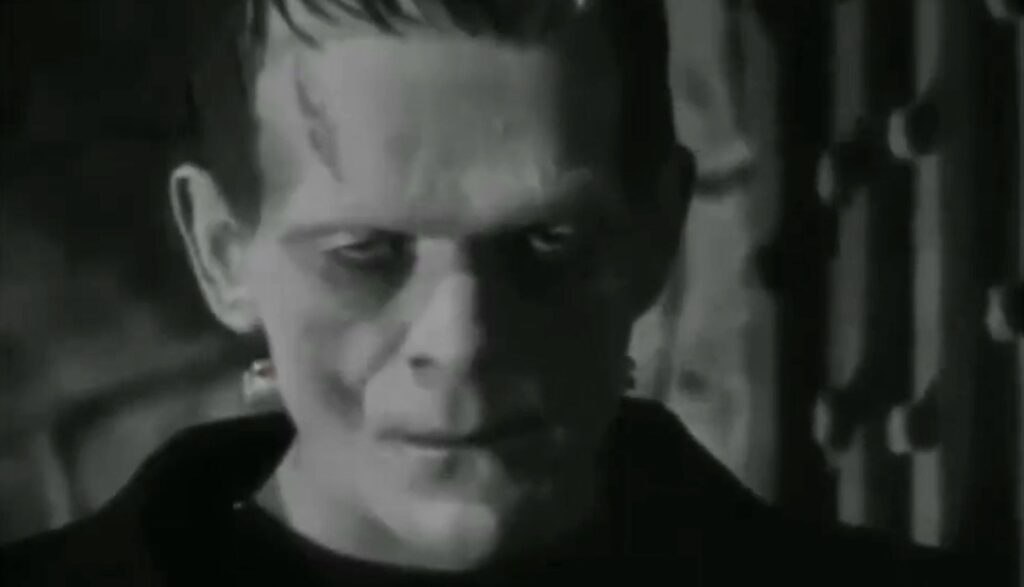
A brilliant man creates a living creature out of dead body parts, unleashing a monster on a small community. The classic 1931 version of Frankenstein raises compelling spiritual questions about creation and the hubris of man and science. There are creepy, raging monster moments here, along with instances of graverobbing, strangulation and the accidental murder of a young girl.
Henry Frankenstein is a brilliant scientist. In fact, this man is so intellectually advanced that he doesn’t believe the constraints of the science community should apply to him. Or the limits of the law, for that matter. In Henry’s perspective, laws and rules are nothing but digressive prattle.
Henry, you see, has discovered the key to reanimating dead flesh. However, Henry would argue that his work has very little to do with the “dead” at all: He has no desire to bring the deceased back to life.
Instead, Henry’s focus has been all about gathering the right parts—the best collection of flesh, muscle, organs and bones—into a construct of his own making. Then, after applying the right chemical processes and the correct amount of electrical stimulus, that construct can be injected with new life.
In a way, then, it doesn’t matter that Henry stole his fleshy building materials from morgues and labs or that he dug up fresh bits and pieces from graveyards. His efforts are for science and the future of mankind. His work will change the world!
Of course, his fiancé, Elizabeth, and friend Victor, aren’t convinced. They worry that Henry has isolated himself in an abandoned watchtower, spending his wealthy family’s fortune on a fevered lunacy. But Henry isn’t concerned.
How could they possibly understand? Henry is on the verge of grasping something that people have foolishly believed was solely the territory of the divine. But Henry’s work will prove that man has surpassed all that.
In fact, when Elizabeth, Victor and Henry’s former college professor, Dr. Waldman, show up at the tower’s door to “rescue” him from his folly, Henry decides to let them in, to witness his work in practice.
As lightning flashes and roars above them, tesla coils and other devices sparking and exploding with billions of joules of electrical power, the doubters cower in fear in the gloomy, stone-walled watchtower. And when Henry lowers the large surgical bed from the massive overhead skylight, the monstrous creation on it moves.
“It’s alive!”Henry cries out, over and over. Henry Frankenstein has revealed his terrible genius.
In doing so, he has created something terrible.
Elizabeth loves Henry with everything she has. And though Henry becomes consumed by his scientific discoveries, he appears to love her as well. Elizabeth repeatedly tries to save Henry from his own choices.
Interestingly, however, it’s the monster that may be the most positive (and destructively negative) thing in the movie.
Frankenstein’s creation is actually somewhat innocent when first “birthed.” We see it try to understand the world that it’s been thrust into, reaching with wonder toward the moon’s light. When the monster first encounters a little girl named Maria, it is as enthralled with the simple joy of tossing flowers into a lake as she is. And when it runs out of flowers and tosses the girl into the lake, we see its shock and horror when she doesn’t float as the flowers did.
(It should be noted that this creature is tormented, whipped and driven to animalistic acts of deadly destruction. It kills repeatedly. Which isn’t positive in the least.)
The film delivers the very constructive encouragement that we should collectively take time to consider our actions, especially in a world filled with scientific advances and powerful opportunities.
Frankenstein presents a prologue warning about the fact that the film explores the “two great mysteries of creation: life and death.” It declares that the tale depicts, “A man of science who sought to create a man after his own image … without reckoning upon God.”
While that preamble may have been designed to intrigue its audience, the film’s director very much wanted to explore that theme throughout his creation. Questions are repeatedly raised in the dialogue about mankind trying to foolishly usurp the power of God.
For instance, when Dr. Waldman sees what Henry has created, he gasps, “In the name of God, Henry.” And Henry barks back, “In the name of God? Now I know what it feels like to be God!” And we see that haughty declaration play out in deadly ways, including the death of Dr. Waldman.
Before her wedding to Henry, Elizabeth worries over a premonition of impending trouble.
Henry and Elizabeth kiss. Henry’s father, Baron Frankenstein, believes that Henry’s absence may be due to “another woman” rather than Henry’s scientific experiments. And it’s clear that Victor desires a closer relationship with Elizabeth as well, though she shunts his advances aside.
Other than those few instances, there are no other sexual elements seen onscreen. However, there is an implication that might lean in a sexual direction. We see the hounded and now animalistic monster crawl in through the window of Elizabeth’s locked bedroom. It creeps up behind the pretty woman and scoops her up into its arms. She screams. The camera cuts away. When rescuers then break into the locked room, the monster is gone, but Elizabeth is sprawled out unconscious (still clothed) on her bed.
Early on, after the monster’s creation, we see instances where Fritz, Henry’s servant/assistant, torments the creature with a whip and a torch. (It’s implied that Fritz has been harassing and beating the chained creature behind Henry’s back.) Later, Fritz’s screams ring out in the tower, and Henry rushes in to find Fritz hanging by the neck and the large creature standing near.
Dr. Waldman drives a large hypodermic needle into the monster’s back, believing the needle’s chemical contents will kill it. (They don’t.)
We see the creature strangle a man to death and accidentally drown a young girl. (The girl’s father carries her muddy corpse into town.) We see scores of men hunting the creature at night with torches, weapons and howling dogs. Pursuers discover dead or staggered individuals who fell under the creature’s attack. The monster batters a man and drags his unconscious form into a windmill. It throws the man off the windmill’s upper floors. And the windmill is set aflame by an angry mob of townspeople. A large wooden cross beam falls on the screaming creature’s back, trapping it in that growing blaze.
There’s an exclamation of “God” in the dialogue. And someone notes that Elizabeth is a “darn” pretty woman.
During Henry and Elizabeth’s wedding celebrations, people drink wine, champagne and brandy, raising toasts to the Frankenstein family. Baron Frankenstein talks of giving the townspeople lots of beer to celebrate with. “It’s extraordinary how friendly you can make a lot of people with a couple bottles of beer,” the Baron states.
A man lights up a pipe and puffs it. Henry smokes a cigarette. Others in a large crowd of celebrators smoke as well.
Several different people express their opinion that Henry is insane or crazy.
We often think of the original Frankenstein as an old black-and-white monster movie that kids giggle over and use for Halloween fodder. But in truth, back when this Universal “horror” film was first released, it was a massive hit that earned millions of dollars at the box office. All during the Great Depression, no less. And the film was also quite groundbreaking, reportedly causing some shocked moviegoers of the day to run out of theaters or faint on the spot.
Interesting enough, the role of Frankenstein’s monster was originally offered to Bella Lugosi, of Dracula fame. But after testing for the role, Lugosi turned it down because it had no dialogue, and he felt it was beneath him. So the part was given to the relatively unknown Boris Karloff (who’s not even listed in the film’s credits), and he became an overnight megastar and a household name because of it.
All of those footnotes aside, though, Frankenstein—based on the classic novel by Mary Shelley—is an incredible film that’s thought-provoking and spiritually compelling.
In fact, back in 1931, some believed the film to be nothing short of blasphemous. When the pieced-together monster at the core of the story is given life by Henry Frankenstein and the scientist madly declares, “Now I know what it feels like to be God,” some viewers were earnestly outraged. Universal Studios was actually forced to mask that line with a crash of thunder in some prints of the film so it wouldn’t be heard.
However, if viewers take the time to think their way through this movie, they’ll find that it actually raises compelling questions that contrast the loving nature of divine creation with the heartless utility of science. Henry Frankenstein has the genius and power to create, but he ultimately loathes his broken creation.
The Frankenstein “monster” then becomes as much of a victim as it is a villain: It’s a broken and tormented soul that’s shown no grace, no love or acceptance. And the whole deadly disaster of this film is caused by Henry Frankenstein’s own human hubris. In fact, director James Whale originally wanted Henry Frankenstein to pay the ultimate price for that arrogance, but the studio forced him to opt for a “happier” ending.
All of that said, however, family viewers with little ones should be aware of the seriousness and, yes, even creepiness that Karloff brings to his wordless, tormented character. This black-and-white pic can feel dark and deadly. (The scene featuring a shattered father carrying his murdered daughter into town can be very unsettling for young eyes.)
For those who don’t fear monstery nightmares, though, you can watch this film knowing that 1931’s Frankenstein is far more than Halloween fodder. It walks a ruminative line that many of today’s films rarely even attempt.

After spending more than two decades touring, directing, writing and producing for Christian theater and radio (most recently for Adventures in Odyssey, which he still contributes to), Bob joined the Plugged In staff to help us focus more heavily on video games. He is also one of our primary movie reviewers.