

A young man longs to know his worth and seeks his father’s love and approval. He then lashes out when his father shuns him aside. East of Eden carries good messages about honestly showing love and acceptance. But, without being graphic, the film also deals with prostitution, drunkenness and acts of violence.
Cal Trask is bad!At least, that’s how he sees himself.
The truth is, he’s not really a deplorable person. But he always seems to get the dirty end of the stick, while his brother Aron ends up smelling like roses. And that makes Cal flare up in angsty, rebellious ways.
Adam Trask generally speaks sternly to his son Cal while praising the better son, Aron. Whenever Cal steps a bit out of line, his father heaps punishments upon him and forces him to read an applicable line of scripture at the dinner table. Aron simply stands by and looks good in contrast.
Surely that means that Cal is the bad brother.
The certainty of all that is driven home one day when Cal accidentally learns the truth about his mother. Father had told the boys that she was dead, but the truth is, she rebelled and ran off. In fact, she lives just 40 miles away, only a quick train hop from the Trask ranch.
Cal treks over to Salinas to find her. He sees the brothel/bar that she owns. He witnesses her choices. And he recognized her “badness,” the same stuff that surely mars him. Father must have recognized it, too.
However, Cal is convinced that he can change. He can be good. He’ll work to support his father’s business ventures. He’ll plot out new ways to reach for success. But again, every effort Cal makes falls short. Every miscalculation, every foolish choice, is discovered: Righteous sunshine spotlights Cal’s failings.
And in contrast, Aron does nothing and appears golden. Aron gets the praiseworthy attention. Aron gets the arm of the town’s sweetest and prettiest girl, Abra.
Cal gets to read another shaming Bible verse at dinner.
If you think this will eventually lead to some sort of calamitous clash, you’re right. After all, it is the time for it. It’s 1917, and a world war is brewing. People are dying; families are being torn apart. And an unbearable, boiling pressure is building in a “bad” young man named Cal Trask.
War, it seems, is inevitable.
Cal certainly tries to work hard and earn his father’s love. He makes foolish choices along the way, and he flairs up in vengeful and violent ways—which, of course, is not positive—but he repeatedly tries to do something good. And in the end, Cal is willing to give of himself out of gratitude for one small sign of acceptance from his father.
Adam can, on the other hand, appear to be a stern and hard man—a man who stands harshly behind his “biblical” principals. We come to understand that he, too, is trying to guide his son in a positive direction. And we see him eventually accept the truth of his own failings and indicate his love to his son.
We also see that Adam is a man who wants to do something positive on a macro scale. During a special business venture, he states that he doesn’t care if it makes a profit: “If I could only do something before I die,” Adam declares, “some little thing for progress, for people … I might make up for all the years that I’ve been laying fallow.”
In truth, though, Aron’s girlfriend/fiancé, Abra, is the most positive source of wisdom in the film. She recognizes Cal’s attraction to her (and her attraction to him) but she repeatedly strives to stay true to her commitments. And she repeatedly attempts to guide all of the Trask men to be aware of the pain that they are causing each other. Abra pleads for them to be wise and make peace, and show their love for one another. “It’s awful not to be loved,” Abra tearfully tells Adam. (That’s not to suggest that Abra is perfect in all her choices, but she is the most identifiably consistent.)
Adam forces Cal to read passages from Psalm 32. He compels his son to acknowledge his sin and be grateful for God’s forgiveness. And it’s evident that Adam’s efforts are doing nothing but publicly shaming his son and pushing him further away from God’s grace.
Later, after Cal’s violent (but seemingly not deadly) clash with his brother, the local sheriff loosely quotes Genesis 4, saying, “Cain rose up against his brother Able and slew him. And Cain went away and dwelt in the land of Nod on the east of Eden.” He then tells the young man, “Now, why don’t you go away someplace.”
It’s clear to see that the movie’s script purposely weaves some parallels to the biblical story of Cain and Abel into its fabric—though that biblical imagery is far from perfect. Abra states that she had an insurmountable quarrel with her father, and she got past her anger with something of a biblical principal: “And the minute I forgave him in my mind, I felt better,” Abra declares.
Abra is tugged and pulled in her physical and emotional attraction for both Trask brothers. She and Aron kiss and hug each other, and she verbally declares her desire for them to marry. But later, Cal kisses her, and she can’t help but be drawn to him as well, though she pushes him back. “I love Aron. Really, I do,” Abra says. She eventually expresses her love for both men.
A young soldier attempts to aggressively pick up Abra at a county fair before Cal steps in and turns the guy away. Abra then talks about all the girls Cal tends to hang around with, implying that his relationships are casually intimate. Cal affirms that he has no committed connections. That leads into a discussion about Aron’s feelings for Abra. She’s afraid that Aron loves an image of her, not her:
“Aron never having a mother, well, he made her everything good that he can think of. And that’s what he thinks I am. And that’s what he’s in love with. It’s not me at all. I’m not a bit like that,” Abra proclaims.
Cal talks to a man who’s showering. We see the naked man from the waist up. Cal’s mother, Kate, runs a brothel. (But we never see any sexual contact or intimacy of any sort.) A prostitute calls out suggestively to Cal. Kate has a small, undefined statue of a naked woman on her desk.
We hear that Cal’s mom, Kate, shot Adam when she left him. “He thought he had me all tied up with his purity,” Kate tells her son. And she expresses that she sees her own raging desire to be free in Cal.
As reports of deaths and government notices of deceased soldiers come back to the town, people begin to harass their German-descendant neighbors. Men throw rocks through a man’s shop windows. Another group drunkenly begins to push and shove the same man later that night. Fights break out and a crowd begins to rip up the man’s fence in front of his house. The sheriff shuts down the violence.
Aron angrily argues with Cal over Cal’s relationship with Abra. The two begin to struggle, and it turns into a fist fight—Aron receiving the worst of the punches. Then Aron leaves to get staggeringly drunk, and we later hear he got into a public brawl. While inebriated, Aron smashes his head through the window of a train car. His forehead bleeds and jagged glass sits just below his neck.
There are one or two uses of the words “blasted” and “d–n” in the dialogue.
Cal drinks alcohol on several occasions, one time, guzzling booze in an attempt to get drunk. We see several men drinking in a bar and at least one staggeringly drunken individual. Several drunken people cause public fights. A young girl, serving drinks in a bar, sips from the leftover dregs in glasses she’s collected. The local sheriff gives a bottle of booze to a drunken man in a jail cell in an effort to shut him up. People drink champagne at a birthday celebration.
People smoke in a bar. The sheriff smokes cigars. And several others take puffs of cigarettes in various scenes, including Cal.
Cal lies and steals throughout the film. His choices aren’t always negative, by any means, but he doesn’t shy away from rebelliously breaking his father’s rules or bending the law. Cal also develops a contorted relationship with his mother. He declares that he hates her, but he is drawn to her. And her feelings for him are much the same. She tries to push him away, even through a heavy-handed attendant, but she can’t help feeling some form of connection with her son.
Aron always appears to be the golden child because he doesn’t disobey. But actually, he doesn’t do anything. And he’s revealed to be an empty vessel that crumbles with pressure.
Adam has an incapacitating stroke. A doctor fears that it could lead to his death. The man lays paralyzed in bed.
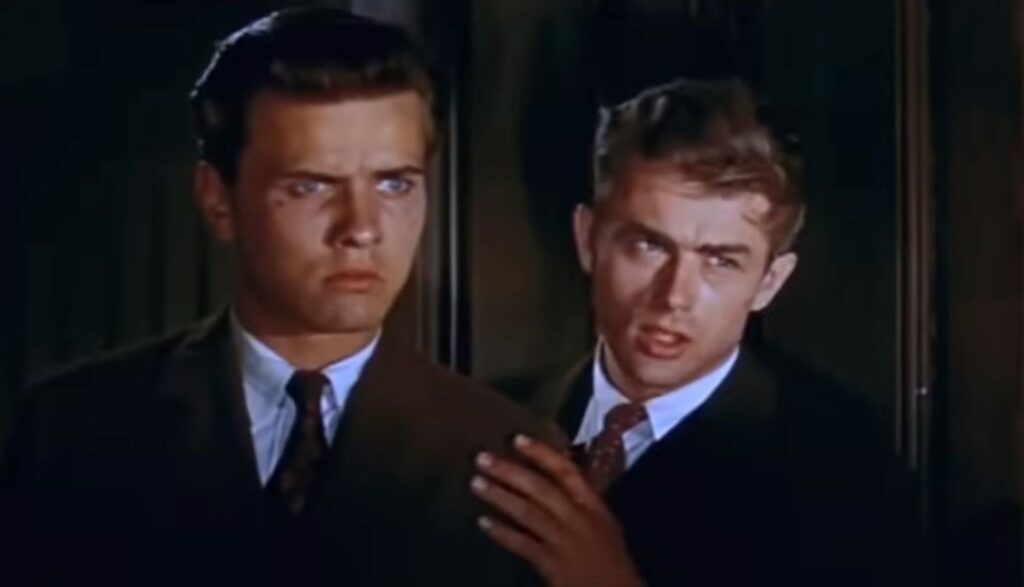
When East of Eden hit the silver screen in 1955, it was a pretty controversial film—loved by some, loathed by others. And much of that had to do with James Dean’s raw and emotional portrayal of rebel boy Cal Trask.
Frankly, Dean’s characterization was shockingly different from what most people had seen before at the movies. Leaning into the new “Method” acting technique of the day—an acting approach that relies on psychological realism, personal memories and physical sensations—Dean slouches, fidgets and restlessly emotes his way through the movie.
Many weren’t that keen on the approach, including his costars. Even today, James Dean’s choices feel a bit overwrought. But in 1955, it was daring. It flew in the face of traditional movie acting.
However, young viewers across the country connected intensely with this new, handsome actor’s portrayal: Dean’s brooding posture and palpable disaffection felt incredibly authentic to them. This breakthrough performance made him a movie star of the first magnitude.
(Dean died soon after the movie’s release. This was the only of his three starring films released while he was still alive. Rebel Without a Cause and Giant followed posthumously, as did Dean’s Academy Award nominations.)
On the other hand, there were others who growled a bit about director Elia Kazan’s choices with the John Steinbeck novel-based film. Those critics declared that the tale was explicitly framed around the biblical story of Cain and Abel. And in that light, people then interpreted Raymond Massey’s portrayal of Adam Trask to be an overly stern and iron-fisted God figure. And they saw the rebellious Cal seemingly being praised by the film for his defiance.
However, in my opinion, that perspective is too narrow. Yes, you can see some biblical parallels here, but rather than being a story of rebellion and punishment, East of Eden (the film, at least) is more accurately a tale of redemption and acceptance. In its conclusion, Adam Trask is finally able to see his own failings, and Cal is able to feel the acceptance—the truth of his value—that he’s so long sought. The movie ends with a thoughtful encouragement about the love that should be expressed between fathers and sons.
That doesn’t, of course, mean that this is a film that the whole family can enjoy. There are heavy story elements here involving infidelity, betrayal, prostitution, angry rebellion, drunkenness, bloody violence and the deadliness of war.
That content isn’t splashed up on the screen like it might be in 2026, but it still requires thoughtful navigation.

After spending more than two decades touring, directing, writing and producing for Christian theater and radio (most recently for Adventures in Odyssey, which he still contributes to), Bob joined the Plugged In staff to help us focus more heavily on video games. He is also one of our primary movie reviewers.