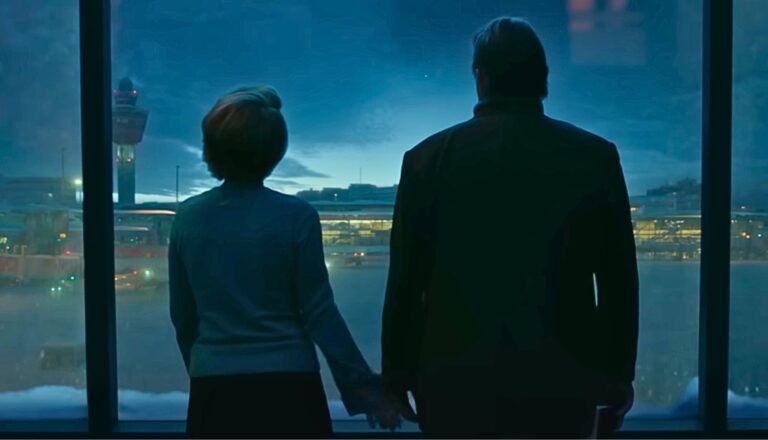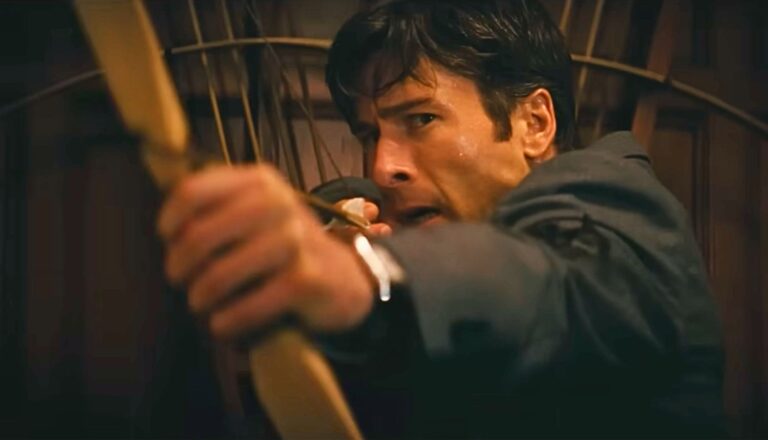



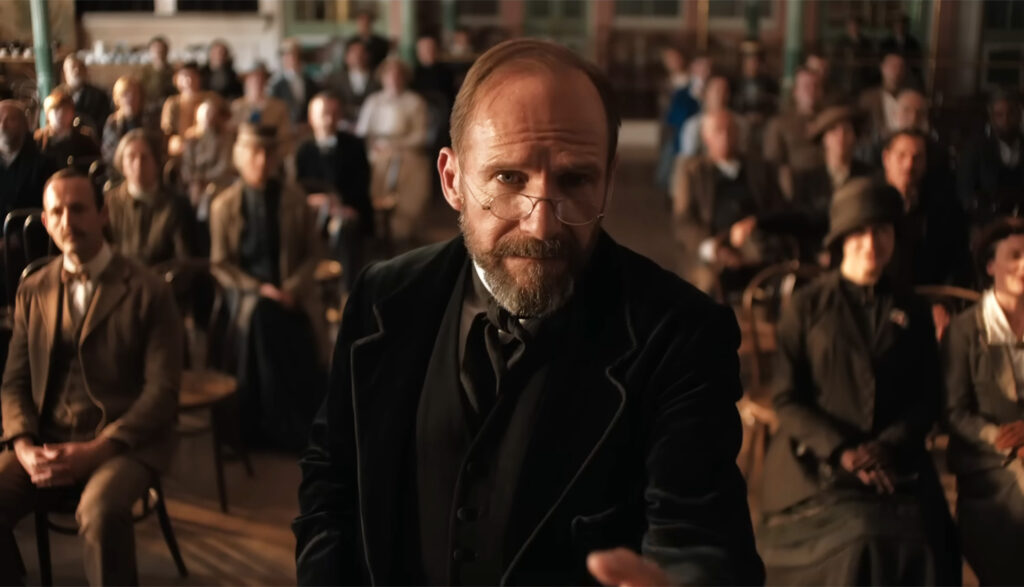
When war takes away many of the young men of Ramsden, Dr. Henry Guthrie is called in to replace the enlisting chorus master. But this struggling community is in need of more than music. The Choral proclaims that everyone requires art and beauty to bear up under “worldly cares.” Unfortunately, it leans too heavily on worldly lows—sensuality and foul language—and too little on the uplifting potential of this story.
By 1916, the Great War has already been raging for two years. Though British leaders promise that war will end any day now, the country’s young men keep gearing up and riding out by the trainful. And more and more official telegrams and sad letters of condolences return in the young citizens’ stead.
It’s gotten so dire, in fact, that Alderman Duxbury of the little village Ramsden is in something of a bind. Ramsden has always had a yearly choral society function: It’s a must. The community depends on it. But this year there are difficult decisions to be made. The chorus master has decided to enlist, and Duxbury has few people he can choose from to lead the choral.
He must appoint Dr. Henry Guthrie.
It’s not that Guthrie isn’t good; he’s actually quite excellent. But he has a, uh, few problems. For one, the man speaks far too kindly about German culture and music. He was only recently forced to return from there. For another, Guthrie has certain sexual leanings that shall not be discussed. It’s not that Guthrie would ever bring up the subject himself, but people do talk.
It seems, however, that Duxbury has no choice.
Of course, there’s also the question of what to perform this year with the choral society’s waning numbers. Can they even stage the traditional choice of Bach’s “St. Matthew Passion” with the few elderly men available and a handful of tinny altos? For that matter, should a German composer even be considered?
It’s Guthrie who proposes a solution: They’ll perform an oratorio from a less polarizing composer. Instead of simply relying on the typical churchgoing singers, they’ll open their doors to pubgoers. And they’ll welcome in the returning wounded: the young men missing limbs and eyes but who still love lifting their voices to classic strains.
In fact, there’s one such armless and limping tenor, Clyde, who helps connect this year’s oratorio with the reality of the ravaged world they all live in.
The piece they are to perform—”The Dream of Gerontius” by Edward Elgar—depicts a pious man’s soul as it journeys from death through judgment to Purgatory. And while the town’s vicar balks at the idea of Purgatory, since the Bible never mentions it, Clyde says that it does indeed exist in the land of war. It’s a place the soldier’s call “No Man’s Land,” the area between opposing armies and trench lines. A place of horror and death.
And just like that, “The Dream of Gerontius” takes on new meaning, new purpose. They all feel it—the young, the old, the broken, the bereaved. The choral will have something to say that has long gone unsaid.
Even Alderman Duxbury has to admit that 1916’s choral society presentation will be like none other.
Guthrie recognizes the need for art and beauty in a struggling world filled with war and destruction, and he makes that clear in his talks with the choir. That’s also a big part of why he forces Alderman Duxbury to reach beyond the typical ranks of singers, going to pubs and convalescent centers for new recruits.
Guthrie is a self-proclaimed atheist. In fact, even though Ramsden is considered a “Christian” community, there are very few characters who actually profess true faith.
Mary is the exception to that general secular perspective. She is a member of the Salvation Army, wears her uniform and bonnet wherever she goes and proclaims her faith. And when her beau presses her for sex, she declines.
That’s not to suggest that Mary’s faith is always on the mark, though. “I’ve asked God. And if I don’t do this, then you’ll be saved,” she tells her young suitor. “If I do this for God, He’ll do this for me,” Mary falsely reasons.
The guy retorts, “Nay, Mary. If God’s like that, you’d be better off without Him.”
Mary’s mom seems to agree with the handsome young man: “I don’t mind Jesus,” the woman tells the boyfriend. “But not while we’re having our tea. Jesus is just a phase. I never fancied Him as a son-in-law.”
As already mentioned, the Ramsden’s vicar protests the performance of a song about Purgatory, since the Bible never mentions it.
There’s a surprising amount of sensual thought in this tale. It seems that all the young men who haven’t yet been drafted (and many of the young women, too) are thinking and talking about the sexual relations they want to procure before heading off to war. One guy tells his friend—who’s a postman—that he could easily get sex from the grieving young women to whom he delivers official government telegrams.
Mary’s suitor disrobes before her (his bare backside to the camera) even though she’s told him she won’t have sex with him. We see several teens remove all but their underwear and jump into a pond together. A young soldier who returns home missing an arm makes overtures toward his former girlfriend, grabbing her leg and hoping she’s still the same “dirty girl” he knew. She rebuffs him. But later he talks her into a sexual act with him (just off-camera) for old times’ sake.
Several teen boys talk about a local married woman, Mrs. Bishop, engaging in prostitution. Indeed, we see the woman welcoming men from various walks of life—including Alderman Duxbury—into her boudoir. Before shipping out, one young teen approaches Mrs. Bishop. Though she notes that he’s a bit young, she lets him undress (down to his undershorts), and we see her embrace him while dressed in a sheer nightgown. Afterward, she tells him it was on the house.
We see Guthrie gazing at a photo of a former male lover (the two of them standing side by side with arms around each other’s shoulders). But that’s the only indication of his sexual preferences other than other people’s conversations. Guthrie’s hired pianist, Robert, openly professes being gay. And when Robert learns that Guthrie’s “friend” was killed in battle, he approaches him and offers to “help” him. “I know you can’t replace one friend with another …” Robert begins. But Guthrie walks away without answering.
At the movie’s start, two teens help some hunters shooting pheasants for the war effort. One of them naively states that “this can’t be any worse than the trenches.” Later, though, we see scores of wounded soldiers returning from those trenches.
The young survivors are torn and bandaged, some missing limbs or eyes, others covered head to toe in bandages. One of those returning soldiers delivers an impassioned speech about war and its toll. “Some drown in it. Some try and crawl out and get driven back by their officers,” the young soldier declares. “And they get shot if they don’t.”
Someone throws a large rock through a church window.
Six f-words and three s-words litter the movie’s dialogue along with one or two uses of the word “d–n.” The British crudity “bloody” makes a couple of appearances.
We see a large group of men drinking at a pub.
Several young women receive painful notifications of their loved ones’ deaths. Some quietly weep, others crumble to the ground. One woman quietly kisses the forehead of the teen delivering the message.
Early on in this film, Guthrie is asked why he, a British citizen, stayed in Germany as the first world war began to unfold. He explains that it was because the German culture tended to put music, beauty and art at the center of everything. He goes on to illustrate his reasoning with a quote from Johann Wolfgang von Goethe:
“A man should hear a little music, read a little poetry, and see a fine picture every day of his life in order that worldly cares may not obliterate the sense of the beautiful which God has implanted in the human soul.”
That’s the theme that this history-based tale explores. As the small British community wrestles with the losses and miseries of war, they rely on ageless music and heartfelt song to help them through.
That could have made for a lovely and uplifting film in other hands. But instead of exploring things of God and beauty, the filmmakers lean in much more secular directions. They spend too much time probing the sensual and salacious failings of mankind and not nearly enough exploring the godly beauty referenced in that von Goethe quote.
That doesn’t make this a bad film, it simply makes it a less satisfying one. The Choral doesn’t quite live up to the story and the talent potential it presents on-screen. And it leaves viewers with some unnecessarily crude language and visuals that would have been better left on the editing room floor.

After spending more than two decades touring, directing, writing and producing for Christian theater and radio (most recently for Adventures in Odyssey, which he still contributes to), Bob joined the Plugged In staff to help us focus more heavily on video games. He is also one of our primary movie reviewers.