


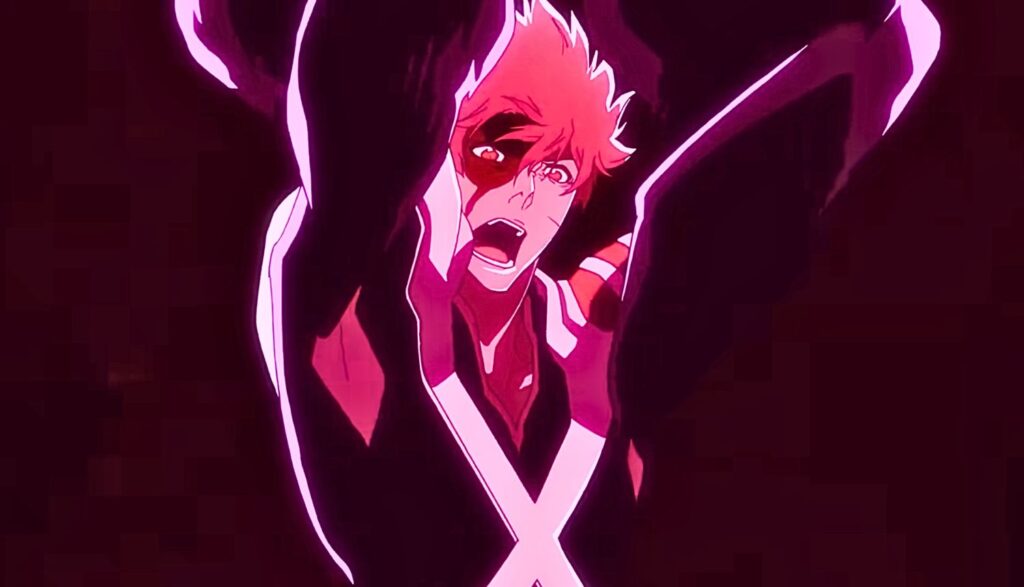

BLEACH: Thousand-Year Blood War – The Calamity showcases the beginning of the end for the main BLEACH storyline. This movie, which strings three episodes of the show together to release early, showcases plenty of fighting, spiritual attacks and several over-sexualized female characters. Though none of that will shock anyone who has kept up with the show.
Do you like your movie-plot stakes high?
If you answered “yes,” well, welcome to BLEACH.
The show has been running for some time now, but Thousand-Year Blood War – The Calamity is the beginning of the end. We don’t have time to explain everything, but here’s what you need to know:
The conflict of this story arc centers around the Soul Reapers and the Quincies. The Soul Reapers are spiritual beings who defeat Hollows (lost souls that have turned wicked). When a Soul Reaper defeats a Hollow, the Hollow is cleansed of its sins and purified, returning to its former state as a regular human being. But when Quincies, who are spiritually aware humans, defeat a Hollow, it is destroyed forever.
The Soul Reapers are fundamentally against the Quincies since destroying a soul threatens the structure of the universe itself (long story). The Quincies likewise hate the Soul Reapers since, long ago, the Soul Reapers killed most of the Quincies in order to protect the universe.
This all leads to the events of this movie, wherein the Quincies—led by their progenitor, Yhwach—defeat the Soul King, the creator and sustainer of the BLEACH universe. In so doing, Yhwach obtains the Soul King’s near-omnipotent power. Yhwach plans to destroy the world and make a new one, so the Soul Reapers and their allies are trying to stop this from happening.
The stakes are about as high as they get. Many Soul Reapers could die. But then, if Yhwach and the Quincies are going to blow up the universe anyway, you might as well risk dying in battle to try and stop it, right?
Characters risk their lives to save the world from being destroyed. Some opt to give up the glory of fighting the main baddie to defend the main character so he can do so.
Characters have unique spiritual powers they employ in battle, including foresight and spiritual weapons. One person’s special ability is called “The Almighty,” which allows them to see all potential futures and choose the one they want.
Many characters have something called “Spiritual Pressure,” which is a sort of raw energy their souls emit—like the aura version of body heat. Some of these characters have vastly more Spiritual Pressure, causing others to struggle to simply move in the presence of these people.
Many of the women in the show are objectified, drawn with exaggerated breasts and wearing form-fitting outfits. One character wears a one-piece swimsuit-like bodysuit into battle, and the animation often ogles her rear, sneaking intimate angles. A man stares at her rear and smacks it with his hand, much to her discomfort.
Another woman wears an outfit that reveals cleavage. A man battles shirtless and has exaggerated ab muscles. A man says he is “interested in His Majesty,” but he clarifies that it’s “not like that,” stating he just wants to see what kind of new world the man could make.
We see a man who was sliced in half, his top half sliding away. We also see another man dying as a large hole is created clean through his body. A man dies when someone rips out his heart with their bare hand. A man loses an arm. Someone else watches in horror as the skin on his arm tears open and then sews itself shut again—the attacker does similar things to his own body. A man buries a magical ring inside another man’s eyeball, doing severe damage and blinding the man.
Characters are thrown through buildings and endure severe slashes, often bleeding heavily through each fight. Some people succumb to poisoning.
We hear a handful of instances of “d–n,” “h—,” “p-ss” and “b–tard.”
None.
A woman accuses a man of wetting himself in fear.
Anime shows have found this nice little niche in the movie market, wherein they release a few episodes of their newest season in theaters and make millions of dollars—despite the fact that it’ll all show up on streaming sites a month or so later anyway.
I’ve no beef with that. Truly, if a fan wants to pay a little extra to watch the episodes as soon as possible, more power to them. But it does make my conclusions on these types of episodes-formatted-as-movies read mostly the same way. They go something like “[Insert Abnormally Long Title] contains blood-soaked violence, some sexual scenes, a couple crudities and half-baked spirituality, but anyone who has been following the series thus far will already expect that going in.”
And indeed, I use that format again: BLEACH: Thousand-Year Blood War – The Calamity contains all of those elements, and, as I’ve stated in our other reviews of anime films based on TV series, none of this will come as a surprise to any fan who’s kept up with BLEACH.
For those who haven’t kept up with the series, there’s no reason to watch this: You’d be missing 406 episodes’ worth of context.
Kennedy Unthank studied journalism at the University of Missouri. He knew he wanted to write for a living when he won a contest for “best fantasy story” while in the 4th grade. What he didn’t know at the time, however, was that he was the only person to submit a story. Regardless, the seed was planted. Kennedy collects and plays board games in his free time, and he loves to talk about biblical apologetics. He’s also an avid cook. He thinks the ending of Lost “wasn’t that bad.”