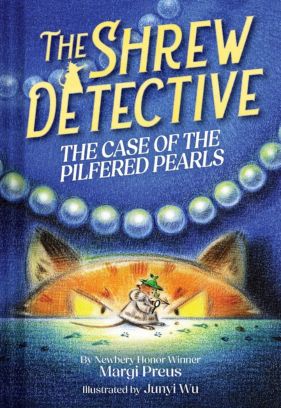
Minerva Shrew must put everything she has—every observational skill, every investigatory discipline and every bit of deductive reasoning—into finding a human’s lost pearls. Otherwise, in a matter of hours, a whole houseful of critters will suffer.


Minerva Shrew is more than happy to spend the lion’s share of her day comfortably seated in her little den beneath the tangled roots of a very large tree.
For one thing, being here keeps her close to her kitchen and its food supply. After all, a pygmy shrew needs to eat frequently—generally eight breakfasts, eight lunches and eight dinners. Minerva also enjoys the coziness of her little den. It’s made from bits and pieces of scrap from the human world. She’s even found old pages of a human dictionary with which to paper her walls. And that’s helped her develop an expansive (extensive or wide-ranging) vocabulary.
The main reason that Minerva loves being tucked away in her little den, though, is because it’s safe and sound, far away from the human world. Humans are constantly involved in some form of mayhem (violent or damaging disorder).
However, this morning—while breakfasting on a cup of pine-needle tea and a piece of toast spread with larvae pâté—Minerva’s peace gets shattered. Her cousin Tenacity shows up out of nowhere, yelling out a frightened squeak. “Mayhem,” Tenacity cries. “And murder!”
This shocking interruption to the morning causes Minerva to jump a full inch into the air—her entire body length. And after a few minutes Minerva finally gets Tenacity to calm down enough to let her know exactly what’s going on.
It seems that something horrible is happening in the nearby human house. A string of pearls has gone missing. And the human owner is convinced that a rodent in the house is to blame. She’s threatening to call in a fumigator (one who kills pests by treatment with poisonous gas). And that could be deadly for the mice, chipmunks, squirrels and other critters nestled within that big old house’s walls, attic and foundation.
It looks like it will be up to Minerva to apply her well-honed detective skills to the problem. If anyone can solve the mystery of the pilfered pearls, it’s her. I mean the sign she hung up in front of her den says it all: “The Shrew Detective: Solving the Big Mysteries of Life and the Universe.”
So Minerva quickly scurries about collecting supplies. She’ll need her hat, her cloak, her spectacles and, of course, several pocketsful of snacks.
I mean, it’s nearly time for Minerva’s sixth breakfast.
None.
Readers will have to accept the fanciful idea that the tiny creatures of our world can communicate and think very much like humans do.
Madame Fruitcake is mouse that lives in the coils of the human family’s sofa. She considers herself a fortune teller but never gets around to telling anyone’s fortune.
The human who lost her pearls—who Tenacity calls “Mrs. Pill Furred”—doesn’t come off as much of a caring mom. She doesn’t ignore or treat her young son harshly, but she isn’t particularly caring either. She’s mostly concerned about her missing possession.
The human boy, Rory, is kind and caring. He removes Minerva from a laid trap and treats her well. In fact, when Minerva collapses from hunger, Rory takes the time to research pygmy shrews and get her the food she needs to survive.
The Hoity-Toit mouse family has some wonderful accommodations within the upstairs house walls. But the parents tend to let their large brood of children run a bit wild. In the end, though, the Hoity-Toits all rally together to help Minerva solve her mystery and keep everyone in the house safe.
A local chipmunk gladly lends his specific abilities to the mystery-solving quest. Others help out as well.
The family cat surprises Minerva and Tenacity as they’re investigating the human house. Tenacity faints when the cat leaps out, and Minerva tries to protect her fallen cousin. The cat talks about taking a bite out of them but then says, “I probably won’t eat you. I’ll just bat your little body around. I like to play with things.”
Minerva bites the cat on the nose and warns the large feline that she might even be venomous (capable of injecting venom by means of a bite or sting). The cat creeps away moaning.
The family dog starts chasing the two pygmy shrews, too. They hide from him inside a jewelry box that is then locked shut by its human owner.
Two human pest control men pose a constant danger. One of them notes that their company motto is, “Annihilate, Obliterate, Eliminate, Eradicate.” Minerva, overhearing, wisely notes that those words all mean the same thing. The exterminators set traps all over the house. Rory runs around, setting off the more deadly devices and keeping small creatures in the house from harm.
Minerva passes out from lack of sustenance on a couple occasions. The book explains that her metabolism requires food every 15 to 20 minutes. Some readers may blanch at the things that shrews consider food, from spiders and worms to dead flies.
None.
Have you ever thought about the small creatures that live around us in this world? How should humans react to these little critters?
Do you know what God thinks about the small creatures He created? Take a look at Proverbs 30:24-28 for some clues. Genesis 1:25 also states: “God made the wild animals according to their kinds, the livestock according to their kinds, and all the creatures that move along the ground according to their kinds. And God saw that it was good.”
Do you like mystery stories? Were you able to solve this story’s mystery before Minerva did? Did you know that the Bible is full of mysteries that God wants us to think about and understand? Take a look at Colossians 2:2-3 and Ephesians 3:5. What mysteries are the writers talking about?
The Shrew Detective: The Case of the Pilfered Pearls is a quick-paced mystery filled with vibrant and quirky characters. The story emphasizes the value of family and community and the need to sometimes step outside of our comfort zones. At the same time, it builds young readers’ word skills with a series of Minerva’s dictionary definitions (some of which I’ve listed in this review).
There is a bit of light peril in the mix, as the tiny heroine tries to outmaneuver threats from a family cat and dog. But all in all, the tale is problem-free and fun.
You can request a review of a title you can’t find at letters@pluggedin.com.
Book reviews cover the content, themes and worldviews of fiction books, not necessarily their literary merit, and equip parents to decide whether a book is appropriate for their children. The inclusion of a book’s review does not constitute an endorsement by Focus on the Family.
After spending more than two decades touring, directing, writing and producing for Christian theater and radio (most recently for Adventures in Odyssey, which he still contributes to), Bob joined the Plugged In staff to help us focus more heavily on video games. He is also one of our primary movie reviewers.