




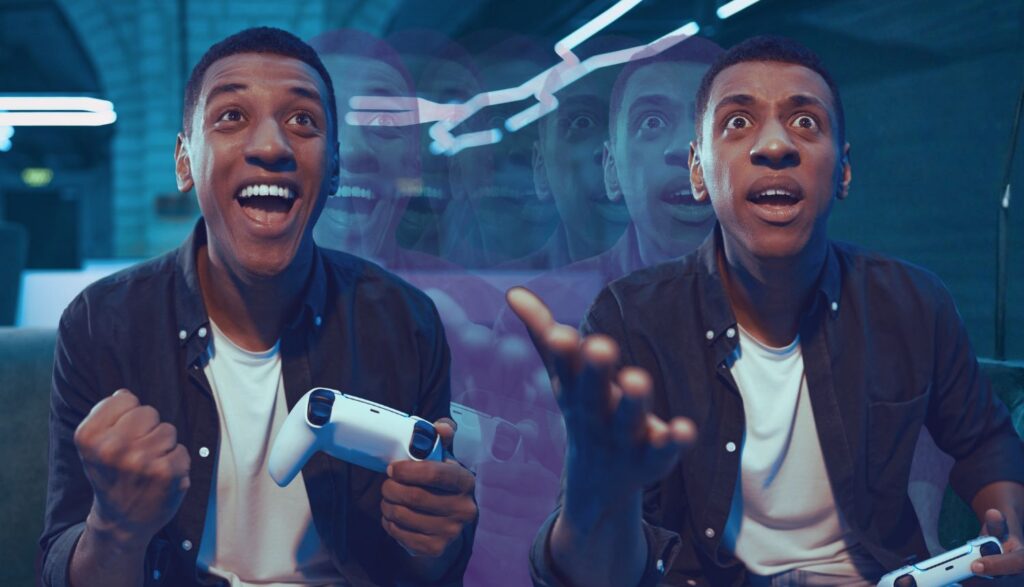
Once upon a time, video games were almost as crude as a cave man’s drawings—a pixelated blip bouncing between two paddles.
But as the medium has progressed in the decades since Pong’s inception way back in 1972, so has it’s impressive realism. Today’s games offer players an immersive, interactive and cinematic experience that plunges them into intricate, morally complex storylines for hours on end—not to mention giving them the chance to test their digital mettle against other competitors online.
Which begs the question: How does this compelling medium influence those immersed in it? Or, to put it another way, are video games ultimately a boon for players? Or a bane?
In a word, the answer might just be … yes.
Here are two perspectives on video games, one for and against. The first will cover the ways in which the medium has had a positive influence—on families and society as a whole. The second will offer a more cautionary note on the world of video gaming.
The Case for Video Games
by Bob Hoose
If you’re bitten by a mean dog, you’re probably going to be a little shy around the neighbor’s hound. For that matter, you might even think the whole species is just a bunch of no-good, rotten mutts. You’d be mistaken, but it’s understandable that you might feel that way.
Well, let me suggest that video games are the misunderstood mutts of the media world. Many people lump these digital amusements together as growling, addictive beasts filled with violence and language and all sorts of foulness. But I’m here to put forth the idea that even a video game can be worthy of a pat on the head now and again.
Let me admit that I love video games. I’ve played them all my life. And I could even share tales of how playing video games helped me keep the communication lines open with my kids at key teen angst crossroads. But I’m not going to toss you anecdotes for this gaming apologetic. This defense deserves science! There have been scores of studies that point to physical and mental benefits linked to gaming.
The Benefits of Gaming
First off, hand-eye coordination boosts are self evident. You don’t even need a study to see how timing a button punch with onscreen activities could help you improve in that department. (But here’s one, anyway.) And the muscle-flexing, heart-pumping benefits of a get-up-and-move games such as Nintendo Switch Sports are pretty obvious too. And there are other plusses to be found.
Boosting Brain Function
Strategy-based games that involve long-term planning and the management of resources, such as the Civilization titles, have been shown to boost high-level brain functions, including multitasking, planning and working memory.
Puzzle games can fire up the mind, as well. A study out of the School of Medicine at the University of California examined the effect of Tetris, a game in which players have to rotate and fit falling shapes into a stacking puzzle. It found that the game made patients’ brains more efficient while boosting their mood and reducing both stress and physical pain. In fact, the study says that cortex of the brain, which influences how well people see and pay attention to things, was shown to actually thicken among Tetris players. (That’s a good thing, the scientists say.)
Increasing Plasticity & Cognition
Research published in the Archives of Surgery found that laparoscopic surgeons who played a video game before surgery had almost 40% fewer errors during those procedures. And though there’s always a justifiable concern when it comes to nasty content in a game, a study at the University of Rochester determined that action games could deliver those same kinds of benefits. The study revealed that the games induced what’s called “plasticity” in the visual cortex. That plasticity is essential to improving cognitive abilities and maintaining mental fitness.
There are plenty of other studies that connect video games with everything from improved vision to strengthened teambuilding skills, but let me bring things a little closer to home. The fact is, we as people are hardwired to be constantly learning, whether we’re reading, walking through the park or, well, playing a video game. Video games incorporate not only visual and auditory modes of input but also tactile (touch) and kinesthetic (movement) forms of communication.
Video Games & Healthy Families
Now, I’m not saying that you should run right out to buy Junior the nastiest M-rated game out there. Bloody third-person shooters or f-bomb-laden sleazefests are never going to be an uplifting experience. But it is possible to incorporate gaming into a healthy family environment.
My suggestions?
1. Talk it out. Make sure your kids know exactly what your family’s standards are.
2. Understand the ratings system. Figure out what the difference is between an “E” and an “M” rating. And use those ratings as a starting point—but not a stamp of approval.
3. Make it social. Get the play out in the open, buy multiplayer games and keep plenty of controllers handy.
4. Play along. Knowledge is power, and the more you know about a game the easier it is to pat it on the head or send it away when it comes time to, once again, address suggestion No. 1.
And as a side benefit, when the alien hoards do someday show up in attack formation, you’ll know exactly how to save the day.
The Case Against (Violent) Video Games
by Adam Holz
If science shows some positive outcomes in this area, there’s a raft of other scientific evidence that video games—especially those drenched in violence—perhaps have done something to deserve the “mad dog” label.
The Downside of Video Games
I’m not an anti-video game crusader. I spent countless hours playing both console games and their arcade cousins in my formative years. Still, I’ve been persuaded to pay attention to the weighty stack of studies that draw strong correlations between video games and problematic behavior.
Teaching Aggression
Few people have spent as much time exploring games and their effects than Iowa State University assistant professor of developmental psychology Dr. Douglas Gentile, who heads up the school’s Media Research Lab.
In 2007, Gentile teamed up with his father, J. Ronald Gentile (a teaching professor emeritus of educational psychology at the State University of New York at Buffalo) to examine how games may teach aggression. Said the younger Gentile:
“We know a lot about how to be an effective teacher, and we know a lot about how to use technology to teach. Video games use many of these techniques and are highly effective teachers. So we shouldn’t be surprised that violent video games can teach aggression.”
The Gentiles’ study focused on three groups of youth: 3rd-5th graders, 8th-9th graders and older adolescents with an average age of 19. After factoring for things like race, sex and prior aggressive behaviors, the father-son team found that violent gameplay was an accurate predictor for increasing aggression. For instance, elementary students who played multiple violent games were 73% more likely to act aggressively (as rated by peers and teachers) than those who played a mix of violent and nonviolent games. Compared to those who only played nonviolent games, these students were a whopping 263% more likely to exhibit aggression.
Decreasing Empathy
And Gentile isn’t the only researcher to find a link between games and aggression. Dr. Craig Anderson, director of Iowa State University’s Center for the Study of Violence, analyzed 130 separate video game studies in 2010 encompassing more than 130,000 gamers in the United States, Europe and Japan. Overall, he said, the collective research “strongly suggests” that the medium can increase players’ aggressive thoughts and behavior, as well as decrease their empathy, “regardless of … gender, age or culture.”
Anderson doesn’t believe the majority of kids who play violent games are going to go on shooting rampages. But, he says, the violence found in games is “the only causal risk factor that is relatively easy for parents to do something about. … Any game that involves killing or harming another character in order to advance is likely to be teaching inappropriate lessons to whoever is playing it.”
Other Problematic Behaviors
Video games have been linked to other problematic behaviors as well. Dr. Laura Padilla-Walker of Brigham Young University published research in 2009 that links game play among college students to a higher incidence of drinking, using drugs and having poor relationships with family and friends.
And then, of course, there are those tragic cases where video games have been implicated as an influence in the actions of someone who takes others’ lives.
In his 2006 shooting rampage at Dawson College in Montreal, Quebec, Kimveer Gill killed one person and wounded 19 others before police fatally gunned down the 25-year-old. Website postings from Gill revealed his fascination with 1999’s Columbine killings and his enjoyment of the game Super Columbine Massacre. Likewise, police found violent video games (among other problematic media) on the computer of German teen Tim Kretschmer, who killed 15 people in 2009. That same year, 17-year-old Daniel Petric killed his mother and shot his father when they banned him from playing Halo 3. The Grand Theft Auto franchise has been repeatedly linked to copycat crimes involving shootings, violence and other crimes.
And let’s not overlook how a video game’s innate ability to “teach” its users can be consciously abused. Norwegian mass murderer Anders Behring Breivik, who killed 77 people, said he used Call of Duty: Modern Warfare 2 as “part of my training simulation.”
Guarding Kids’ Hearts & Minds
Again as Anderson noted, most kids who play violent video games aren’t going to turn into mass murderers. But the body of research regarding the potential influence of these games does, I think, mean that families should approach gaming with extreme caution. My wife and I have decided that we will not have a video game console in our house. It’s a conviction that I’m sure we’ll have to defend as our kids, especially our son, gets older. But he gets enough screen time already, even as we work diligently to guard that boundary, too.
What Do You Think?
What are your thoughts? Do you think the effect of video games trend more positive or negative? What decisions have you made for yourself or your family regarding video games? Let us know in the comments below!


Recent Comments