
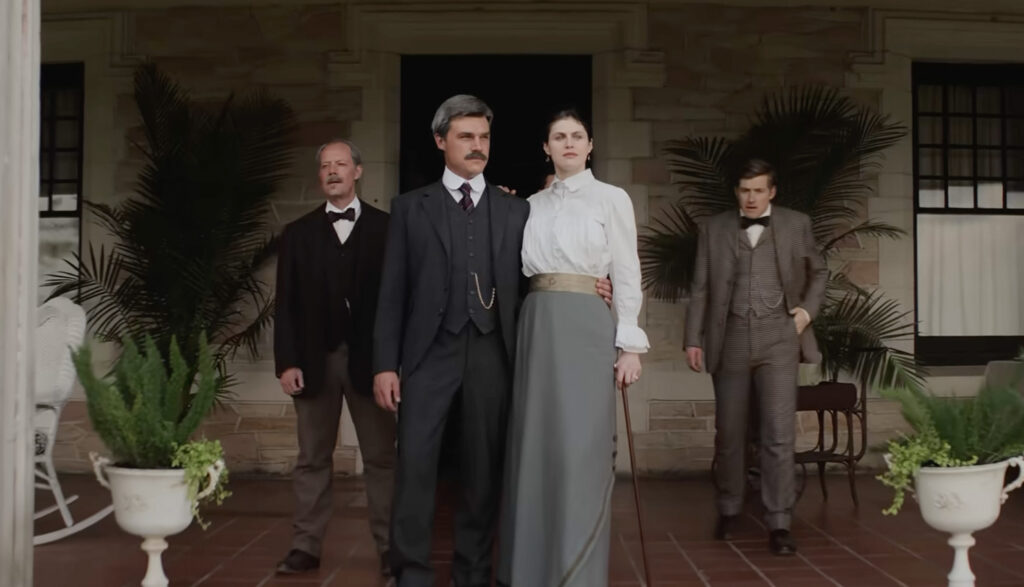
After a childhood spent in penniless poverty, Milton Hershey strives to create delicious candy that even poor kids can enjoy. This biographical drama is a bit dry, but its story is inspirational. We see a depiction of a debilitating neurological disorder, but there’s no foul content onscreen.
As a boy, Milton Hershey didn’t have very much to call his own. In fact, even after spending the day scouring the streets and railroad tracks for discarded chunks of coal to sell, he would save up the few pennies he earned and give them to his family.
You see, Milton’s father, Henry, was a dreamer—a man who lost money on silly inventions and speculative booms. And Milton figured that even a tin can with a few pennies rattling around in it might help the family pay off some of their debt.
Eventually, though, Henry packed up a bag and left his family behind. I know I’m not wanted here, Henry said. And though Milton cried out that wasn’t true, all he could do was watch as his father trudged away. After that, Milton and his mother moved in with Mennonite relatives. And Milton found that he now had even less than he had before.
However, there was one thing that Milton got from his father: a desire to follow a dream. And for some reason, candy was that dream.
Perhaps it stemmed from the coal-gathering he used to do. After turning in his bucket of coal for a few pennies, the merchant Milton worked with always took pity on the grime-covered boy and smilingly tossed him a piece of rock candy. And the joy that Milton received from that brief, sugary respite of candy-crunching rest made the day of scrabbling and scrounging all worth it. As the sweet flavor burst deliciously in his mouth, the world felt right. Everything felt good.
Milton wanted to somehow give that feeling to everyone. He wanted to create inexpensive but delicious confections that any poor boy could buy to sweeten his world.
That dream … led to Milton’s first failed business.
It wasn’t that Milton’s candy was bad: He had worked for a local confectioner and learned his lessons well. He had an excellent sense of combining just the right ingredients into a scrumptious bit of taffy or caramel. The problem was that “just the right ingredients” tended to cost a lot. And Milton was a pretty lousy businessman.
But one thing that Milton learned from his poor, Mennonite upbringing is that time, perseverance and hard work are all blessings, all necessary parts of life. Milton Hershey will not give up. He will repay his debts; he will try again.
For Milton Hershey has a sweet dream.
Part of Milton’s dream is to not only establish a successful business but create a company that will also serve the workers in it. He pays his employees a good wage when his competitors will not. He takes care of their needs, builds housing for them and earns their loyalty. Milton goes so far as to build a town for his community of employees and, at his wife Kitty’s prompting, they establish a school for underprivileged children.
Eventually, Milton even decides to give the employees and the school ownership of the Hershey company through a controlling trust—an arrangement that is still in place today.
After Milton meets Kitty, he is immediately smitten with her and makes every effort to stay in touch. They fall in love, marry and are completely devoted to one another. In fact, the one instance in which Kitty essentially lies to Milton (hiding a debilitating illness from him) is only done, in her estimation, as a means of protecting him. (When Milton later finds out about the illness, he instantly does everything he can to lovingly take care of his wife, telling her that he would have far preferred she had told him the truth.)
Later, after escaping a potentially deadly situation, Kitty tells Milton, “We’ve been given a gift. … Promise me we will never forget that.” Milton agrees that life is fleeting, and they need to hold every moment as precious.
Milton’s family isn’t initially very supportive of his money-losing endeavors. But some of them take money out of their own savings to help him. Years after leaving, Milton’s estranged dad shows up briefly to apologize for deserting the family and to tell his son how proud he is. (He then slips away once more.)
After his business initially fails, Hershey sits alone and verbally asks God what he should do. Someone walks up and praises his casual way of conversing with the Lord.
Milton and his wife kiss several times. Once, while on their honeymoon, Kitty gets out of bed dressed in a full-length cotton gown.
While Milton and Kitty are working at home on a new chocolate formula, Kitty suggests they take a break. When Milton says no, Kitty unties her apron and begins walking away, suggesting with her glance that she wants to be romantic. Milton gets the clue and hurries after her.
Someone illustrates a point about keeping a positive perspective by mentioning an event that happened to him in the First World War: “When I was in the war, a friend lost his leg to a cannon ball. He said to me, ‘I’m lucky that didn’t hit my heart, I only have one of those.”
Kitty Hershey suffers from a progressive neurological disorder that eventually kills her. We see several instances where she goes into spasms and falls to the ground in pain. Because of Kitty’s illness, she and Milton must cut an overseas trip short. (We then learn that the changed schedule caused them to avoid traveling on the Titanic’s deadly maiden journey.)
Young “hoodlum” boys steal some of Milton’s candies and tip his cart over, spilling the rest on the ground.
There’s nothing crude or foul in the dialogue mix. However, we do hear exclamations of “blast,” “harebrained ideas!” and “gosh darn.”
None.
Early on, Milton is devoted to his younger sister who is sick with an undisclosed disease. The boy returns home to find his mother weeping and hugging the girl’s now lifeless form.
As a cinematic portrayal of a historical success story, Hershey feels a bit undercooked: It just doesn’t play out as sweepingly compelling or even, well, sweet as you might hope it to be. This pic feels more like a brief chapter in a school textbook than it does a stirring event at the movies.
That said, Hershey’s story of dogged perseverance in the face of failure is certainly an inspirational one. Milton and Kitty Hershey shared a life devoted to one another and aimed at helping others. Milton followed a dream and built an incredibly successful business in a world struggling through war and economic depression. And he and his wife used their generated wealth to insulate their working community and fund a school for disadvantaged children: a move that served the company’s workers and families for generations.
That’s an important American story. And your family can grab some Hershey bars and watch it without having to worry about any foul or tasteless stuff being stirred into the movie’s recipe.
Frankly, in light of many offerings at today’s box office, that’s a treat.

After spending more than two decades touring, directing, writing and producing for Christian theater and radio (most recently for Adventures in Odyssey, which he still contributes to), Bob joined the Plugged In staff to help us focus more heavily on video games. He is also one of our primary movie reviewers.