
While certainly falling a few steps below the Disney princess films that it so longingly wishes to emulate, Steps does offer families some sweet messages about sisterly reconciliation. But be warned of some lightly creepy porcelain dolls, snotty trolls and the consistent use of magic that may frighten more sensitive young princesses.
It’s always “Cinderella this!” and “Cinderella that!” Sure, Cinderella’s father passed away, leaving her to do most of the household labor for her stepmother and stepsisters.
But has anyone ever considered how those stepsisters, Lilith and Margot, might feel about all of this?
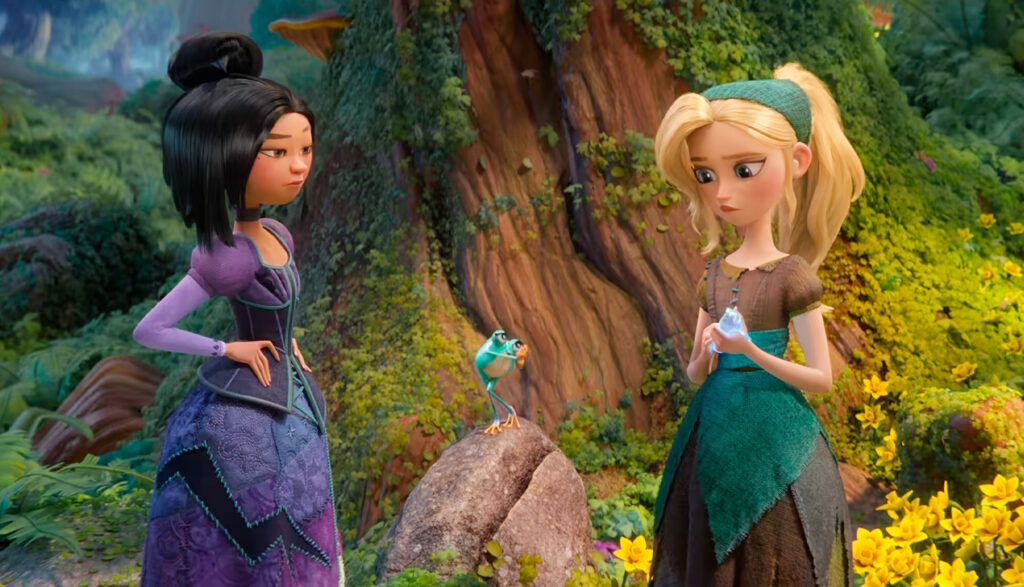
It’s easy to be kind when you’ve had a fairy godmother orchestrating your every move—always out of sight, ready to help at a moment’s notice. Lilith was not struck by such magical luck. Instead, her family has now moved to a new kingdom, and Lilith is stuck dealing with town terror Priscilla—perhaps the most spoiled girl in all the land.
Priscilla tricks Lilith and Margot early on, luring them into a storm drain to play—only to close the door behind them. Lilith isn’t too worried, though: Cinderella will surely stand up to Priscilla and let them out!
But Cinderella doesn’t. Worse still, without the help of their stepsister, Lilith and Margot are on their own in a town eager to treat them as outcasts.
Oh well. If the townsfolk are going to hate Lilith and Margot no matter what, then they might as well give everyone something to hate.
While most of the film’s central obstacles could easily be solved by clearing up some miscommunications, Steps does prioritize the importance of reconciliation between sisters. Though long overdue, these conversations showcase the need to apologize when a friend or sibling is hurt by your actions, whether you did so intentionally or not.
“Being kind is better than magic” is a simple theme, albeit an important one for kids to understand. At the end of the film, it is not simply magical abilities, but kindness that wins the day.
Lilith and Margot’s mom is extremely hardworking. She’s also very loving to her daughters within her brief screen time. The film briefly touches upon the importance of honoring cultural traditions, as the girls’ seamstress mom feels most in touch with her artform when she’s crafting dresses that reflect her ethnic heritage.
Given this is, in part, a retelling of Cinderella’s story, the typical magic that comes prepackaged with that fairy tale is all present here: pumpkin carriages, magical transformations, fairy godmothers and the like.
The thievery of said fairy godmother’s wand plays a big part of the narrative, with the wand’s magic seemingly doing most anything its user requires. In the wrong hands, this includes turning folks into animals or inanimate objects, as well as changing a kingdom’s worth of people into unthinking porcelain drones.
Margot gets transformed into a frog for the majority of the movie’s runtime. A group of ill-intentioned trolls play a significant role in the film’s narrative.
The magic of true love, of a perfectly fitted slipper and of the “fate” that brings two lovers together is all very present here. Fairy Godmother sees the future in a cauldron. It’s revealed that this magical woman was using her abilities to make Cinderella’s life a bit easier all along, secretly guiding her behind the scenes. Someone places incense alongside a sort of memorial shrine. A young girl shares a story about a magical snake-woman.
The Prince in Steps is tasked with finding his one true love within 24 hours in order to “continue the family lineage.” A few different couples seemingly find “true love” upon first meeting.
Beyond those typical fairy-tale tropes, though, a few sensual lines may surprise parents. Dialogue about “hot trolls” is thrown around a few times, and one such creature named Gef does catch Lilith’s eye. The two nervously flirt with each other, brushing hands and the like.
A man who, as we’re told, made some bad financial decisions apparently can no longer afford clothes, and he is seen wearing an undershirt, underpants and a barrel around town. After Fairy Godmother sends Cinderella on her way, she comments that it’s time to “focus on my own love life.” We see her suggestively eye a couple of handsome bachelors. A few attendees to a ball wear dresses that bare some animated cleavage. A couple shares a kiss.
After turning into a frog, Margot exclaims, “I can breathe out of my butt!” She also jokes, “No shoes, no shirt, no problem.” Priscilla’s army of porcelain townsfolk (including The Prince) often mindlessly drone on about their love for the spoiled princess. At a ball towards the end of the film, two men are briefly seen ballroom dancing together.
While much of the film’s bumbling, cartoonish falls can be expected, a troupe of snotty trolls and a psychotic, wand-wielding girl frequently yell lines about killing their enemies. Roderick, Priscilla’s loyal bodyguard, certainly has a scary level of devotion to the young princess. At her command, he and his cronies chase our leading ladies with swords, swiping at them. Characters clash with swords, wands, mops and their own fists.
A creepy doll is briefly featured onscreen, and the dozens of royals and guards that Priscilla turns into porcelain doll people are pretty eerie, too. Lilith and Margot arrive to a ball in a skull-shaped carriage. A few chase scenes feature a crumbling glass carriage, a mechanical moving house with glowing red eyes and hungry, human-eating trolls riding goats.
A skeleton in a cage acts as proof that some trolls’ intentions are hardly trustworthy. A character talks of how these trolls have eaten people. We hear about a frightening section of forest aptly named the “Screaming Woods.”
A character is comedically injured by wolves, a beehive and falling off a log—scratches, splinters and stingers follow in due course. Bad guys fire arrows at their enemies. A tidal wave of water briefly threatens to drown a few characters.
A couple of young girls launch themselves on a mattress down some stairs, clearly regretting that decision after a hard fall.
There are a couple misuses of God’s name. Name-calling includes words such as “stupid” and “idiot.” In one instance, a character says, “What the frock?” Elsewhere, we hear, “Shut your goat hole.”
Adults sip brightly colored drinks at a ball.
Priscilla is exceedingly spoiled and quite rude throughout the film—she also desires to literally murder her peers in order to take the kingdom for herself. Her constant bullying of anyone who dare oppose her is portrayed as villainous. Even before her magical takeover, she manages to name-call Lilith and Marge multiple times while locking them in a storm drain.
Speaking of which, Lilith calls out to Cinderella for help from the storm drain, but Cinderella deems it too difficult to contradict Prisiclla—thus kicking off the hurt that would permeate the sisters’ relationship for years to come. (This discord manifests in a few heated arguments throughout the film.) After this betrayal, Lilith’s mindset is as follows: “If they were going to hate me, I’d give them something to hate.”
From that point on, Lilith wears edgy, skull-ridden clothes. She douses her room in black paint and displays a few drawings of the kingdom burning—although much of this drama never comes to fruition. Lilith’s youthful rebellion includes some uncommon outfit choices and the playing of rock music at a fancy ball.
Prisiclla lies to The Prince, as well as his parents, temporarily pretending to be a decent person before her façade quickly falls. A funeral is briefly shown. Characters are kidnapped.
There’s a bit of potty humor involving characters who need to pee, as well as some poorly folded napkins that “look like a diaper.” Without Fairy Godmother’s magic, Cinderella reports the inconveniences of smelling bad and having pimples.
Sometimes children gravitate towards certain films for reasons that make little sense to the adult brain. As a kindergartener, my favorite of the original Star Wars trilogy was Return of the Jedi, simply because Luke’s lightsaber is green in that film.
From a purely critical perspective, it’s hard to imagine any child preferring Steps over the Disney films that it so desperately wants to emulate, such as 2013’s Frozen or 2010’s Tangled. Alas, the eye of a kid is far less critical than that of a parent, and since Steps was clearly made with a young audience in mind, it may become a film that your children play on repeat.
Thematically, the typical fairy-tale lessons of kindness, truth and integrity are all intact. Much of the story revolves around the importance of reconciliation between estranged sisters, and it even shines a positive light on the relationship between stepsiblings.
That said, due to its focus on the “evil” stepsister, Steps is a smidge edgier than past iterations of this classic tale. A few sensual quips about “hot trolls” and some villains who intend to kill our leading ladies may keep this animated Netflix fairy tale out of reach for the most sensitive of young princesses.

Jonah Parker’s first interaction with Plugged In came when he was just five years old, after his parents read a review for The Chronicles of Narnia: Prince Caspian and deemed the content too intense for him. What started out as a contentious relationship between Jonah and a staff of reviewers who knew not of his existence would later turn into an appreciation for the site’s ability to present media content in a way that was accurate and fair. Jonah enjoys analyzing how our entertainment echoes the creativity of our Creator while finding glimpses of Biblical truths within every genre. He believes that Robert Pattinson’s Batmobile is the perfect mix of cool and practical.