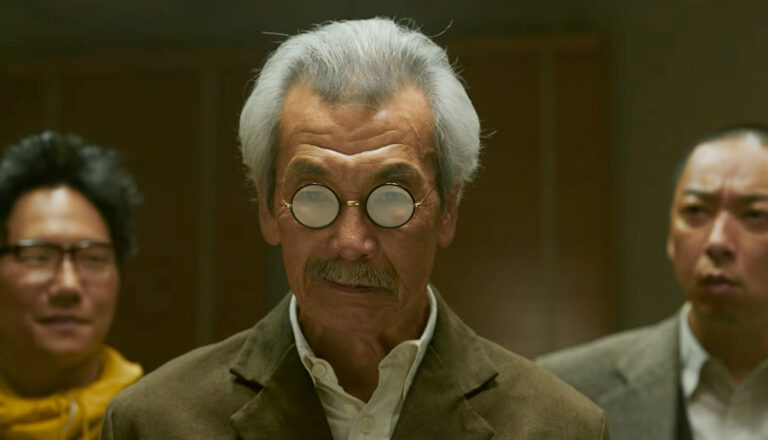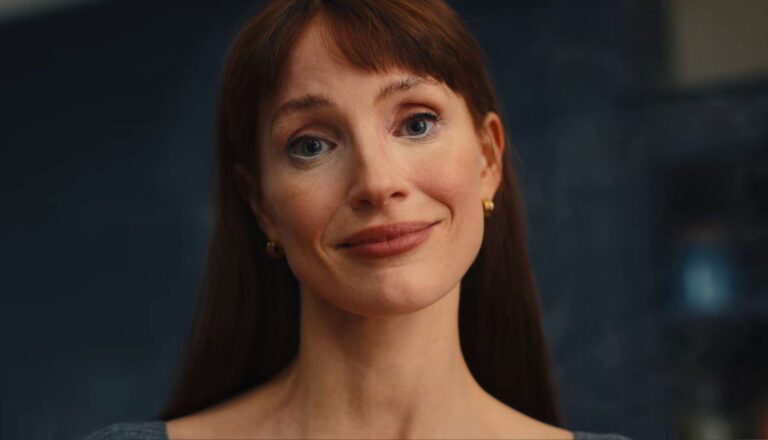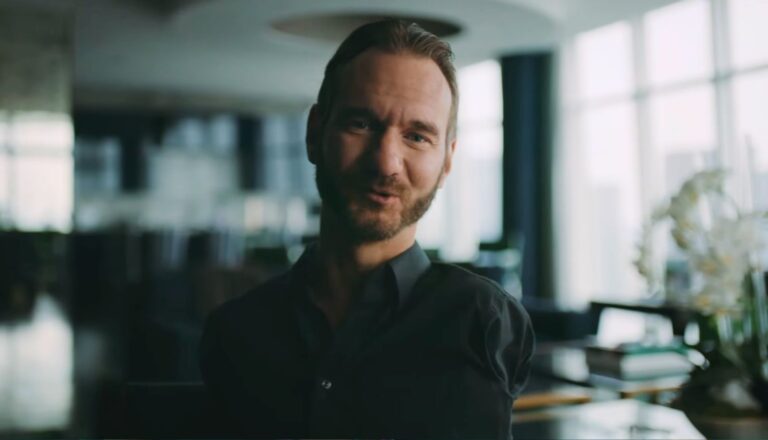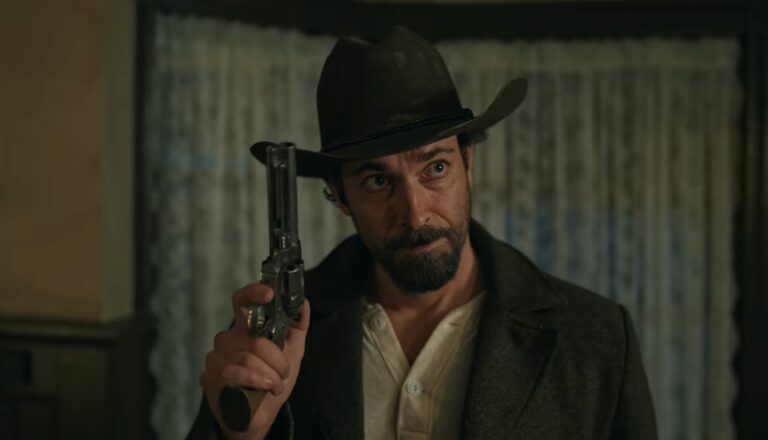

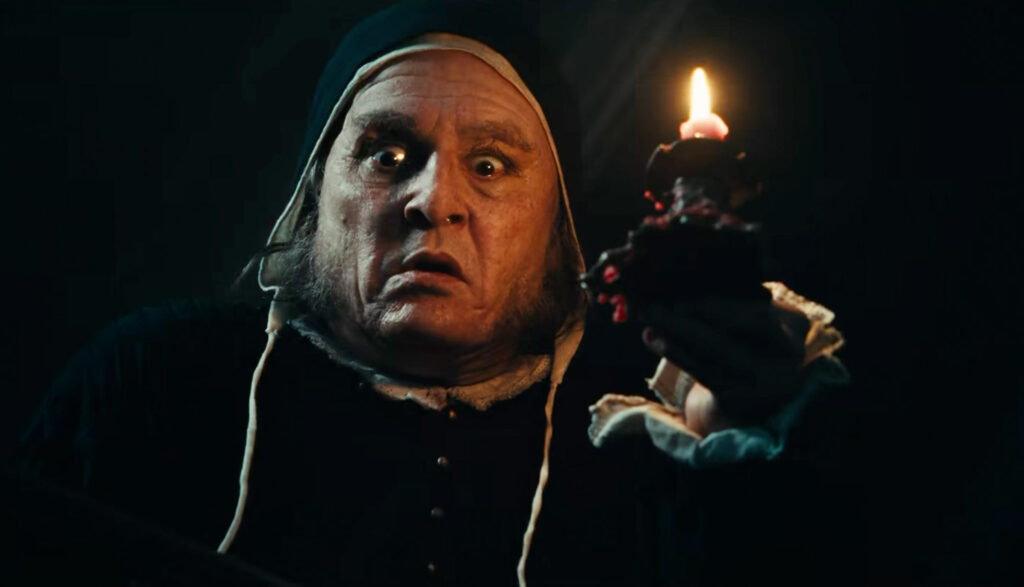
Ebenezer is director Ti West’s dark, slightly comedic adaptation of Charles Dickens’ A Christmas Carol. The film still exudes messages about kindness, generosity and keeping the spirit of Christmas alive. However, some mild profanity and creepy, sometimes violent ghosts haunt this narrative.
Change can be difficult.
It can be especially difficult if you’re a miserable old miser who’s been stuck in his ways for the past several decades.
But if your name happens to be Ebenezer Scrooge, well … there may be hope for you yet.
Everyone knows that Scrooge is a wealthy man. But they also know he’s a skinflint. He doesn’t donate money to charitable causes or offer loose change to beggars on the street. He hasn’t promoted his loyal clerk, Bob Cratchit—a man who could use some extra money to help his sick son—since the man came to work for him. Even his kindly nephew, Fred, gets the brush off for the mere suggestion of a merry Christmas.
Scrooge is determined that he’s in the right—that generosity and kindness are all humbug.
But Scrooge is about to be proven very, very wrong.
On Christmas Eve, the ghost of Scrooge’s old business partner, Jacob Marley, comes to warn Scrooge. If Scrooge doesn’t change his ways and start keeping the spirit of Christmas in his heart, he’ll be doomed to a very miserable eternity. And Jacob would know: He’s been living in that misery since his own death seven years prior.
Three spirits will visit you, Jacob says. Listen to them. Learn from your mistakes.
Change, Ebenezer.
Ebenezer embraces two core virtues: kindness and generosity. Scrooge is a miserly old soul who doesn’t care for either. He sees no reason to help the poor or even to entertain Fred’s friendly offer to join him for Christmas dinner. He scoffs at any show of optimism and berates those who collect donations.
However, Scrooge’s encounters with the Christmas spirits (and their exploration of Scrooge’s past, present and future) encourage him to change his ways. Through visits to his past, he recognizes the moments in his life that caused his heart to harden. By journeying through the present, he sees how his actions directly affect those closest to him. And a quick trip to the future reveals just how much loss and misery he could have prevented.
Reflecting on this, Scrooge realizes that it is completely within his power to make a difference—not just for himself, but those around him. He offers to help a beggar. He makes amends with Fred and Fred’s wife, Clara. He sends well wishes to his former love, Belle. And he even helps out Bob Cratchit, whose youngest son is disabled and needs extra care.
When asked what caused this sudden change, Scrooge simply says, “Christmas.” And he vows to keep the spirit of Christmas—the spirit of kindness and generosity—in his heart not just for the day, but all the year round.
Before Scrooge’s transformation of heart, Fred tells Clara that he’ll never give up on his uncle. He believes that Scrooge can change for the better. Moreover, he believes that his mother, Fan (Scrooge’s beloved sister who died “too young”), would have wanted him to keep trying. Travels to the past reveal that Fan was ever a source of joy to young Scrooge. And when reconciling with Fred, Scrooge admits that he’s kept Fred at a distance because Fred reminded him so much of Fan—and the pain was too much to bear.
Bob and his family care deeply for one another. At one point, Bob despairs at his family’s financial situation and apologizes to his wife for not being a better provider. However, she encourages Bob, telling him that she believes he’s always done his best and that his best is enough.
Many volunteers provide food to poor people living in the workhouses.
Scrooge is visited by four specific ghosts on Christmas Eve (though he’s haunted by others throughout the film). The first one, that of Jacob Marley, is a pale, translucent spirit that looks a little like a rotting corpse. He seems to be able to affect the physical world, slamming doors and opening windows with his powers. However, when Scrooge throws a pot at Marley, it passes right through him.
Marley’s ghost carries many heavy chains. He tells Scrooge that those chains were forged by the sins he committed in his life. And now, in death, he is doomed to drag that weight for eternity. He urges Scrooge to change his ways so that he will not suffer the same fate.
The second ghost is the Ghost of Christmas Past. She’s corporeal and looks like a corpse bride, complete with pupilless eyes. She first appears in a flash of bright light. Her powers allow her to transport Scrooge into his past, where he can see events of previous Christmases, but nobody can perceive his presence. At one point, Christmas Past says that she cannot see the future and that this inability is part of her “penance”—though she never details what her sins were.
The third ghost, the Ghost of Christmas Present, has similar powers to Christmas Past—only instead of traveling to the past, he and Scrooge traipse around the current Christmas. Christmas Present is also corporeal, but he looks like a normal human. In fact, when Scrooge first spots him, he doesn’t even realize the character is a ghost. But Christmas Present has his own limitations: His existence is relegated to a single Christmas Day. So as the day proceeds, his skin begins cracking like soil in the hot sun. The laurels that adorn his clothes wilt and turn brown. His eyes become clouded. And he eventually dies when the day is done.
It’s revealed that Christmas Present is toting around two emaciated, child-like spirits called Ignorance and Want. These spirits represent the sins of mankind, and Scrooge is warned to beware of them. They remain trapped in Present’s ribcage throughout Christmas Day, but when he dies, they are able to burst free. Christmas Present mocks Scrooge frequently, even laughing at Scrooge’s miserable, seemingly inevitable fate.
The Ghost of Christmas Yet to Come is the final ghost, giving Scrooge a glimpse into the future. He’s a dark, shrouded figure, and when he lowers his hood, he bears Scrooge’s face with coins over his eyes—an indication that Scrooge is responsible for his own future and the fate that awaits him. The spirit coughs up a living crow at one point.
In addition to traveling through time and space unseen, the spirits here are able to manipulate their surroundings—slamming doors and windows, ringing bells and otherwise scaring Scrooge.
A whole mob of ghosts—all of them bearing the same qualities as Marley’s ghost—haunt Scrooge throughout the film, sometimes giving chase. But it seems that they are unable to enter any dwellings. Scrooge runs into a church while fleeing one of those mobs, going into an ossuary (bone chapel) beneath the sanctuary.
Just before Jacob’s death, Scrooge sees the flame of a street lamp flare unnaturally and extinguish. Seven years later, the same phenomenon occurs just before his encounter with the ghosts. Scrooge’s door knocker temporarily transforms into the face of Jacob Marley, but when Scrooge takes a second look, it has returned to normal.
Bob and his son Tim attend a Christmas Eve service at church. When Tim is unable to kneel for prayer (which he seems embarrassed by), his father sits in the pew with him, and the two folds their hands in prayer instead. Later on, as Bob despairs at his son’s disability, he recounts Tim’s words to his wife—that it’s good for him to be in church since it reminds everyone present of the One who made lame beggars walk.
At Christmas dinner, Tim proclaims, “God bless us, everyone.”
Many characters sing the hymn “Silent Night.” We hear some other Christmas carols as well. Several crosses adorn graves in cemeteries. A beggar says “God bless you” to everyone who offers him coin. We hear part of a church sermon about the birth of Jesus. We see Bob praying in a couple of scenes.
Journeys to Scrooge’s past reveal that when he was young, he fell in love with and courted a young woman named Belle. We see the couple dancing together and holding hands. In one scene, they sneak into a quiet alley and begin kissing, and it appears that young Ebenezer grabs Belle’s leg. Belle spends quite a bit of time at Ebenezer’s home, but it’s unclear if she lives there with him or is simply visiting. (Given the story’s Victorian setting, the former seems unlikely.)
A woman’s gown reveals some cleavage when she leans over. A woman kisses her husband on the cheek.
Jump scares scattered throughout the film can feel rather jarring and violent. The ghosts that chase Scrooge (including Jacob) are all like rotting corpses, and their creepy appearance adds to the feeling of violence. Many seem to mean him harm, attempting to break down doors and windows. At one point, Scrooge is knocked into an open grave, and gravediggers begin to bury him alive as arms reach up through the soil to hold him down—though this is later revealed to be a dream.
When Jacob Marley dies, we hear the sound of a cup breaking and the man falling. When Scrooge investigates, he finds Jacob already dead, the man’s eyes still open and his face contorted in a grimace.
A man gets stabbed in the gut, and we’re told that he dies. Several bullies gang up on a boy in a schoolyard, shoving him around. One bully punches the boy in the face, bloodying the boy’s nose.
A young boy flees his drunken father and hides in a small creek. His father gives up the chase, but the boy still nearly dies from hypothermia. We see him recovering in a hospital ward.
Scrooge throws a variety of objects at people and ghosts.
We hear single uses of “b–tard” and “d–n,” as well as the British profanity “bloody.” There may be one misuse of God’s name. There’s a little name-calling, including “idiot.” And we hear several colorful expressions, such as “frivolous ninny” and “pickled old skinflint.”
Scrooge’s father, we learn, was an alcoholic—and a mean one at that. He drunkenly chases Scrooge out of the house at one point. Jacob keeps a bottle of gin in his desk drawer. People appear to drink wine at meals and parties. A drunk couple stumbles out of a tavern together.
When solicitors come to collect money for a charity, Scrooge refuses to donate. He then accuses the men of skimming off the top, using some of the donated funds to buy fancy clothes for themselves. It’s unclear if this is true, but later in the film, someone falsifies a will, naming that same charity as the benefactor of a large fortune. Even though they know the will is fake, the collectors accept the money. The person who provides the document takes half of the funds for himself as a “finder’s fee,” and in so doing, he knowingly steals the inheritance from a close friend.
When Jacob Marley is still alive, he and Scrooge are quite rude to Bob Cratchit, mocking and belittling the man. They refuse to listen to Bob’s pleas for help for his sick child, telling Bob that he should keep “personal matters” to himself. Neither he nor Scrooge believe in being generous or kind to those less fortunate. Scrooge in particular says some very mean-spirited things about poor people. (The Ghost of Christmas Present later throws those same statements back in Scrooge’s face, helping him to realize his hypocrisy in a very blunt manner.) And the two men revel in the fact that they have made their fortunes off the unpaid debts of others.
Scrooge’s father is an unkind and neglectful man. We’re led to believe that alcohol plays a part in his behavior. He leaves a young Scrooge at school over the holidays, and Scrooge is only able to come home when his sister asks their father to let her brother visit for Christmas.
A visit to the past reveals that Belle decided to leave Scrooge because he had become obsessed with wealth. She tries one last plea, but Scrooge refuses to listen. He turns her out, telling her she was an “unprofitable dream.” In the immediate aftermath, we see Belle sobbing in an alleyway. An older Scrooge looks back on this event with regret, noting that he regretted the decision for the rest of his life.
We see many people living in one of the work houses designed for the poor. The place is filthy and completely open to the freezing weather. Many are sick and cough frequently. And we’re told that these places are so awful, most people would rather die than wind up there. (When Scrooge hears this, he says they should die and decrease the “surplus population.”)
A beggar apparently pretends to be half-blind by wearing an eyepatch over his perfectly functioning eye. Many people say unkind things about Scrooge behind his back. Someone steals some food. People take a dead man’s belongings and try to pawn them off.
A man wets himself in fear. We see someone shoveling horse manure. Someone belches loudly. A butcher cuts the head off of a dead chicken. A dead, featherless goose hangs in a grocer’s window. A glimpse of the future shows someone’s house in disarray with maggots and clumps of hair everywhere.
It seems there’s a new adaptation of Charles Dickens’ A Christmas Carol every year. And while the story continues to resound with messages about kindness, generosity and keeping the spirit of Christmas alive year-round, I can’t help but wonder: Did we really need another Scrooge flick?
Apparently, for the creators of Ebenezer, the answer was yes.
This film brings back all the story elements we know so well, adding actor Johnny Depp’s unique flavor to the title character. The result, purposely so, is much darker than previous versions. The people are more somber. The ghosts are creepier. The jumps are scarier.
And yet, the film falls flat. While this is certainly one of the more accurate adaptations of the 1843 novel, it’s not an honest one. Artistically speaking, Ebenezer feels uninspired and boring. And it seems that in their efforts to create a hard PG-13 version of the story, the filmmakers forgot to make sure that Dickens’ original message came through. Instead, it has to be spelled out for viewers, line by excruciatingly delivered line.
In terms of A Christmas Carol movies, I could easily recommend half a dozen others with stronger performances and more earnest motifs. (The Muppet Christmas Carol, for all its own flaws, is still one of my personal favorites.)
Bah, humbug!

Emily studied film and writing when she was in college. And when she isn’t being way too competitive while playing board games, she enjoys food, sleep, and geeking out with her husband indulging in their “nerdoms,” which is the collective fan cultures of everything they love, such as Star Wars, Star Trek, Stargate and Lord of the Rings.