
Prince Ram simply wants to live a good life with his beloved wife and devoted brothers. But fate won’t allow that, as he’s the seventh incarnation of the Hindu god Vishnu, destined to slay a demon king. Hindu mythology informs much of the film’s narrative, and there are many non-bloody battles.
Ram is a prince. He’s also an exile. He’s also the seventh incarnation of the Hindu god Vishnu, which means he’s possibly destined to slay the demon king Ravana.
Of course, Ram doesn’t know anything about his deified nature or possible fate just yet. All he knows is that he’s a prince living in exile. On the eve of his would-be coronation, his stepmother—a woman who he loved and whom he thought loved him—demanded that her son be crowned king instead. She reminded her husband, Ram’s father, that this was a promise he made when they married.
Ram’s father, King Dashrath, doesn’t want to fulfill this vow. He’d rather die. But Ram is willing.
Ram may be a prince, but he’s also a humble man. He always does the right thing, even at great cost. If the queen demands that he go into exile for 14 years so that her son can legally inherit the throne, he’ll do it. He loves his parents. He loves his brother. And he loves his people. So if this is the best way to avoid a deadly war, he’ll happily acquiesce.
But while he’s gone, Ram will be tested. Even though he’s not aware of his connection to Vishnu, Ravana certainly is. He’ll send his demonic minions to destroy Ram. He’ll kidnap Ram’s beloved wife, Sita, to draw him out.
Of course, if Ravana isn’t careful, Ram may surprise Ravana. Ordinary human Ram may be, but there’s definitely something to be said for being the avatar of a divine being.
Ram and his brothers all love each other. And when Ram gets banished, they all oppose the exile. Even Bharath, who will become king in Ram’s absence, tries to bring Ram home and keep the throne available for his brother.
When Ram gets exiled, Sita goes with him, reminding him that she married him “for better or for worse.” The couple is completely devoted to each other.
Lakshman, one of Ram’s other brothers, also joins Ram in exile. He dedicates his life to protecting Ram and Sita from harm.
Ram, as mentioned, always does the right thing. He is humble, patient and kind. And he constantly advises others to exercise restraint. He leads by example, and many are devoted to him and his cause. When he learns that his father has died—which would technically release him from exile—he refuses to return home. He believes that it is his duty to honor his father’s wishes, even in death. Ram refuses to break any vow he’s ever made.
Ramayana is based on the Hindu epic poem of the same name. It details important events within Hinduism and teaches life lessons. And for those who practice Hinduism, it’s a very important text. But it’s also a bit like The Odyssey because there are many different translations and interpretations of the story, which prime it for a big-screen adaptation.
But let’s just dive in to the main stuff:
We are introduced to three gods who essentially control the universe: Brahma is the creator; Shiva is his opposite, the destroyer; and Vishnu acts as an intermediary, protecting the universe from the constant chaos caused by Brahma and Shiva.
We are also introduced to two groups of human-like beings, the Devas (the divine allies of humans) and the Asuras (shapeshifting demons), who are constantly at war. Near the movie’s beginning, Ravana’s mother leads the Asuras into battle against the Devas. However, they are defeated because Indra, prince of the Devas, had been granted supernatural powers by Vishnu to wipe out his enemies.
When Ravana comes of age, his mother urges him to liberate their people from the control of the Devas and take his “rightful” place on the throne of Lanka—a legendary city that acts as the seat of power for all the cosmic realms. Ravana was born with the wisdom of the sages (because his father was a sage), so he knows he will need the power of the gods to do this. He goes on a pilgrimage of sorts and meditates atop a mountain peak for several days. His meditation is so intense that a spiritual energy begins pouring out from him, threatening to tear the world apart.
Brahma intervenes at this point, acknowledging Ravana’s dedication and offering him a boon: Ravana requests immortality. Brahma says he cannot give Ravana that, but he concedes to making it so that no god, demon, Deva, Asura, illness or even old age can kill Ravana. Essentially, only an ordinary human will be able to claim Ravana’s life.
Ravana immediately puts his new almost-immortal powers to the test. He storms the city of Lanka, but the Deva guards are unable to kill him. They strike him with arrows, swords and spears, but his wounds heal instantly. (Later in the film, someone manages to behead him, but because that character isn’t human, Ravana’s head magically reappears.)
With his new powers, Ravana sets about to conquer the world. He gives his enemies a choice: bow to him or die. Some bow, some fight. But in the end, Ravana becomes ruler of the heavens, the earth and the underworld.
It’s at this point that Indra, prince of the Devas, again intercedes. He knows about the loophole in Ravana’s immortality, so he petitions Vishnu to become human incarnate to defeat the demon king. Vishnu acquiesces to this request, sending his spirit to the kingdom of Ayodhya, where the human king Dashrath is performing a fire sacrifice in the hope that the gods will make his three wives fertile and grant him an heir. (The sacrifice works, apparently, because all three wives become pregnant.) Vishnu’s spirit is then reborn in the king’s eldest son, Ram. As such, we’re told that Ram, an ordinary human, becomes the seventh reincarnation of the god.
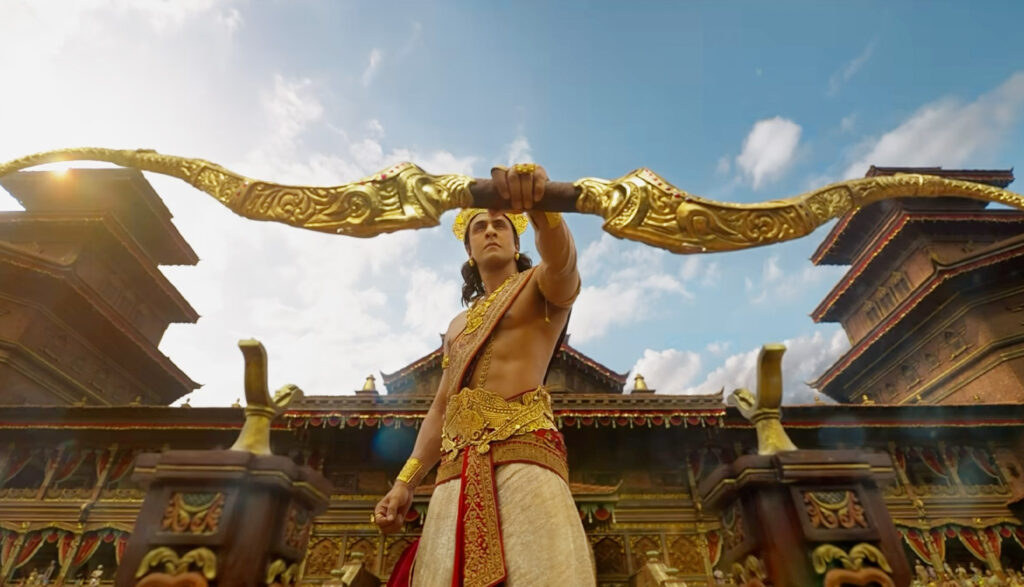
Ram doesn’t display any supernatural powers or abilities as he grows up. But when he comes of age, he goes on a pilgrimage of his own. During his travels, it’s revealed that he is Vishnu’s avatar, and he completes tasks and trials to earn gifts from the gods. By the film’s end, he is in possession of Vishnu’s divine bow and a quiver of arrows that never runs out. He can also summon the powers of the gods through sacred prayers. In one battle, he uses these powers to create a tornado that sweeps up his enemies. Then, shooting a fiery arrow into that twister, he immolates them all.
Lakshman, by joining Ram on this journey, also winds up earning some deific weapons and powers. At one point, he uses these to create a powerful protection barrier that no demon can cross.
The Asuras are shapeshifters, so we see them adopting the guises of animals and humans alike. More than a few Asuras are giants, including one of Ravana’s brothers. Demons plague several forests, transforming the once lush woods into decrepit and dangerous landscapes. Ram and Lakshman slay several of these demons (who appear as snarling giants) to restore the woods to their former beauty.
We’re introduced to the “king of the birds,” Jatayu, who is essentially a giant humanoid eagle who can talk. Sages—men who essentially act as priests to the gods—are also important figures in the story. Most are simply wise men, but a few seem to have such strong divine connections that they can see into the future.
We see many rituals and prayers to the Hindu gods throughout the film. Sita is said to be the avatar of the goddess Lakshmi.
The bow of Shiva plays an important role here: It’s said that only someone who is worthy will be able to string it. As such, the king of Mithila, who is the bow’s protector, has issued a decree that any man who can string the bow will be given his daughter’s hand in marriage. When suitors try, they’re not even able to lift the bow off its pedestal. (Notably, Sita was able to gently lift the weapon when she was just a little girl—a testament to her virtue.) Ram becomes the first man worthy of carrying the weapon.
There’s a lot of talk about dharma throughout the film. It’s always a challenge to distill complex aspects of other religions into a movie review, but essentially, in Hinduism, dharma is like a divine moral code that guides everyone and everything. Ram is unwilling to break his father’s orders to go into exile because of dharma. Sita and Lakshman travel with Ram into exile because of their own sense of dharma. And Ram believes that by honoring his dharma, he will discover his fate.
Speaking of fate, that also comes up quite a bit. Sages tell Ram that his fate will be determined by his choices, but for a while, Ram doesn’t seem to understand: He simply goes along with whatever life throws at him, trying to uphold his dharma. However, by the film’s end, he realizes that he is in control of his choices and determines that he will write his own fate.
We also hear a bit about karma, a sort of cosmic comeuppance that keeps the universe in order. More than a few characters (mostly bad guys) wonder if their unfortunate circumstances are the result of karma.
Several characters ride mythical steeds, including a winged elephant and catlike beasts. Indra uses his powers to rain lightning down on some foes. Ravana marks a horse with blood to make it “sacred.”
Ram’s people revere him with a devotion that borders on worship. People say “Glory to Prince Ram” on several occasions. Ram and Sita’s devotion to each other, while good, borders on idolatry. At one point, Ram tells Sita that he would not accept heaven without her.
A man sees a vision of his own death in a dream. Someone blows some magical dust to bewitch a woman. We hear about planets aligning.
Ram is smitten by Sita from the first moment he sees her. (Sita is similarly smitten, even praying to the gods to make Ram worthy of asking for her hand.) They get married soon after meeting—and after Ram proves himself worthy—and it’s clear that they are deeply devoted to each other.
Surpanakha, the sister of Ravana, is devastated when her husband is murdered. Although it was a political marriage, she had fallen in love with him. (He was a pig, however. Just before his death, he had grabbed a servant girl and pulled her into his lap as a sort of snub to his wife and brother-in-law.) However, Ravana refuses to acknowledge her pain, saying she should just find a new husband.
As such, Surpanakha becomes drawn to Ram when she meets him. She tries to seduce him, offering to become his second wife, but Ram refuses. He tells her his heart only has room for Sita. Surpanakha tries to trick Ram by taking the guise of Sita, but her plans are foiled. She then blames Ravana for her failure, saying that if he hadn’t killed her husband, she never would have desired Ram.
Ram’s father had three wives. There’s a stark difference between the way human women dress and the way Asura women dress. Sita and other humans dress modestly, donning saris that cover their entire bodies. Surpanakha and the Asura women, however, wear tops that show cleavage and their entire midriffs. These tops are often adorned with jewels, making them stand out even more. There’s no difference in the way men dress: Almost every man is seen shirtless or draped in garments that show off his chest and belly.
Battles are almost constant in this film, but we rarely see blood. When characters die, they simply fall down, and the weapons are not stained with blood. There are a few notable exceptions, however.
Lakshman gets sliced across the chest during a pivotal fight, and blood stains his tunic. When Surpanakha tries to trick Ram, Lakshman loses his temper and strikes the woman with a sword, scarring her face. (Many of Surpanakha’s brothers go to battle to seek revenge for this insult.)
Jatayu, the eagle king of the birds, attacks Ravana. He carries the Asura in his claws and rams him into the side of a mountain while in mid-flight. Ravana uses a magical sword to cut off one of the bird’s wings, and Jatayu responds by cutting off Ravana’s head. While Ravana’s immortality heals him, Jatayu has no such powers. Ravana fatally stabs Jatayu and throws him off a blimp. And we see the bird splayed on the ground as he takes his last breaths.
Vidyutjiva, the husband of Surpanakha, grows jealous when a battle feast is given in someone else’s honor. He insults his brother-in-law, Ravana, so Ravana challenges him to a duel. During the fight, Vidyutjiva is unable to land even one blow on Ravana, so he surrenders. However, Ravana is still angry, so during what is supposed to be a peaceful hug, Ravana crushes the man in his arms, breaking bones and killing him. He later says that this was a merciful, quick death compared to what he would have done to an enemy.
Giants sometimes crush people underfoot. Ram, Lakshman and Sita kill many foes during a battle—with Ram using his quiver of unending arrows to take down many enemies at once. More are killed when Ram fires an arrow to knock down a boulder. The boulder crushes several soldiers, but it also creates a ripple effect, collapsing the plateau those soldiers are charging across. Ram uses his mystical powers to immolate many foes trapped within a tornado.
When Ravana goes on his pilgrimage to appeal to Brahma, he nearly dies: Exposure to the elements, bloodied feet and fierce beasts all threaten his safety.
When King Dashrath is asked to crown Bharath instead of Ram, he doesn’t want to fulfill his duty. He asks Ram to kill him, knowing that his death would free Ram from exile. Ram refuses, choosing instead to honor the vow that his father made to the queen.
Ram is initially against war, only resorting to battle in self-defense. However, when Sita gets kidnapped, he vows to kill anyone who stands in his way.
None.
During a feast, a man becomes increasingly drunk, ordering more and more wine and insulting his host about not having enough.
After Indra and the Devas defeat the Asuras in an early battle, the Asuras are forced underground. There, the people are starving. Their only food is a bit of rice that a kind servant purposely spilled.
Ram is initially hesitant to kill a female demon since it’s against his dharma to harm women. However, after someone tells him that evil knows no gender, he kills the beast without question.
Ram’s stepmother raises him as her own. However, when Ram and her birth son are fully grown, she allows herself to be manipulated by a maidservant. That old crone convinces the queen that Ram will banish her and her son if she doesn’t demand that the king crown Bharath instead. Notably, the queen’s actions don’t anger Ram: They sadden him. As he leaves for his exile, he tells her that he hopes they’ll reconcile one day. When Bharath finds out what his mother did, he grows angry and threatens to cut her off. However, Ram tells his brother not to hate her.
Sita is kidnapped by Ravana.
Ramayana: Rise of a Legend is deeply rooted in Hinduism. We hear all about the Hindu gods and see people praying to them. We also hear a lot about some non-human entities. And there’s a lot of emphasis put on dharma, karma and sages.
If you look at all of that from a fantastical, mythological standpoint, then Ramayana may be navigable for many families. There’s almost no sexual content, zero language and battle sequences are kept mostly bloodless. And the narrative itself is quite entertaining.
However, that doesn’t mean you should just watch this film without considering those spiritual elements. This isn’t mythology in the sense of Hercules or even The Odyssey. For the most part, we don’t have a whole lot of people worshipping Zeus and Athena anymore. But there are around 1.2 billion people who currently practice Hinduism worldwide. To them, this isn’t mythology—at least, not completely—it’s history.
That makes Ramayana a lot heavier that you might have expected, and it’s definitely worth considering before diving into this three-hour epic.

Emily studied film and writing when she was in college. And when she isn’t being way too competitive while playing board games, she enjoys food, sleep, and geeking out with her husband indulging in their “nerdoms,” which is the collective fan cultures of everything they love, such as Star Wars, Star Trek, Stargate and Lord of the Rings.