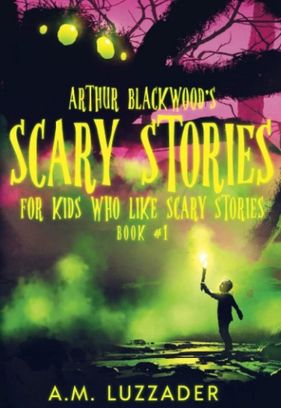
Arthur Blackwood, collector of scary stories and frightening fantasies, welcomes young readers into his parlor. His is a house that’s warm enough to give comfort while his tales run a chill up your spine.


Arthur Blackwood has stories to tell. Dark stories, familiar yarns, frightening tales—and he recounts them with passion.
Arthur tells of Finn Finnegan and his younger sister, Durvla, a pair of nasty grade-school bullies who deserve a comeuppance. And there are a bunch of red-eyed jackrabbits just waiting in the shadows for a chance to give it.
Then there’s Robby Dobalina, a boy who’d prefer spending his whole day playing video games than wasting one minute in a museum. But when he spots a mysterious room in a hidden corner of the museum his mother has dragged him to, he’s intrigued. It’s a room full of armor and weapons. And he can’t help looking and touching. Touching, however, is forbidden!
Arthur also likes to recount Oliver Whistler’s tale. Oliver has a secret. It’s something that weighs on him and tugs at him. It chews at him. Oliver tells himself that he can keep this mystery hidden, but then he ventures into a fortune teller’s tent. She shows him her crystal ball, and in the center of that mystical object, Oliver sees his secret with all its teeth bared.
These are but three of Arthur’s stories. He tells of a freezer-cold cellar, a forest of spiders, a boy and his sly doppelgänger. And Arthur warns you about hearing or reading any of his tales at night, when the dark presses in and shadows shift.
You’ve been warned!
The book doesn’t deal with biblical faith. However, there is a story of a boy who visits a fortune teller. (The Bible strongly forbids this practice, calling consulting with mediums a detestable practice.) In the story “The Secret of Oliver Whistler,” the fortune teller lets Oliver look at her crystal ball. And when the boy sees evidence of his own sin there (cheating on tests), the fortune teller warns him that his secret will destroy him if he doesn’t admit his wrongdoing.
A girl tries to fool a pair of bullies by saying that she is a witch. And she warns the bully siblings to stay away from (and in so doing, entices them to go to) a place that she says is “cursed.” “It’s hexed,” the girl proclaims. “It’s full of witchcraft.”
The short stories here ask young readers to imagine the possibility of some supernatural creatures. That group includes instantly materializing rabbit monsters, a werewolf, magically imbued medieval armor, gigantic spiders and a doppelgänger, which one character defines as a “spirit or demon that takes on someone else’s appearance.”
Early in the book, we’re introduced to Arthur Blackwood who simply wants to entertain his young guests with chilling (but not too scary) tales.
Several parents and teachers get mentioned in Arthur’s stories. And all of them appear to be thoughtful individuals who strive to protect or teach their young charges.
Someone asks, “What the heck is that?”
There are several thumping scenes in the story mix. The messiest moment features a boy thwacking a tarantula spider with a comic book and killing it. That story also shows the boy swarmed by spiders and being knocked to the ground by a huge Spider Queen (though the spider then leaves him unharmed).
There are bullies who hit kids in the head with textbooks. A hairy, clawed hand shuts a door, implying that a werewolf dwells within a room. A family almost hits a moose with their car during a snowstorm, and a young boy imagines that it’s a deadly monster. A boy is chased by a raging gorilla. A couple of children are surrounded by an ever-growing and squeezing flood of wild-eyed rabbits.
None.
Have you ever been scared late at night by something that you saw in the shadows? Was it really scary or just your imagination?
Sometimes we actually like being a little scared by stories or movies. But when things get really scary, do you know what the Bible says we should do?
Philippians 4:6-7 tells believers to pray instead of worrying. And 2 Timothy 1:7 states that God gives us a spirit of “power and love and self-control,” rather than a spirit of fear.
Take a look at Isaiah 41:10, Psalm 34:4 and Psalm 56:3. What do you think those verses are telling us?
Author A.M. Luzzader’s book of short stories is designed for beginning and young readers. The tales are creepy, without being intense, harshly violent or bloody in any way. Some of the stories also incorporate light admonishments against cheating, bullying or choosing to harm defenseless creatures.
Parents should note, however, that some of this collection’s stories dabble in the supernatural (including a carnival fortune teller, an implied werewolf, a magical suit of armor and glowing-eyed beasts). And there are mentions of curses and witchcraft.
You can request a review of a title you can’t find at letters@pluggedin.com.
Book reviews cover the content, themes and worldviews of fiction books, not necessarily their literary merit, and equip parents to decide whether a book is appropriate for their children. The inclusion of a book’s review does not constitute an endorsement by Focus on the Family.
After spending more than two decades touring, directing, writing and producing for Christian theater and radio (most recently for Adventures in Odyssey, which he still contributes to), Bob joined the Plugged In staff to help us focus more heavily on video games. He is also one of our primary movie reviewers.