

Well-rounded characters and a protagonist who values all life are worthy selling points for families, but the detractors in Princess Mononoke are just as encompassing. Surprisingly brutal violence and murky spirituality will likely ward off younger animation fans from riding into director Miyizaki’s beautifully animated but thematically dark world.
How might you react if you were told your life would soon be cut short by a terminal condition? Such news could garner a multitude of reactions: Perhaps it would seem necessary to spend your final days with family and friends. Maybe check off a few crazy activities that have long been dormant on a bucket list. Ashitaki’s death sentence isn’t quite like that, though.
A demon boar attacks Ashitaki’s village, its hatred for humans manifested into pure evil. Ashitaki protects his village, but that evil leaves a painful burn on his arm. Now, he must venture alone into the woods to find a cure for his cursed appendage and discover the source of the hatred that infected this godlike creature.
On his journey, Ashitaki witnesses a brutal battle between two human factions, and he helps two injured soldiers return to their home in Iron Town after the carnage subsides. There, he meets Lady Eboshi, the town’s leader, who has worked to transform Iron Town into something of a safe haven for marginalized peoples. Eboshi provides those peoples with food and housing in exchange for laboring in her iron factories. However, it’s these same factories that are responsible for the demon boar that attacked Ashitaki’s village. Laborers are tearing up the surrounding forests to find resources for the factories—a fact that is not an easy pill to swallow for the surrounding animals, spirits and gods.
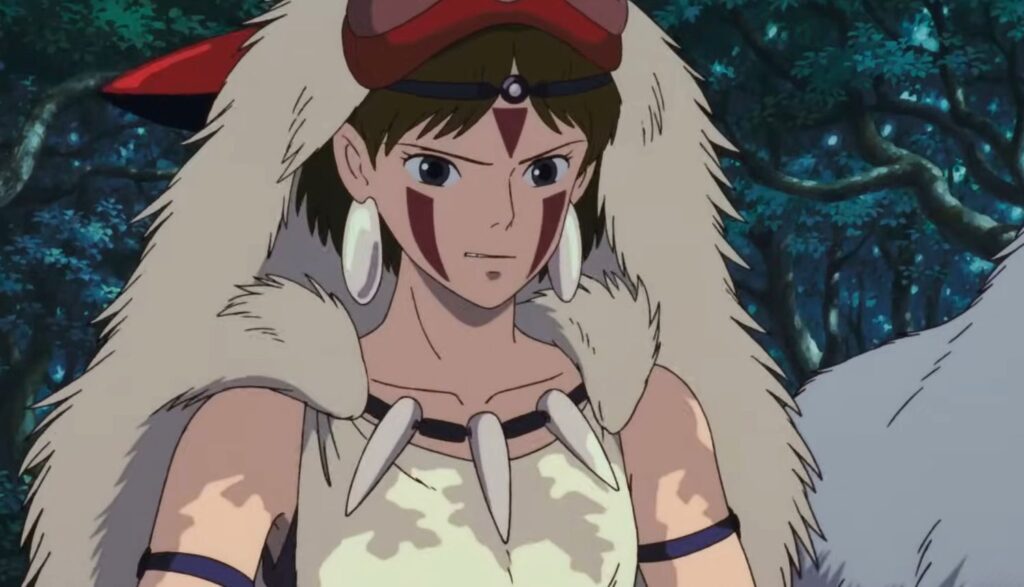
Now, caught in the middle of this war between greedy humans and terrified animals, Ashitaka meets San—a human girl raised by a wolf goddess who is a consistent foil to the human’s industrial progress. But how can one human intercede in a conflict this massive? And if Ashitaka doesn’t find a way to instill peace, will anyone be left to call the forest home?
Most all the characters in Princess Mononoke, even the villains, show a certain level of bravery, standing up for what they truly believe is right. Lady Eboshi, although acting as the main catalyst for war, uses her power and influence to set up a new line of work for women who used to work in brothels. She has also employed lepers; they claim that Eboshi took time to clean and care for their lesions when no one else would.
Ashitaka’s commitment to peace is the most admirable element of the film, though, as his affirmation of life extends not only to his friends, but his enemies as well. Ashitaka only allows violence as an unsavory last option to end conflict, or in self-defense. This confuses many people, and at one point in the film, a soldier asks, “What side is he on?” Ashitaka chooses to save the lives of those who previously made attempts to kill him and his friends.
Ashitaka’s motives are altruistic. He has seen firsthand the devastation that hatred causes to both the person doing the hating and to those around them, and he wants to protect everyone from those spiritual effects.
There are some messages here about preserving the beauty of creation, but mostly, the movie encourages a balance of protecting the animals of the forest and the humans who need the forest’s resources to survive. Over time, Ashitaka begins to earn San’s trust through mutual respect and a desire for humans and nature to coexist peacefully.
Spirits, gods and demons are common entities here. The film borrows from Japanese folklore, in which gods are powerful, but not all-powerful. These beings are depicted as vulnerable, although they are hard to kill. Together, Ashitaka and San are trying to avoid the ramifications that will follow if the forest spirit perishes. It is said that if the spirit dies, the forest will die as well—along with San herself, whose soul has been tied to the forest in some way.
By the film’s lore, gods can turn into demons through unbridled hatred (which is what happened to the boar demon that attacked Ashitaka’s village). Given how human actions have turned parts of the forest into a desolate wasteland, these spirits have plenty of reason for hate. Their demonic forms are quite frightening, as the beasts are encompassed by deep red tendrils and thrash about in fits of rage. While the demons are certainly scary-looking, it should be noted that the word demon is interchanged frequently with monster. It certainly feels like the movie wants its audience to view them as just that: spiritual monsters rather than anything riffing off of biblical demons.
San was raised by a wolf goddess after her parents hastily submitted her as an offering out of fear. It is said that she is the “princess of the spirits, of ghouls and beasts and ancient gods.” A character recalls a time long ago when gods, nature and humans all lived in harmony.
Little forest spirits called the kodama are said to bring good luck. The little pale creatures bounce around tree branches making a curious clicking noise. The main forest spirit materializes in several different forms, including an elk-like creature with a human face.
A “wise woman” uses stones to read the fortune of a supposedly unlucky individual. The mark left on Ashitaka’s arm from his encounter with the boar demon provides him with momentary bursts of supernatural strength. In order to appease both gods and demons, characters throw out phrases like “calm your fury, almighty lord” and “god of rage, I bow before you.”
After having its head severed, a god turns into a large, vengeful spirit. Ashitaka has a prescient vision of some animals dying.
Several of Lady Eboshi’s female employees either worked, or still work, in brothels. They wear robes that reveal some cleavage. This group of women also make some sensual innuendos to Ashitaka, commenting on his looks. One says, “He’s so young,” while another jokes, “That’s never stopped you before.”
Many male characters saunter around in nothing but a loincloth. We see other men remove their shirts. While clearly not having human anatomy, the kodama’s bare backsides are defined and on display throughout the film.
Ashitaka comments on San’s beauty, and we see their feelings for each other blossom throughout the course of the film. Ashitika holds San close in a scene later in the film.
While those familiar with other Studio Ghibli films will likely be familiar with their mystical sense of dense spirituality, Princess Mononoke features a level of bloody violence not common in those other films.
Battle scenes depict men dying from swords, spears, musket-esque guns, explosions, arrows and blow darts. Heads and limbs get lobbed off, typically with a gush of animated blood accompanying the dismemberment. The ongoing conflict between man and nature has had catastrophic results on both villages and forests alike. The introduction of more advanced guns results in people, landscapes and buildings getting blown apart.
A demon boar covered in crimson tendrils attacks a village. The creature is shot in the eye with an arrow as its skin and flesh melt into a pile of bones. Dozens of animals suffer bloody injuries, falling victim to arrows, bullets and explosions. Blood gushes from their wounds, and both human and animal bodies are scattered throughout battlefields.
Ashitaka gets burned while fighting the boar demon, and it causes him pain throughout the rest of the film. It writhes and contorts underneath his sleeve in several scenes, and if he can’t find a way to remove or cure the cursed wound, it will kill him.
A wolf goddess repeatedly threatens to chomp off the heads of humans. It smashes through a small battalion of soldiers, pushing a few off a cliff. After the creature is injured with a poisoned weapon, a girl sucks the contaminated blood out of the wound and spits it out. Battle scenes between animals and humans can be surprisingly brutal, with both people and beasts landing bloody blows to the other. Ashitaka has a vision of a large group of boars dying from an explosion, and his foresight becomes reality later on in the film. A group of apes express their desire to eat humans as revenge for what has happened to their beloved forest.
A group of soldiers attacks unarmed villagers. Ashitaka describes as a “massacre” before he races over to intervene.
Lady Eboshi tells Ashitaka that in order for peace to be achieved, her whole clan would have to be killed. Townsfolk begrudgingly discuss how it always seems to be their friends and family who are sent into battle, not the emperor’s guards. Soldiers wear the skins of dead animals, either to taunt or blend in with their enemy.
After a god is decapitated, a thick ghostly slime emits from its body, growing into a tall vengeful creature that decimates everything in its path as it searches for its lost head.
A fire and a great wind cause quite a bit of damage to a village. A group of samurai attack a village of women after finding out that all the men have left.
We hear a few uses of “d–n,” and a use of “b–tard” and “h—.” There are also a couple misuses of God’s name. Name-calling includes “idiot,” “coward” and “runt.” A character exclaims, “What the devil!” twice.
A character mentions drinking sake, a Japanese liquor. It appears that characters are drinking alcohol in a few scenes, but all we see is dark liquid in glasses.
The war that takes place in the film only becomes so devastating because human characters are unwilling to have a conversation about peace. Some women make light of the war and the lives that have been lost because of it.
The strength of Princess Mononoke lies in Ashitaka’s strong conviction that all life—whether human, animal, spirit or plant—matters. Rather than accepting his death sentence and spending the rest of his days in selfish pursuits, he instead spends the film’s runtime trying to prevent conflict and spreading the virtue of peace. And as tensions escalate and war seemingly becomes inevitable, his efforts to stop the violence and preserve life only grow more desperate. Ashitaka knows that killing Lady Eboshi—or at least letting someone else kill her—would make this conflict more manageable. Instead, he continually tries to talk her down, to help her see reason. And in one scene, he even saves her life.
Lady Eboshi is a compelling villain because, instead of grandiose speeches or fits of dramatic rage, she stays calm and collected. She protects marginalized groups of individuals, and she believes that her actions are justified because of the people she’s helped. However, it’s this false sense of righteousness and tunnel-visioned line of violent thinking that nearly brings about her demise.
Discerning viewers should consider the film’s murky spirituality before diving in. Like many Studio Ghibli films, it derives that spirituality from Eastern traditions and folklore. As such, we see powerful gods and demons battling against humans. And those battles can depict a lot more bloody violence than fans of animated films may be used to seeing.
Still, director Hayao Miyazaki’s films are epic, vibrant, terrifying and beautiful. Princess Mononoke may be the best example in his entire filmography of how a director can get his point across without feeling preachy. Scenes showcasing the carnage of battle are juxtaposed here with the serene beauty of nature, demonstrating the sinful nature of humans while still remaining a very hopeful movie. And while the world of this film is heightened with fantastical elements, it will likely leave audiences making comparisons to our own world.
In a land of gods and demons, Ashitaka is a human who continually chooses peace over conflict, love over hate. There’s something very potent about his optimism: It’s not ignorant, but persistent. And while it’s doubtful that most Christians will ever be in a situation half as pressing as stopping a war between nations, we can uphold a similar level of unshakable conviction to be peacemakers to those around us.

Jonah Parker’s first interaction with Plugged In came when he was just five years old, after his parents read a review for The Chronicles of Narnia: Prince Caspian and deemed the content too intense for him. What started out as a contentious relationship between Jonah and a staff of reviewers who knew not of his existence would later turn into an appreciation for the site’s ability to present media content in a way that was accurate and fair. Jonah enjoys analyzing how our entertainment echoes the creativity of our Creator while finding glimpses of Biblical truths within every genre. He believes that Robert Pattinson’s Batmobile is the perfect mix of cool and practical.