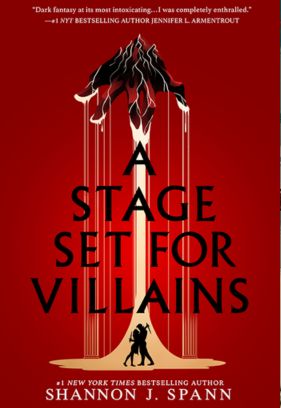
A Stage Set for Villains

a stage set for villains

Credits

Age Range

Publisher

Awards

Year Published

Reviewer

Bob Hoose

Book Review

Riven Hesper is slowly dying from a curse. And it’s all connected to the godlike Players of the magical Playhouse. Each Player is incredibly powerful and virtually immortal. But Riven has a plan to bring the whole enchanted place tumbling down.


Plot Summary

Eighteen-year-old Riven Hester walks into the open courtyard of a place called the Playhouse.

In truth, though, there’s very little that’s playful about this dark theater that magically jumps from town to town. In fact, the strange, enchanted Playhouse is the crux point of the ongoing political and social conflict between the North and the South. It’s a place of entertainment that draws attention from the masses in a way that borders on religious fanaticism.

A big part of that public fervor is thanks to the performers in the Playhouse: the Players. These tall, glowing, incredibly powerful individuals are all beautiful. They’re in love with their own inestimable charm and their ability to bend reality itself with a magical Craft—allowing them to literally die onstage during a play with no harm to themselves.

Riven, however, is well aware of the harm caused by the Playhouse and its cast members. Her father died mysteriously at the Players’ hands years before. And Riven herself was “cursed” in a childhood encounter with one of the superhuman Players.

In the 10 years since, Riven has turned from a vibrant young girl into a hollow-eyed adult that people tend to blanch at. She’s thin, frail, deathlike. But she has a plan.

You see, the Playhouse recently announced the spectacle of a lifetime: a chance for one mortal to steal a Player’s immortality and take their position onstage. And with that amazing opportunity, Riven sees her chance to infiltrate the Playhouse walls and find some answers she so desperately seeks.

Where does the Playhouse and its Players get the power that swirls about this magically traveling place? Why are the Players allowed to continue unabated if they are as dangerously powerful as they appear to be? Where do the stories that the Playhouse presents come from? Is there a way to break the Players’ rapturous hold on the public at large? For that matter, is there a way to break Riven’s curse?

The list of Riven’s questions stretches on and on. But there’s one query she isn’t asking quite yet: Is she the hero of this story …

… or its villain?

Christian Beliefs

None.

Other Belief Systems

The Players are presented as “godlike” characters who are brilliantly attractive and who can control people’s choices and actions with a word. In fact, the only barrier from that control—and the only thing that can harm a Player—is Eleutheraen gold. People in the North embed that substance into the skin on their upper chest in a protective symbol called the “Mark.” An aftereffect of the Mark is that its bearers cannot lie.

The Players also have an otherworldly ability to connect to the theater and each other called the “Craft.” It allows them to not only magically reshape the stage, its costumes and its settings—not to mention physically reshape themselves—but it allows them to connect mentally and psychologically with the watching audience. The Craft also gives the Players an interdimensional connection with each other that reverses any physical damage they might sustain in the midst of a performance.

The Playhouse is also magically enhanced and populated by magical creatures. For instance, the Playhouse can magically repair its own structural damage. And the stage manager, Nyxene, is a powerful magical creature that crawls around in the shadows of the Playhouse. It’s said that those who break the Playhouses rules will be ripped limb-from-limb by this creature.

[Spoiler Warning] Eventually, it’s revealed that the Players are actual humans who are possessed by spiritual entities that long ago “replaced the old gods.” These entities wear humans like stage costumes, keeping them until they want to inhabit a different host. At that point, they shed the skins and slip into a new human. Once a human becomes “self-aware,” however, they begin to die bit-by-bit: Their skin begins to slowly crack and peel away from the glowing golden entity within.

In a sense then, spirituality in this fantasy world becomes something of a parasitic religion of art. The “immortal” Players demand absolute worship, and in so doing, they replace traditional divinity with theatrical spectacle. This dark, performance-based belief system utilizes psychological manipulation and rituals of mass submission that fuel the Players’ power.

Riven was “cursed” as an 8-year-old through this same process. The golden blood of a wounded Player splashed on her arm and was absorbed, giving her a slow, wasting illness until later contact with the Players reverses it.

There are some references to Greek gods in the story mix. Someone mentions Hades, for instance, and it’s said that the Players’ connection and powers originated from “the blood of the slain Greek god Dionysus.”

Someone suspects that the ghost of someone who died is haunting the Playhouse. But we find out that it is actually a Player who didn’t die as some believed.

Authority Roles

Silenus Darstellar is the strict, manipulative director of the Playhouse. He wields absolute authority over the Players using a magical artifact called the “Script” to dictate their actions—actually writing the scenes of their lives on and off stage and controlling their destinies.

Galen is Riven’s older brother, an important figure in the protagonist’s life. He takes actions to protect his sister but ultimately drives a wedge between the two of them.

Jude Stepharros is the lead Player. He commands the fanatical devotion of the unmarked masses. Desperate to avoid fighting in the upcoming Great Dionysia tournament, he strikes a bargain with Riven and uses her as a pawn.

Mattia is the oldest Player and specializes in roles that emphasize her snake-like, lethal grace. Arius is the most gentle and charming Player. Parrish is an energetic Player who appears childlike but displays disturbingly macabre habits, collecting gory trophies from the people she kills. And Titus is a powerfully built Player who projects his physical dominance onstage. Offstage, he acts as the brutal enforcer of the theater’s strict rules.

Profanity & Violence

F- and s-words are scattered throughout the story, along with uses of “d–n,” “a–” and “godsd–ned.”

Players lounge around and drink cups of wine. People use a drug-like concoction that has Eleutheraen gold in its mix. It weakens Players and causes them to lose their abilities.

There are a number of bloody scenes where people are commanded by a Player to injure themselves. For instance, a woman cuts out her own tongue and bleeds out, another individual gorily beats her own head on a marble step, others slash their own throats. People are impaled by spears, arrows and various blades.

Magical creatures attack people with sharp teeth and claws. We hear of one human getting torn asunder. Someone gets battered by attackers, and her ribs get painfully broken. Riven’s Mark is seared off her chest, leaving her in agony. Player’s bodies begin to leak golden blood as their skin shreds. A Player unleashes a dark plague that leaves humans blind and staggering. Etc.

It’s also revealed that trusted figures in Riven’s life weren’t always honest with her. She comes to realize that some things she held fast to as important truths were actually lies.

Sexual Content

The Players are well known for their universal appeal and the fact that their many, many sexual dalliances have no gender boundaries. We hear of instances where players pull men and women off for sexual interludes. (Though none are described.) However, Riven does have something of a love/hate relationship with one of the Players. They eventually embrace and kiss passionately.

Discussion Topics

None.

Additional Comments

Author Shannon Spann’s debut novel, A Stage Set for Villains, is a dark fantasy novel with a bit of slow-burn romance in its makeup.

Spann has woven in easily recognizable parallels between her fantasy world and our own world. And she delivers warnings about the way we sometimes allow media and entertainment to heavily influence our choices and even control us.

The book also challenges readers to stop and consider their own perceptions of good and evil and whether those perspectives are based on actual truth or a “truth” that’s been spoon-fed to them by others.

Parents of younger readers should be aware that there are some bloody and deadly moments in the story mix, along with instances of romantic sexual tension. And a large part of the fantasy premise here is focused on a rather dark spirituality, which includes people getting possessed by immortal entities.

You can request a review of a title you can’t find at letters@pluggedin.com.

Book reviews cover the content, themes and worldviews of fiction books, not necessarily their literary merit, and equip parents to decide whether a book is appropriate for their children. The inclusion of a book’s review does not constitute an endorsement by Focus on the Family.

Bob Hoose

After spending more than two decades touring, directing, writing and producing for Christian theater and radio (most recently for Adventures in Odyssey, which he still contributes to), Bob joined the Plugged In staff to help us focus more heavily on video games. He is also one of our primary movie reviewers.