



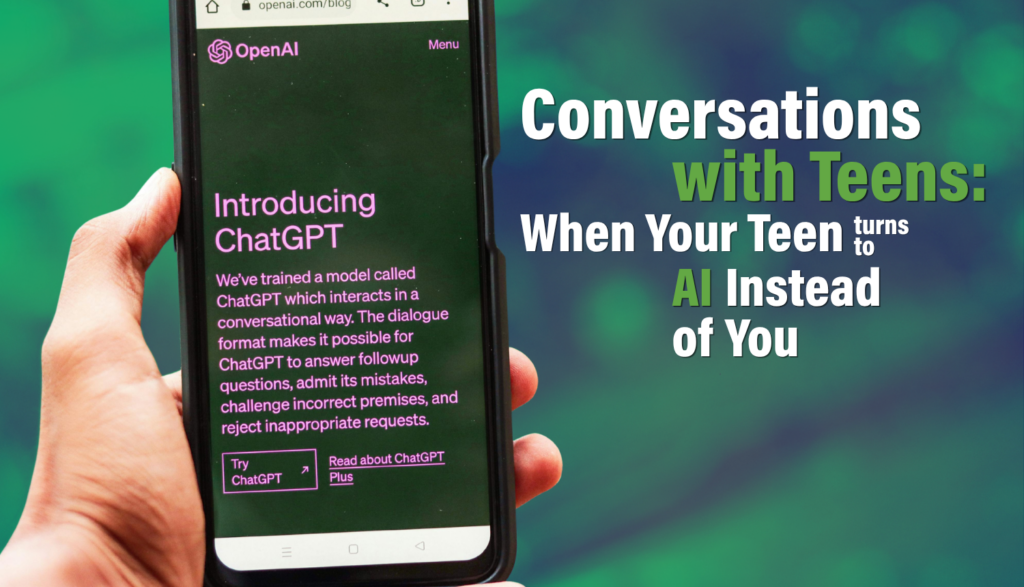
According to new research, including a national study published in JAMA Pediatrics, it appears that about 20% of young people between the ages of 12 and 21 turn to AI chatbots for mental health advice instead of going to therapists or the adults in their lives. And a Common Sense Media report declared that a whopping third of all teens regularly use AI companions for social interaction and relationships.
That adds up to a lot of teens bringing their thoughts and problems to a robotic program instead of talking with a real person. They slip away to chat with a synthetic mimic rather than stepping into the family room and saying, “Hey, uh, can we talk about something?” That sort of choice sounds nonsensical to the average mom and dad, but frankly, it kinda makes sense to the average teen.
Most of the surveyed young people point to a belief that a chatbot always has time for them. They declare that AI conversations don’t cost anything, they’re anonymous and that AI will always be non-judgmental. In other words, teens are convinced that no matter what the topic is, a chatbot won’t frown about anything. And when the conversation is finished, no one will know anything about what’s been said.
Problem is, none of those assumptions are actually true.
And Now, The Truth
It may feel to many people that chatbots are being non-judgmental and receptive. But that AI acceptance isn’t because of any ingrained empathy or understanding; it’s just part of a program. AI is stitched together as an entity of machine learning. It’s designed to “listen” and validate. It won’t and can’t really give any objective advice or insight. It feeds you back what you feed it. Now that’s a great tool for manipulation, and it’s a great tool to keep you talking, but it’s not so great at solving problems.
Oh, and that belief of total privacy? Well … not so much. When a troubled teen uses AI as a “friend” or “therapist,” the personal and emotional information they share is typically stored and analyzed. It’s then used to train AI models, give advertisers a heads up on the individual’s likes, or to fine-tune and personalize service.
In other words, that private, shared stuff isn’t tossed into the ether when everyone’s done chatting. It can be sold to any number of places or used for anything that the AI owner/programmers deem desirable. There’s no confidentiality agreement with this therapist. In fact, the secrets you spill become data that can be retained or reused indefinitely.
But it’s still anonymous, right?
Well, users will get a true sense of how “incognito” their discussions are when personalized product ads start pouring in for things they were just talking about. Oh, and if any individual were to “confess” to anything that might cross a legal line, they should know that all of that information can be subpoenaed under a court order. Your private murmurs to AI are not legally privileged.
How Do We Get the Conversation Ball Rolling?
OK. So what should parents do about this AI friend and therapist problem? I mean, it’s a normal and healthy thing for adolescents to want to talk about their feelings, their relationships and changes happening in their lives. And you don’t want them to shut down. It’s also very good for teens to talk openly, without getting instantly hit with a bunch of judgment. They need understanding and support, and they benefit from loving, kind guidance.
But how can we change a young person’s focus from AI (artificial intelligence) to HI (human interaction)?
Well, sharing some of the facts mentioned above can help. But getting into that kind of conversation could be awkward. Spilling out a list of “Here’s What I Hate About AI” bullet points might not land on accepting young ears.
So maybe raising questions about AI could be a better place to start. After all, teens generally consider adults to be far less knowledgeable about techy things than they are. And well-framed questions from a curious mom or dad can help your teen understand your concerns better, too.
So, think through some discussion-starter questions like the following:
- Have you ever had a conversation with an AI chatbot? Did you enjoy it? What was the draw?
- What’s the best reason for having a conversation with AI? What do you think is a really bad reason?
- I’ve been reading about the way people interact with AI. Can you explain it to me from your perspective?
- When people use an AI chatbot, what sort of things do they usually talk about?
- Who takes the blame if AI messes up or gives bad advice?
- I’ve been reading about the fact that anything you tell a chatbot can be kept and used by the AI Programmer/Owner. Are you or your friends ever worried about privacy concerns like that?
- Do people listen to your AI conversations?
Obviously, this isn’t a comprehensive list of questions but more of a guideline to the sort of questions you might ask. After all, questions get a conversation going, they can create a back-and-forth about topics like privacy, sound advice, respect and autonomy—elements generally absent from AI conversations.
The goal is to build trust and openness, giving you a chance to foster a solid connection between you and your kids and demonstrate your interest in their world. (Take time to realize that that interest is an ongoing process not a one-and-done question session.) Hey, you might even try using AI together, which could open the path to side-by-side discussions.
Hopefully, all of this can lead to situations where you set AI rules together and have a chance to answer questions that both of you might have.

Recent Comments