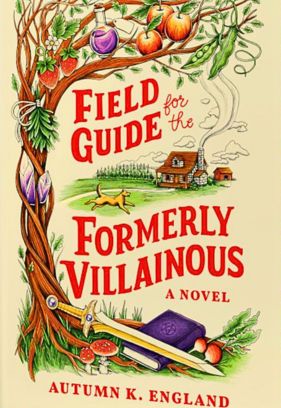
Field Guide for the Formerly Villainous

Credits

Age Range

Publisher

Awards

Year Published

Reviewer

Bob Hoose

Book Review

Oaklin Nettlewood escapes a magical cult and uses a dwindling purse to purchase a crumbling farmhouse and its land. Oaklin’s past memories—times of loss, pain and deadliness—are spotty at best. But there’s only one sure-fast rule that drives Oaklin forward: Never use magic! Never!

Plot Summary

It’s not an easy choice to join a cult. That’s especially true if that cult is all about ending the world through magical mind-control and deadly maleficence.

However, when Oaklin Nettlewood joined as a teen there was no talk of gory death and destruction. They simply welcomed young Nettlewood with smiles, pats on the back and promises of freedom from familial demands and worldly limitations.

Oh, and there was the assurance of magical powers! Don’t want to forget that. Of course, the powers were supposed to be the sparkling, life-changing sort, not the mind-twisting and tormenting stuff that the evil Enchantrix doled out.

(Maybe the name “Evil Enchantrix” should have been a clue.)

Anyway, after the resulting horrible war ended, Oaklin somehow survived cult life with little but a Swiss-cheese memory and a very heavy load of emotional trauma. When Oaklin limped away, starting over seemed like a good idea.

Miraculously, there was a small, crumbling farmhouse outside a town called Mossley’s Rest, a house with acres of seemingly fertile land. No one else wanted it. And it fit Oaklin’s meager budget perfectly.

In fact, Mossley’s Rest seemed like the perfect place altogether. It was quiet and green and friendly and … restful. Nervous as Oaklin was about being found out as a former cultist, the local townsfolk were as welcoming as one could possibly hope.

Some in town, such as the local librarian—a comely female paladin with muscular shoulders and arms—suggested that Oaklin might just find more than friends there. Ahem.

In any case, getting the farmhouse patched up and figuring out how to make a living off the land are Oaklin’s first objectives. And they’ll gobble up plenty of this quiet newcomer’s time.

Just keep your head down. Stay calm. Don’t look out of place. Figure out how things work, Oaklin mutters while nailing, digging and patching. And it all starts to feel a bit like a sort of mental and physical therapy. It feels good to be normal.

But Oaklin can’t escape magic.

I mean, lots of folks in these small towns use magic in their work. The village bread mage in Mossley’s Rest, for instance, makes a magic-infused muffin that’s to die for. His baked goods even bolster your mood and wellbeing thanks to their magical glaze.

But Oaklin can’t lean upon any latent magical powers, no matter how much of the stuff seems to emanate from the very land about the farm. Magic is off limits. Magic is dangerous. And Oaklin is quite happy to put in whatever it takes to scratch out a life without any of it.

That non-magic campaign seems to be working just great for a while. But then the ghost of the farmhouse’s former owner shows up. And this ghostly, grumpy granny drags Oaklin out of bed with a list of demands—farming demands, magic demands.

Looks like farming in Mossley’s Rest may not be as restful as Oaklin had hoped.

Christian Beliefs

Christian faith isn’t a part of the spiritual structure of the Mossley’s Rest community and surrounding areas. But to a large degree, the story is focused on Christian principals such as forgiveness, redemption and loving acceptance.

Oaklin is very fearful that the townspeople will automatically reject anyone associated with the Enchantrix’s cultish forces. The Enchantrix had magically bent both friend and foe to her will through magical mind control. And even though the cult members were “essentially” not to blame for their actions, Oaklin felt that the cult’s actions were unforgivable.

However, the majority of the people in town are very willing to forgive and help everyone rebuild their lives. They all rally together, helping one another and sharing what little they have. Oaklin meets another former cultist, and the people in Mossley’s Rest embrace both of them with open friendship, offering them a chance to start over as redeemed and forgiven individuals.

Other Belief Systems

All of the above said, there are various “gods” that the people of this world mention and put their faith in. One individual proclaims, for instance, that his family are “followers of Eorna, the goddess of hearth and grain.”

Mossley’s Rest is built around a temple of the Three Above, a prominent trio of gods or deities representing “the daytime sky, nighttime dark, and heavens.” This large temple is not only the main building in town, but it houses the town library. The religious organization represents the main force that protects the citizenry with temple paladins.

However, the order is more feared than respected by the people. Loir is one of the order’s few members who appears devoted to her faith. When she prays, she glows with an inner light. Another devoted individual prays and rids someone of a curse.

On the opposite end of the spectrum, a church inquisitor rides into the peaceful town of Mossley’s Rest and declares that “The Three Above will see you judged and punished,” before casting a curse on several people.

Of course, this is also a realm of magic. And though not many wield powerful magic, most people use it in one form or another. We also meet the deceased former owner of Oaklin’s property who presents herself as an insubstantial ghostly figure that’s more shadow than form. She was formerly known as the “Village Witch” who used her magic to protect the fields from drought and the scourge of insect infestation. Oaklin is eventually called upon to take over those magicking duties.

The book also presents a philosophy of finding inner peace and a sense of oneness when you care for and protect nature.

Authority Roles

Oaklin develops good friendships with: Ryn, a kindly and gifted baker who goes out of his way to help the newcomer and make sure that Oaklin’s early basic needs are taken care of; Jules, a talented songster who sings in the local tavern and rallies the townspeople with good song whenever needed; and Lior, the beautiful and kindhearted paladin who protects others while also being sensitive to their need for books and educational literature. For all her muscular strength, Lior is gentle and giving.

On the other hand, Sister Tally is painted as a difficult and hard-nosed sister of the Three Above church. But we later learn that she was a good friend to Granny the ghost and was well aware of her friend’s great pain and loss.

We never meet the Enchantrix, but through Oaklin’s slowly returning memories, we see her as a foul magician who uses her great power to horrible and bloody ends. The Enchantrix manipulated an army of mind-numbed people, including Oaklin.

Profanity & Violence

There’s not an abundance of profanity and crude language in this story but we do see f- and s-words along with uses of “h—,” “a–” and “godsd–mit.”

Oaklin and friends gather and drink freely at the tavern. They get tipsy in their revelry as well. We read mentions of drinking wine with meals.

We see memories of bloody acts and killings. It’s not gruesomely specific, but it’s clear that many people died during the horrors of war. Oaklin laments the deaths that they caused during the war.

Sexual Content

Polyamorous sexuality swirls in and around everything in this fantasy land. There are a number of same-sex, opposite sex and non-binary couples presented here. And they all seem ready to engage in sex with anyone that takes their fancy. In fact, sexual attraction is presented as an openly fluid and by-the-moment thing with no particular boundaries.

One man, who used to be in a male/female relationship, for instance, is easily open to same-sex flirtations and relationships.

In another example, the protagonist Oaklin is presented as a non-binary individual that the author takes pains to mask as neither male nor female. Oaklin is addressed as they/them. However, Oaklin talks of having sweaty “chest bindings,” and the story hints elsewhere that, biologically, Oaklin is a woman hit on by both men and women. And Lior, a woman who “isn’t into men,” falls head-over-heels for this newcomer.

Oaklin also flashes back to snippets of memories of “kissing a blacksmith’s daughter” and “flirting with a local farm boy.” A farmer’s wife winks at the popular Oaklin, promising a “night of fun.” Eventually, Oaklin and Lior begin kissing and caressing one another and, after a while, begin to live with one another. The book poetically describes their slowly growing intimacy and eventual lovemaking.

Discussion Topics

None.

Additional Comments

Field Guide for the Formerly Villainous is a character-driven YA fantasy book that has a nice, cozy, small-town farm setting, and a generally warm story arc of loving friendships and redemption.

However, this young adult novel is also peppered with magic and ghosty spirituality. Some of that magic is of the dark and painful stripe that causes emotional and physical harm. Flashback scenes center around magical mind-control and violent deaths.

There is also quite a bit of foul language in Field Guide. And perhaps most critically, the story resides in a realm where pansexual attractions and polyamorous romances are the norm.

The fact that the tale’s central character is non-binary makes just reading this book a little difficult at times: your brain stumbles repeatedly over the clunky “they/them” nomenclature and other narrative elements that are at war with long-standing grammatical rules. Author, Autumn K. England, is obviously attempting to normalize LGBT sexuality and its terminology in a book that looks very kid-friendly, but isn’t.

You can request a review of a title you can’t find at letters@pluggedin.com.

Book reviews cover the content, themes and worldviews of fiction books, not necessarily their literary merit, and equip parents to decide whether a book is appropriate for their children. The inclusion of a book’s review does not constitute an endorsement by Focus on the Family.

Bob Hoose

After spending more than two decades touring, directing, writing and producing for Christian theater and radio (most recently for Adventures in Odyssey, which he still contributes to), Bob joined the Plugged In staff to help us focus more heavily on video games. He is also one of our primary movie reviewers.