



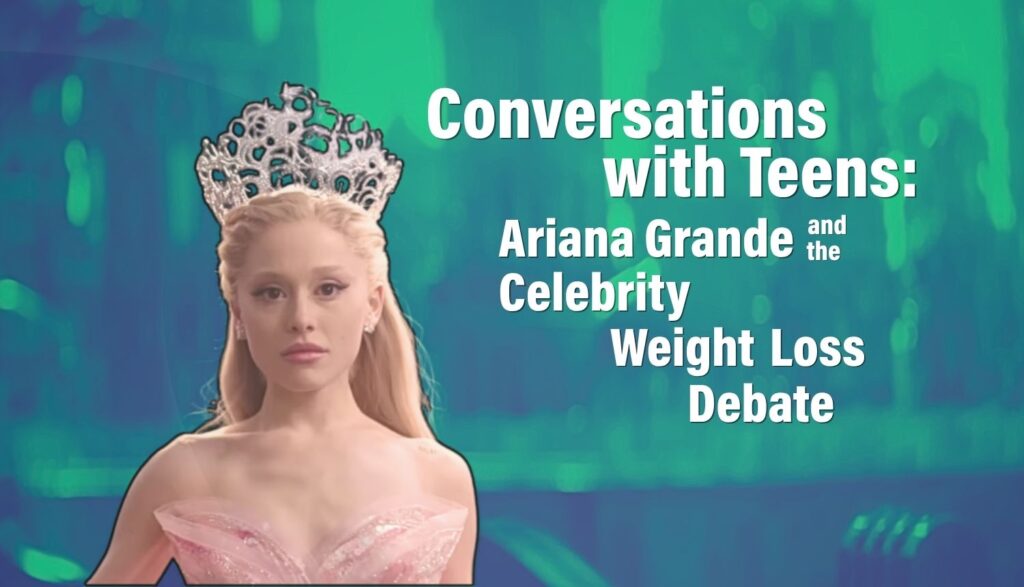
In 2025, Wicked: For Good (aka Wicked 2) released in theaters. Press junkets featuring the stars of the film—Ariana Grande as Glinda and Cynthia Erivo as Elphaba—revealed that both women had lost quite a bit of weight. Since then, there’s been a ton of media and fan discussion, with some voicing genuine concern for the health of the actresses and others offering up criticism. And with the upcoming release of Grande’s eighth studio album, Petal, on July 31, these conversations have taken flight once again.
Why Are We Even Talking About Someone’s Weight?
When adolescents see their idols go through dramatic body changes—whether that be losing weight, gaining muscle, undergoing plastic surgery, etc.—it can have a negative effect on their own self-image.
One Reddit user on the subreddit “r/EatingDisorders,” said that as someone who had had an eating disorder in the past, Grande’s appearance was triggering. “I cannot even imagine how detrimental this would have been to me as a child. She would have been my ultimate thinspo,” the user wrote.
In the ’90s and early 2000s, millions of teen girls (including myself) were deeply affected by the “heroin chic” or “waif” look made popular by Kate Moss and other celebrity icons. Although that trend was heavily criticized for glamourizing drug culture and eating disorders, magazines continued to print pictures of ever-thinning models, actresses and singers.
And teens today may be facing ever greater pressure than those of yesteryear.
For starters, we’re still seeing trends related to the heroin-chic era: “Y2K Skinny” was a popular online trend in 2025. “SkinnyTok” and “Thinspiration” posts flood teen algorithms. Ads toting weight-loss drugs (like Ozempic), protein supplements and even testosterone are a near-constant. And that’s to say nothing for the makeup industry and cosmetic procedures.
Does Voicing Our Concern Help or Cause Further Harm?
Discussions about Grande’s weight have been going for well over a decade—ever since she played Cat on Nickelodeon’s Victorious. Though she typically doesn’t respond, in April 2023, while in the midst of filming Wicked, the singer/actress took to TikTok add her voice to the conversation.
Grande told her fans that the “before” photos circulating online—the ones that commenters considered healthy—were taken when she says she was very unhealthy. She said she had been on anti-depressants, drinking while on them and eating very poorly. So she asked fans to be gentler when commenting on others’ bodies. Or, better yet, to not comment on other people’s bodies at all.
A writer for USA Today had a similar opinion, reminding readers that seemingly innocuous comments on someone’s weight could have long-term negative effects on that person’s self-esteem or relationship with food.
Additionally, both Grande and the USA Today writer pointed out that we rarely know what’s going on in a celebrity’s life. For instance, in the months before his sudden death in 2020, many people felt entitled to discuss the recent weight loss of Chadwick Boseman (of Black Panther fame). They wanted to know why the actor had lost weight: Was it for a movie role? Did he have an eating disorder?
As fans tragically learned, Boseman had been battling colon cancer for four years and kept it quiet until his death in 2020 at the age of 43.
So where does this leave parents of teens? How do we protect them from the dangers of eating disorders while still teaching them to be kind to celebrities online?
How Do We Have a Conversation About This?
So, I’ll start off by stating that if your child has already been diagnosed with an eating disorder or is displaying symptoms of such, then asking how they feel about Ariana Grande or Hugh Jackman or any other celebrity may not be the best course of action. I would strongly recommend speaking with a licensed professional—you can call 1-800-A-FAMILY to speak with a counselor, and Focus on the Family can also help you find counseling services near you.
However, if you simply want to get a feel for how a celebrity’s (or influencer’s) appearance might be impacting your son or daughter, this may be a good place to start.
When having this conversation, it doesn’t have to be a confrontation. Ask these questions when you’re driving your teen to and from activities, buying groceries at the store or cleaning up the house. You don’t want to put unnecessary pressure on your teen: You want to end up in a place where you can affirm them.
Also, while these are questions to ask your teen, they’re also questions to ask yourself. It may help your teen to understand your concern better if you tell them how you feel about a specific celebrity’s influence, too.
[Note: I’ll frame these around Ariana Grande, but you can substitute any celebrity or influencer whom your child looks up to.]
- What do you think about all the comments regarding Ariana Grande’s weight?
- Why do we feel entitled to talk about a celebrity’s physical appearance? Why do you think others have inserted themselves into the conversation?
- Do you think Grande has a responsibility to give her fans answers about her physical health? Or, as a role model, do you think she’s being irresponsible? Why is that?
- Have you ever felt pressured to look a certain way? Why do you think that is? What are some things your dad/mom and I could do to lessen that pressure?
- The Bible tells us that we are fearfully and wonderfully made—and that includes how God designed our bodies. How can we focus our attention on the incredible things our bodies can do rather than how they look?
- What are some things you do/don’t like about Grande that aren’t focused on her body? What are some things you like about yourself?
- How can you use those good things to be a light in this world?
To wrap up this conversation, even if you only get to one or two questions, just remember to reaffirm your child’s inherent worth. Remind them that you love them no matter what—even if they find themselves struggling with their self-esteem—and that God, who knows them intimately, loves them too.

Recent Comments