

A very wealthy and influential individual is examined through the subjective viewpoints of his friends and confidants. The film artfully illustrates the corrupting nature of power and wealth, while lauding innocence, kindness and the choice to be loving. There’s smoking, drinking and a drug overdose on-screen.
The journalists huddle together in a dark, cramped and smoke-filled projection room. They had done their duty and stitched together the latest News on the March obituary. It sounds important. It depicts the deceased through film clips and headlines from his life.
But is it enough?
The newsreel producer, Mr. Rawlston, doesn’t think so. He abruptly stops the projector, his cigarette glowing red in the dark, the only other source of illumination in the room coming from the bright, piercing beam of the projection booth.
“It’s not enough,” Rawlston declares, facing the others. Before this piece hits theaters across the country, they’ll need to find an angle for the story. This guy is Charles Foster Kane! Sure, the newsreel currently covers a good 70 years of Kane’s life—his publishing empire, his political campaigns, his massive wealth—but it fails to reveal who the man truly was.
“What were his last words?” someone in the shadowed crowd asks. “Rosebud,” someone else replies.
“And that’s the angle,” Rawlston says. “What is Rosebud? Who is it? What does it mean?” Deciphering the meaning behind this guy’s dying whisper is the key to understanding the enigmatic media mogul himself. “Maybe he told us all about himself on his deathbed,” Rawlston speculates, waving his arm. Shadowed heads nod. Cigarettes glow. Smoke puffs out through the projector’s gleam in exhaled swirls.
And so they will take more time. A week. More if necessary. They’ll ask his ex-wife, his former associates, his servants, anyone who might uncover the truth about Kane’s life and mindset.
They’ll get to the core of Charles Foster Kane … and Rosebud.
Editor’s Note: Citizen Kane is being rereleased in theaters for its 85th anniversary.
The opening newsreel gives us many facts about the life and death of Kane, and some of them are good. He was hard-working and ambitious. Through the follow-up interviews with those closest to Kane, the assigned reporter discovers that Kane was sometimes very generous, sometimes gentle, loving and kind. Kane proclaims his desire to fight for the underprivileged, and his newspaper writes scathing articles about abusive corporate practices and government fraud.
(However, Kane also becomes vain, domineering, hardnosed and harshly hurtful. Traits that aren’t so positive. One character declares: “Charlie never believed in anything except Charles Kane.”)
Ultimately the film delivers a cautionary tale about the character-corrupting aspects of wealth, fame and power. And it lauds the importance of true friendship and a loving family—things that Kane could never seem to hold onto.
We’re told in a newsreel that Kane had “the biggest private zoo since Noah.”
Kane was married and divorced twice. His first marriage was initially very loving. We see the couple embrace and kiss several times. But the marriage crumbles over time and eventually ends after Kane’s implied marital infidelity. That implied mistress, Susan, then became Kane’s second wife.
An office celebration features a band and dancing chorus girls. The women are dressed in tights and mid-thigh sequined skirts. Kane smilingly kisses one of the dancers.
There are conversations and news articles about war, but we never see any battles or conflicts. Someone attempts to kill herself with an overdose of a prescribed medication. It’s implied that Kane’s father may have been abusive, but we don’t see any violent actions.
Citizen Kane was released in 1941 under the strict censorship of the Hays Code, so there’s no coarse language. However, there are some intense arguments in the dialogue mix that feature slights and insults aimed at someone else’s character (political jabs, accusations of infidelity, harsh lies, etc.).
In the 1940s, nearly everyone smoked, so we see many people puffing cigarettes, cigars and pipes. There is quite a bit of drinking on various occasions, too—champagne, wine and the like.
One of Kane’s close associates, Jedediah Leland, tends to drink his worries away. He’s inebriated a few times and passed out cold once. Susan becomes an alcoholic later in life. We see her drunk several times as well.
Susan gets a toothache medication from a druggist.
Some call Kane a communist and others declare he’s a fascist. Kane says he’s nothing more than “an American.” We see pictures of Kane with political figures, including Hitler.
Early on, Charles Kane’s boyhood is upended when his mother is given the deed to a “worthless” Colorado mine. But when the mine strikes gold and the family suddenly becomes rich, Kane’s mother sends him away under the care of a bank trustee.
After taking over his first newspaper, a 25-year-old Kane grows the paper’s circulation by reporting news that’s more “made-up lies and gossip” than pure fact. And that same kind of truth-twisting is used later by a political opponent to tarnish Kane himself.
Citizen Kane has been celebrated by many as the greatest movie ever made. Of course, if you’ve never seen it or thought about it, you may be wondering how a statement like that could possibly be true. After all, this is a black-and-white pic from 1941 that features young actors playing 70- and 80-year-olds in clunky makeup. Surely there have been more compelling and impressive-looking films over the years.
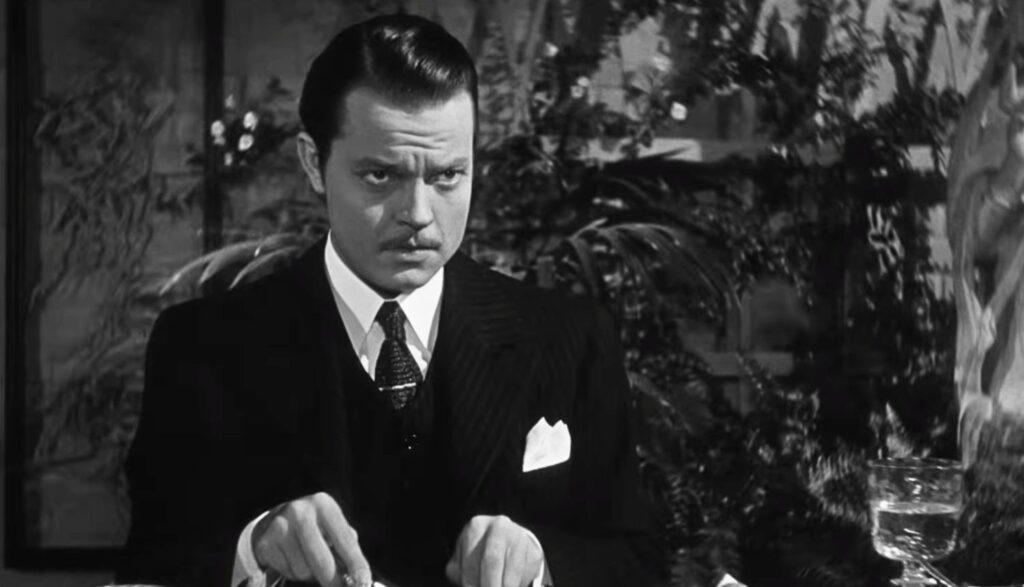
While that’s true, the very fact that Citizen Kane was made in 1941 is what lends heft to its acclaim. The film’s cowriter, producer, director and star, Orson Welles, made some risky, and frankly, groundbreaking choices with his first feature film—incorporating things that Hollywood of the day would never dare try.
At the ripe old age of 25, Welles decided to rip up the linear story template that films had been using since, well, the beginning of moviemaking. Citizen Kane then tells us about Charles Foster Kane, whose life is examined through the subjective and sometimes contradictory perspectives of people who were once in his life. That sort of complicated narrative style had never been tried before. And in a way, it opened the door to new thematic depths for the films that came after it.
Welles also changed the nuts-and-bolts way that films were made. He established wide-angle lenses that kept the foreground, midground and background of large sets all in crisp focus, and he created new techniques for camera placement and movement. Welles also incorporated time-compressed visual montages that had never been done before—but that we see used in many modern films.
Of course, all the moviemaking whizzbang in the world won’t make a lousy story great. But Citizen Kane excels in that department, too.
Welles uses his film—based satirically on the real-life story of yellow-journalism magnate William Randolf Hearst—to show us a man who sets out with idealistic, fight-for-the-little-guy values, but who slowly deteriorates into an emotionally isolated husk. Wealth and its associated power transform Kane into someone who tries to buy love, control the lives of others and force his demands into place.
In the end, the one thing that protagonist Kane yearns for most is his lost childhood and innocence, the simple joys and love of a family. Those are things that everyone can obtain but that all the money in the world can’t truly buy. That’s a powerful message. And it’s one that is as applicable today as it was in 1941.
For moviegoers thinking about taking their families to see this classic, however, you’ll encounter lots of smoking and drinking on-screen. There’s even implied marital infidelity and an attempted suicide in the story mix.
But the biggest drawback here is the depressing nature of this cautionary tale’s subject matter. Citizen Kane is brilliant and thought-provoking, to be sure. It’s even witty and funny at times. But don’t expect any warm or fuzzy feelings by the curtain’s close.

After spending more than two decades touring, directing, writing and producing for Christian theater and radio (most recently for Adventures in Odyssey, which he still contributes to), Bob joined the Plugged In staff to help us focus more heavily on video games. He is also one of our primary movie reviewers.