


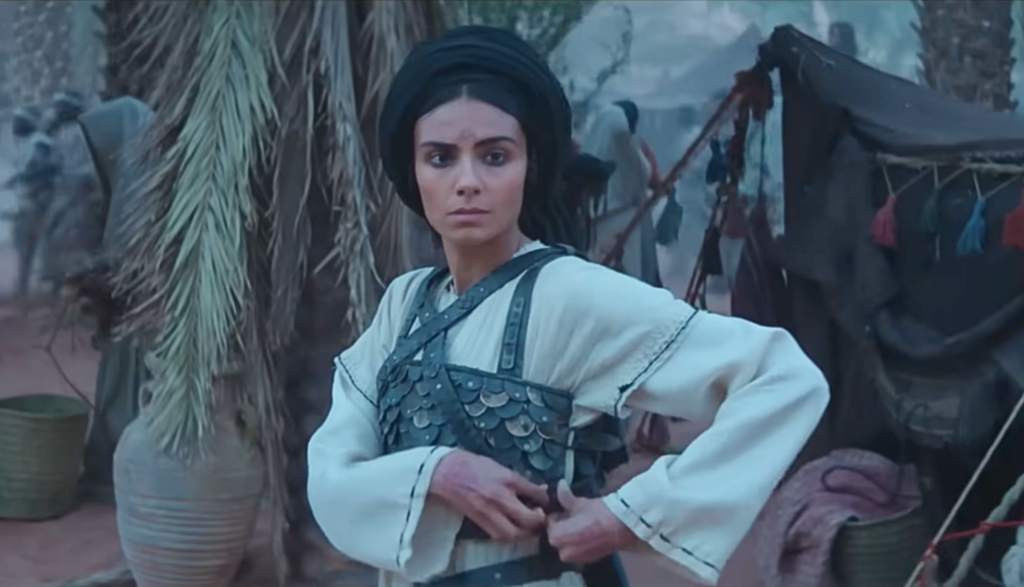

Desert Warrior brings viewers to a seventh-century conflict between Arab tribes and the powerful Persian Sassanid army. While most of its content concerns are minimal, the movie grows bloodier and more violent as it goes on—enough to earn an R rating.
In the deserts of seventh-century Arabia, kings and tribes fight for land and water. There is little unity and plenty of distrust.
But one man is about to make things even worse: Emperor Kirsi II of the Sasanian Empire. He demands all the tribal kings of Arabia pledge their submission and loyalty to him by giving their daughters to him as concubines.
King Al-Numan of the Lakhmid territory refuses. He and his daughter, Princess Hind, flee into the desert as Sassanid forces charge after them. It’s there, under the sweltering sun, they meet a bandit clad in black who, for the price of some gold, offers to bring them to the nearby Shaybani territory.
They narrowly make it. But the Shaybani people take them in as guests, refusing to hand over the king and his daughter when Kirsi’s people come demanding Hind.
It’s a dangerous thing to do with an emperor who has killed people for less.
Still, Hind’s father returns to the Sassanid capital to face Kirsi directly. At the very least, Al-Numan hopes he might offer his own life in place of his daughter’s. It’s his last action: Kirsi sentences the man to death by crushing him under the feet of an elephant. Al-Numan’s final words are an ominous message to the other tribal leaders:
“This comes for us all.”
Princess Hind, like her father, refuses to run and hide forever. And with her father’s death, she knows that not even her high status can save her. But if the other leaders hear of what has happened to her father—and what might happen to them if they remain complacent—perhaps she can finally unite the distrustful tribes.
And perhaps they will stand a chance at defeating Kirsi’s forces.
When Hind and Al-Numan make it to the Shaybani settlement, the leader there refuses to give them up to the Sassanids. Instead, he tasks his community with protecting their guests for the sake of honor.
Despite differences and previous bad relationships, a number of the Arabian tribes come together to fight against the encroaching Sassanids. On a similar note, Anthony Mackie’s unnamed bandit, while initially requesting gold in exchange for his services, eventually decides to fight alongside Hind for honor instead.
A woman risks her life to compel her tribe to join the battle for freedom alongside Hind.
A man describes another group of people as “fire worshippers.” Someone else says that he hopes “God protects us from you.”
We see some men shirtless. Someone describes a man sent to do Kirsi’s bidding as “the emperor’s whore.” The plot revolves around the emperor seeking to make Hind his concubine. We see some of the other women he’s done this to seated around him.
Dozens upon dozens of men die in many bloody ways—the worst content concern within the film.
Men die by the sword, spear and arrow, each weapon leaving its own relevant, bloody marks. Others are hit with rocks, stabbed with bones, get their necks snapped or get crushed by war elephants. Men also get devoured by hyenas. Other men fight in a stadium, slicing at each other until only one remains. Some vomit blood from their mouths after getting poisoned.
A couple of women die, too. Plenty of bodies from offscreen deaths show up. A man brands a child offscreen.
Men pin down and punch Hind on a couple of occasions. Others threaten to kill outsiders with stones. Raiders burn down a home. A woman falls off a horse. An army uses a trebuchet to fling hunks of cow flesh at approaching enemies.
None.
Men smoke from pipes.
A man skins a dead sheep.
Desert Warrior brings to life a conflict that’s likely unknown to your average Western viewer: the seventh-century Battle of Dhu Qar, in which a confederation of Arab tribes fought against the much more powerful Persian Sassanid army and prevailed.
The $150 million movie, allegedly the most expensive film to be shot in Saudi Arabia, spends its runtime building up to that battle—a scene which takes up a decent chunk of the movie’s final minutes. And the violence of that pivotal moment, along with a scattering of other violent scenes, will be the biggest content hurdle for viewers. (A multitude of mostly men will die before the credits roll in ways deemed gruesome enough to merit an R rating.)
Perhaps a little strange is the trailer’s decision to frame Anthony Mackie’s character (an unnamed bandit) as the desert warrior to which the movie’s title apparently refers. Yes, Mackie’s character plays an important role in the plot, but the story focuses far more on Princess Hind and her unification of the desert tribes. Then again, Mackie’s fame will probably draw a few more eyeballs to the film, so from an advertising perspective, I suppose it makes sense. (That’s more than can be said for Ben Kingsley fans; the man appears for roughly five minutes in total.)
Historians will debate the accuracy of this movie to actual events, but for all its bloodshed, at least Desert Warrior kept away from most other content issues.
Kennedy Unthank studied journalism at the University of Missouri. He knew he wanted to write for a living when he won a contest for “best fantasy story” while in the 4th grade. What he didn’t know at the time, however, was that he was the only person to submit a story. Regardless, the seed was planted. Kennedy collects and plays board games in his free time, and he loves to talk about biblical apologetics. He’s also an avid cook. He thinks the ending of Lost “wasn’t that bad.”