Game Review
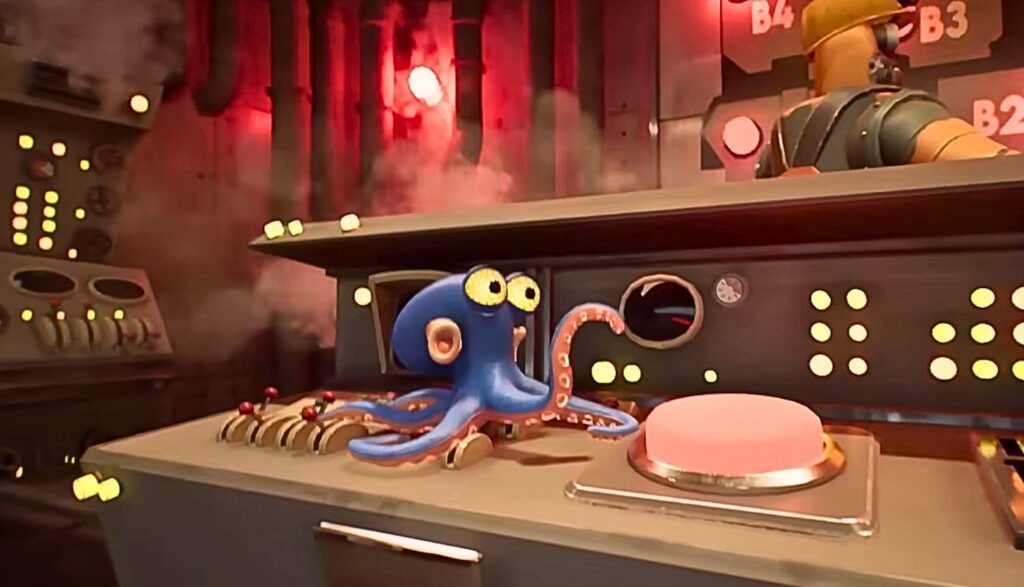
Darwin’s Paradox is another puzzle-platformer with loads of fun environmental challenges. What sets this one apart is its cartoony charm, witty twists and turns, an army of clandestine, 1950s-style space aliens, and a protagonist who’s part innocent octopus and part plot-purloining paladin.
In short, Darwin’s Paradox (which doesn’t have anything to do with the real Charles Darwin or his Theory of Evolution) is a hidden gem of a game that might pleasantly surprise you and wrap you up in its quirky suction-cupped arms.
In the game, you’re an innocent-and-happy octopus named Darwin who gets literally sucked into a nefarious plot. Darwin and his fellow octopus pal are swimming contentedly through the ocean deep when a hovering spacecraft (on a planetary fishing expedition) catches them up in a tractor beam.
The craft whisks both away to a new interplanetary corporate entity called UFOOD that, out of the goodness of its collective, cosmic heart, wants to feed the human populace with good, healthy and completely non-threatening supply of canned and preprocessed chow. If humans were to expend even a single brain cell thinking about the name of this new company or consider the business’ robotic-looking employees, they might have reason for a moment of pause. But who has time for that?
But the troubles of the human world mean nothing to Darwin. He just wants to find a way out of captivity, track down his octopus pal (who was whisked away to another part of the facility) and make his way back to his ocean home. Fortunately, octopi have eight independently operating, suction-cup covered arms to cling and climb with. They have the ability to camouflage themselves in seconds. And they have squirts of ink that can short-circuit electronics and mask their movement in the water. They’re pretty much the perfect, sneaky escapee.
Of course, simply surviving is the main thing our squishy, squirming hero is concerned with. As Darwin navigates his way through a dump, sewers, factory floors, processing plants, science labs and other parts of a sinister alien complex, he needs to keep his large eyes peeled for danger. Swarming rats and hungry seagulls lurk above water, and sharp-toothed carnivorous predators swim below. Conveyor belts littered with choppers and mashers and pipes glow with blazing heat. Darwin must find a way past stomping alien boots and across deadly chasms, too.
And who knows, as Darwin travels along, key items might fall over in his wake. He might short-circuit the wrong electronic, turn the wrong valve wheel or flip the wrong switch and cause some unexpected havoc. I mean, alien factories can be sensitive to things like that.
Darwin’s Paradox is a single-player game that doesn’t require an online connection other than for download and activation.
POSITIVE CONTENT
As mentioned, Darwin’s main concern is to escape and hopefully free his friend along the way. The fact that he also foils a nefarious human-enslaving plot is an accidental bonus.
The non-verbal humor and Pixar-like artwork are pleasant pluses to the game’s easy-to-maneuver gameplay.
CONTENT CONCERNS
At points in the game, Darwin will die. (In fact, in some instances you might not figure out how to proceed until the octopus protagonist dies.) Death comes from blazing fires, gobbling predators, smashing objects, crushing gears and zapping ray guns. Short death scenes play out and some blue and yellow blood spatter. But the violence is handled playfully. (Then Darwin starts again just before his deadly encounter to try again.)
Players cross through an area that’s spattered with seagull droppings. Another area features the bones of large fish and sea creatures. Buildings explode and topple.
Darwin passes through an alien lecture featuring chalkboard descriptions of how the cartoony invaders plan to manage humanity through mind control.
GAME SUMMARY
Darwin’s Paradox is one of those friendly and fun games that nearly everyone in the family can play. And even beginning gamers will enjoy watching Mom or Dad get their squishy game on.