Lost Evangeline

Credits

Age Range

Publisher

Awards

Year Published

Reviewer

Bob Hoose

Book Review

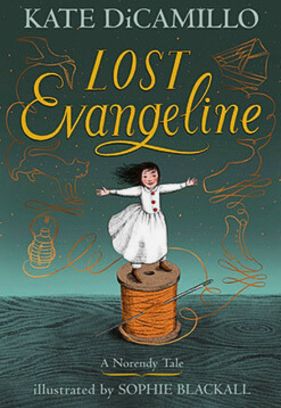
A shoemaker dreams of the wonders of the sea, but in his land-bound life he discovers a different kind of wonder: a small girl tucked away in a square-toe boot. He treasures her and raises her as his beloved daughter. But wonders and treasures can sometimes draw the wrong attention.

Plot Summary

There once was a shoemaker who had dreamed all his life of going to sea. Alas, his father told him it was a pointless fantasy. And when, years later, the shoemaker shared those dreams with his wife, she called his thoughts foolish and dangerous. “Better that you are here, safe and warm with me,” she told him.

Still, the shoemaker couldn’t help but keep reading of the sea and watching ships come and go in the nearby port. He couldn’t help but think of the wonders of the world that he would never see.

However, one day he discovered a completely unexpected sort of wonder. While examining a square-toe boot he was asked to repair, he found a tiny baby tucked away in the boot’s toe. The shoemaker held the child in his cupped palm and called to his wife in joy. “You must see what has been given to us!” he cried.

Indeed, the child was a gift, for the owner of the boots never returned. The shoemaker named the little girl after a beautiful sloop he had once seen in the harbor, Evangeline. To the shoemaker, that was a name full of joy and curiosity, daring and courage—a name that spoke of possibilities.

In fact, the tiny Evangeline—no bigger than a mouse—was all of those things and more. And the shoemaker raised her well. He told the girl stories of the sea and sang shanties to her as he worked. She would sing back; her tiny, beautiful voice filling the room.

They would take walks together and talk of the beauty of things. Evangeline loved her father deeply. And she came to love the idea of going to sea as well.

“When will we go to sea, Papa?” Evangeline would ask the shoemaker.

“Someday, my dear,” the shoemaker always replied.

However, the shoemaker’s wife could not share in their joy. She never did take to the tiny girl with her tiny handmade bed and dresser and tiny handcrafted clothes and boots. She did not enjoy the songs that her husband and the girl shared. In fact, the shoemaker’s wife, feeling left behind, grew jealous and afraid that shared dreams and songs might one day carry her husband away.

And here’s the thing about fear and jealousy: They can sometimes drive people to do hurtful things. The woman who balked at her husband’s “foolish and dangerous” dreams was willing to do something foolish and dangerous to stop them.

That’s when a tiny girl named Evangeline found herself lost in a very large world. All the girl has is her song, her dreams of the sea and an expansive love to keep her going.

Christian Beliefs

None.

Other Belief Systems

This is a world that’s filled with belief in fantastic things—a tiny girl, a talking cat, a mermaid, etc.

Authority Roles

The shoemaker is a good man. He is devoted to his newfound child and does everything he can to raise her well and protect her from the dangers of the world. The shoemaker makes it plain that his adopted daughter is a wonderful gift in his life.  He repeatedly tells Evangeline that she is courageous and kind, and those reminders become part of her fabric, things she holds most dear about herself.

The shoemaker also stands by his commitments to his wife, even though he longs to be elsewhere. It’s only when his wife betrays his trust and sells their adopted daughter that the shoemaker leaves, traveling out to sea in search of the girl. The wife is left with gold and loneliness because of her selfish choice.

Evangeline meets a marmalade-colored cat—a disdainful and self-satisfied creature—who eventually is persuaded to help the young girl on her journey. Because of their connection, the cat discovers a number of new things about the world, and he becomes enamored with the idea of a life at sea, too.

Evangeline grabs the attention of a self-serving man named Stumphaulf, who is always seeking out “winsome oddities” that he can showcase and make money with. The man captures Evangeline and puts her in a cage with the intent of tormenting her until she obeys and performs at his beck and call.

Evangeline becomes friends with a young boy named Timothy. He helps her and aids her in seeking her father at sea. Theirs becomes a lasting relationship of trust and protection.

Profanity & Violence

Tiny Evangeline has very little to protect herself with other than her wits and courage, and this leads to several moments of peril. She’s snatched up in a sack; threatened by a cat who intends to gobble her up; grabbed by a guy who means to starve her; and faces other dangers.

Sexual Content

None.

Discussion Topics

Have you ever longed to set off on an adventure? Why do you think adventures into the unknown seem so exciting? What keeps us from going? Why do you think the shoemaker never set off to sea when he was a young man?

How do you think God feels about the adventures in our lives? Did you know that scripture encourages us to step out in faith, trust God’s guidance, and embrace the unknown? Take a look at Genesis 12:1; Proverbs 3:5-6; Joshua 1:9 and Isaiah 43:19.

Those verses may not be sending us out to sea, but they encourage us to step forward in whatever path we choose with God’s purpose in mind.

What things did the shoemaker give his daughter that served her for her whole life? And what did she give him? In the end, what was the most important thing in the shoemaker’s life.

Additional Comments

Lost Evangeline is a quaint and charming story—the third fairy tale set in Norendy, the same world as author Kate DiCamillo’s The Puppets of Spelhorst and The Hotel Balzaar. The book mixes peril and whimsy as it explores themes of parental devotion, living life with courage and sharing love with others.

Like many fairy tales, however, there are sad moments of loss here, and someone loses a great deal because of her own selfishness.

You can request a review of a title you can’t find at letters@pluggedin.com.

Book reviews cover the content, themes and worldviews of fiction books, not necessarily their literary merit, and equip parents to decide whether a book is appropriate for their children. The inclusion of a book’s review does not constitute an endorsement by Focus on the Family.

Bob Hoose

After spending more than two decades touring, directing, writing and producing for Christian theater and radio (most recently for Adventures in Odyssey, which he still contributes to), Bob joined the Plugged In staff to help us focus more heavily on video games. He is also one of our primary movie reviewers.