


It Was Just an Accident tells the story of some former Iranian prisoners who kidnap a man because they believe he was their prison torturer. The film explores ideas of justice, mercy and lingering trauma as the characters recount their horrific pasts—and it’s built upon real-life experiences. Crude language and violence occur in the film, including references to deep, emotional trauma that may leave viewers upset.
Vahid pulls out Rashid Shahsavari’s license and places it on the table in front of Salar.
“Who’s that?” asks Salar.
“It belongs to Peg Leg,” Vahid answers.
Salar’s eyes widen. “How did you get it?”
Vahid leans forward. “I finally found him. I hit him with my car. He’s in my trunk.”
Vahid had first spotted Rashid when he pulled into his auto repair shop. The man appeared as any other customer might. But from the moment Rashid took his first step, Vahid knew who he was.
Vahid could never forget the distinctive squeak of his Iranian prison torturer’s prosthetic leg. Like the other prisoners, Vahid had always been blindfolded—so he’s never seen the man. But that squeak is unmistakable.
Rashid Shahsavari is Vahid’s torturer, once called Eghbal the Peg Leg.
And so Vahid hit Rashid with a shovel, tied him up and drove him into the desert to bury him alive. But as Vahid piled dirt on the man, Rashid screamed that Vahid had the wrong guy; he’d lost his leg only a year ago, much too recently to be Rashid’s prison torturer, and the recency of his scars will prove it.
Vahid checks the amputated stump. The scars do seem recent. Doubt begins to form in his mind. He knocks out the alleged Eghbal and shoves the man back into his van, hoping fellow torture survivor Salar might be able to identify him.
And so Vahid looks into the pained eyes of one who knows the deep nature of the pain Eghbal inflicted and asks Salar a question.
“Can you confirm it’s him?”
Salar refuses to identify Rashid as Eghbal, and he attempts to talk Vahid out of his vengeance. Though he, too, remembers the pain inflicted upon him, Salar tells Vahid that they are not killers like Eghbal. They have no need to dig their torturer’s grave.
“It’s your ideals you’d be burying,” Salar says. He encourages mercy (though he points Valid to someone who may be willing to confirm Rashid’s identity).
Vahid’s anger is tempered: Despite believing that Rashid is truly Eghbal, Vahid assists the man’s daughter and pregnant wife. When Rashid’s wife faints and goes into labor, Vahid drives her and her daughter to the hospital. He even pays out of pocket for many of the medical expenses.
Despite a law demanding a woman’s husband be present in order for her to receive medical treatment, a doctor chooses to treat an unaccompanied woman.
We hear references to Islam. A man says that people like Eghbal “think they are connected to God and hide behind the Sharia.” When discussing justice, someone shares the perspective of the torturers: “Either you deserved your sentence and you got it, or you didn’t deserve it, and justice will be done in heaven.”
We hear a reference to a holy war. A man states that “those who were supposed to liberate us kill our youth while reciting prayers.” Someone says Eghbal “believes in the hell he wants to send us to.”
After running over a dog, Rashid’s daughter gets upset. Her mother tries to comfort her by saying that God must have put the dog in their path for a reason, but the daughter responds that “God had nothing to do with it.” Later, when their car breaks down, someone claims the event is a sign from God.
A woman says that Eghbal believes women who remain virgins go to heaven. Another woman calls herself the angel of death. A man wears a shirt with a cross on it.
Rashid begs to be released, saying “in the name of all the saints, untie me.”
When a woman in a wedding dress vomits, a man assumes she is having morning sickness and comments, “Looks like the bride and groom put the cart before the horse, huh?”
Rashid’s underwear is exposed when someone examines his peg leg.
Another torture survivor, a woman named Shiva, recounts how, when she was a girl, she was sentenced to be hanged. Instead, her captors left her blindfolded, standing for hours with the noose around her neck waiting for the moment that never came to pass.
The same woman says that Eghbal demanded she be “deflowered” before her death, since “if I was a virgin, I’d go straight to heaven.” While not explicitly stating it, her conversation implies that Eghbal may have followed through on his threat. Likewise, another woman recounts how Eghbal threatened her as he stripped her naked. A man also mentions Eghbal and others dragging him across the prison floor while naked.
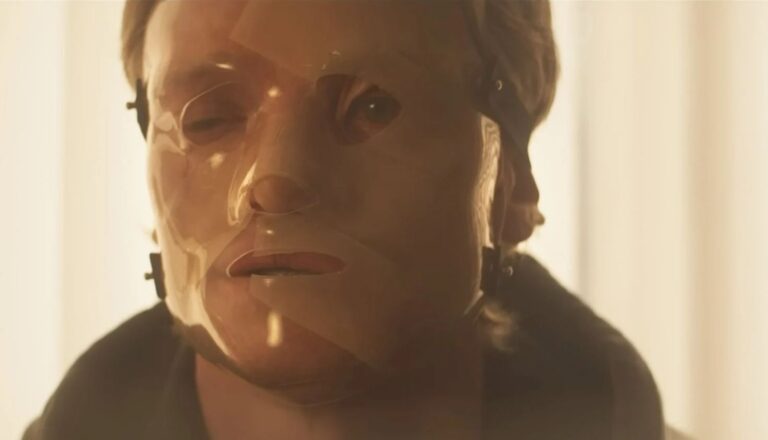
Vahid throws Rashid into a grave and begins to bury him alive. He stops after Rashid pleads his innocence, instead knocking the man unconscious and placing him in a human-sized workbox in the back of his van. Vahid hits Rashid with his car door and with a shovel, and Shiva hits the man with a shovel, too. People scream at and smack Rashid, demanding he confess to the crimes they’ve accused him of.
A man says that his fiancée killed herself because of Eghbal’s torture. Other former victims tremble, fly into fits of rage or collapse at the mere mention of the man’s name, tacitly revealing the horrific impact he took on their lives. Vahid says Eghbal beat him so badly that he lives with permanent back pain. A man states that many miscarriages occurred as a result of Eghbal’s torture.
A man pushes a woman to the ground.
Rashid accidentally runs over a dog, and though we do not see it onscreen, we hear its pained whimpers.
English subtitles contain many translated crudities, including two f-words and 13 s-words. “B–tard” is the favored profanity, appearing more than 15 times. Other words, including “a–,” “b–ch,” “h—,” “p-ssed” and “whore” are all used, too. Someone complains that the others are “busting [his] balls.”
A few characters smoke cigarettes. Vahid and other survivors drug Rashid to keep him unconscious.
Vahid and other prison survivors spend plenty of time debating the morality of their potential actions.
A woman vomits onscreen. We are told that an unconscious man unintentionally defecated.
Police extort a man for money, and others attempt to pry money away from Vahid in a variety of underhanded ways.
What is justice in a system that seemingly cares little for it?
That seems to be the plumb line throughout Iranian director Jafar Panahi’s newest release, It Was Just an Accident.
Panahi made the film without a permit from the Iranian government, shooting its scenes in secret. The filmmaker has been imprisoned more than once (alongside other filmmakers), and Panahi revealed that some of the stories of abuse found in this movie were based on the real-life experiences of the prisoners he met there. Understandably, the movie showcases a critical perspective of Iran’s oppressive laws and even breaks a few of them, including depicting a woman without a hijab—a requirement by law for Iranian women since the 1979 Islamic Revolution.
Our main characters have each endured terrible abuse from the regime which imprisoned them. And though they’ve been released from prison, they continue to carry those torturous moments with them as physical, mental and emotional burdens.
As the characters come together to determine what is to be done with their kidnapped subject, they cannot agree on how to proceed. They could kill him, yes, and that would satisfy the revenge they each carry inside their hearts. But even if doing such a thing might bring justice, some of them know it will also change them forever—and it will do little to truly heal the wounds they’ll carry long after he’s dead. In life, he tortured them. In death, he may very well continue to do the same.
It Was Just an Accident explores those themes of justice, mercy and revenge as it walks through its trauma-centric storyline. Much of that trauma is only mentioned rather than seen onscreen. Still, violence nevertheless shows up in other instances, as do many crude words.
The film’s dialogue is well written, with each character displaying visceral honesty onscreen as they recount the torture they endured. Through the movie’s impressive storytelling, we connect with them easily and feel their pain pass through the screen.
Because of that, viewers should be ready for all that pain to seep into their living rooms, should they choose to watch.

Kennedy Unthank studied journalism at the University of Missouri. He knew he wanted to write for a living when he won a contest for “best fantasy story” while in the 4th grade. What he didn’t know at the time, however, was that he was the only person to submit a story. Regardless, the seed was planted. Kennedy collects and plays board games in his free time, and he loves to talk about biblical apologetics. He’s also an avid cook. He thinks the ending of Lost “wasn’t that bad.”