
Drama
VisionQuest
Vision is alive again—or as much as the AI synth ever is—in Disney+’s ‘VisionQuest.’ Though violent and profane, the show itself returns close to ‘WandaVision’ form.




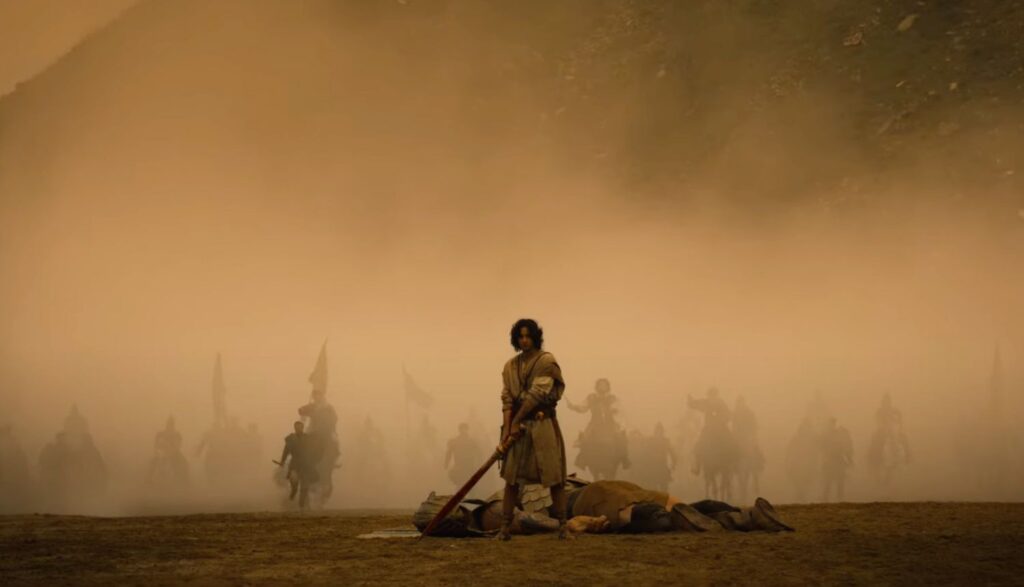
Ask a Christian for the biggest names in the Bible, and it won’t be long before you hear about King David.
The powerful story of David and Goliath—where David, through the power and providence of God, saved Israel from its enemies with a sling and stone—is so well known that even secular audiences use it to describe an underdog situation.
But ask that same secular audience about the rest of David’s life—his rise from shepherd to prophet-anointed king; the long years he spent fleeing from King Saul in the wilderness; his terrible fall into sin and the lifelong consequences he faced as a result—and chances are they won’t be as well-versed in those events.
House of David may be their—and your—entry into learning the rest of that story.
Of course, you can’t tell David’s story without telling a few others—most notably, King Saul’s. House of David’s first moments picture the aftermath of Saul’s battle with the Amalekites (found in 1 Samuel 15). Saul has disobeyed the commandment of God, and the prophet Samuel tells him that God has rejected Saul as king.
It’s a solemn warning that Samuel had given years before: “Only fear the Lord and serve Him faithfully with all your heart. For consider what great things He has done for you. But if you still do wickedly, you shall be swept away, both you and your king” (1 Samuel 12:24-25).
And as Saul turns away from God, God raises up an unlikely man to take Saul’s place: David, the youngest son of Jesse, born of a different tribe than Saul, who’s busy tending to the flocks while his brothers fight in the war.
By any metric, what man would choose David to succeed Saul? But, as a scene in House of David reminds us, the Lord does not see as man sees. For while man judges by external appearances, God looks on a man’s heart. And so, as an evil spirit torments Saul, the Spirit of God rushes upon David.
Saul is determined to maintain his power. But God has determined that David will reign—no matter how much resistance Saul brings.
On its surface, House of David is a political thriller. Saul doesn’t accept God’s decree, so he (and in this adaptation, his wife, Queen Ahinoam) instead dives deeply into political conspiracy and threats. And as they quickly devolve from being passively resistant to the changes in the kingdom taking place to being actively hostile to them, we see that it’s not just David they’re scheming against; soon, it’s the prophet Samuel. And then, it’s even their own God-fearing son, Jonathan.
But dive a little deeper and you’ll find that every move in House of David has a spiritual undercurrent. Viewers would certainly expect this from David’s side of the story, of course; the man “after God’s own heart” comes from a less-than-regal background, and it’s only by a working of God that he could ever hope to take the throne. But in every action taken by Saul and Ahinoam, too, we see not only their movement away from God but also their embrace of pagan practices. Every political decision, then, is intrinsically a statement about how the characters view the God of the universe.
Christians know that the story of David goes well beyond his God-given victories over Saul and Goliath—and we know the grime that comes with the rest of his life, too. It’s grime that the show, so far, isn’t afraid to put to screen—an attitude not always present in typically sanitized Christian media. In House of David, we see the consequences of worshiping false gods, of engaging in pre- or extramarital affairs (though these actions aren’t depicted onscreen). And when people die in combat, they bleed, and in no small trickle, either.
But merely depicting the strict biblical text telling the story of David’s life does not a TV series make. After all, that’d be an awkward watch, what with the books of 1 and 2 Samuel covering approximately 150 years of history. That’s why viewers will find that House of David takes some extrabiblical liberties with its storytelling. It’s a concern that may be best described by the same words we used to describe The Chosen, Dallas Jenkins’ creation which covers the life, death and resurrection of Jesus:
“It’s fiction, in other words—fiction that was inspired by and embraces Scripture, but fiction that nonetheless feels free to remove and (mostly) add elements as the story—not theology—demands.”
Some of those added elements seem harmless. If David writes dozens upon dozens of the Psalms, it makes sense to watch him practicing on a lyre. Other elements seem to be inspired by various Midrashic texts (Jewish rabbinical commentaries on Scripture) or extrabiblical sources such as the Book of Enoch. For instance, the show follows a midrashic reading of 2 Samuel 21 in depicting Ruth’s sister-in-law, Orpah, as the mother of the giant Goliath.
But viewers could take issue with other creative moments—such as when, in the opening moments of the first episode, Goliath’s javelin strikes David, leaving him bleeding on the ground and struggling for a stone. And some of David’s actions seem to go against his biblical character, such as when he sneakily sits on Saul’s throne despite the biblical figure always honoring Saul’s place as king chosen by God.
Still, perhaps viewers can take some comfort and may be willing to extend grace to the show knowing director Jon Erwin’s comments on the subject.
“I love the material,” Erwin told Plugged In. “I feel like the material is life-changing, and so you want to try to really honor the themes of the story while making a dramatic television show. … As a parent, I find it so hard to get my kids aware of or interested in the Bible at all in this visual generation they live in, and so, if all we do is to start a conversation about the material again, so people reengage with the Bible, we’ve succeeded.”
(Editor’s Note: Plugged In is rarely able to watch every episode of a given series for review. As such, there’s always a chance that you might see a problem that we didn’t. If you notice content that you feel should be included in our review, send us an email at letters@pluggedin.com, or contact us via Facebook or Instagram, and be sure to let us know the episode number, title and season so that we can check it out.)

When the truth of David’s anointing is revealed, David must flee for his life. Others react to the news in a variety of ways.
We see several biblical moments throughout the episode, starting in 1 Samuel 19:12-18, when Mychal assists David in escaping. (We’re told here, however, that it was Mirab who concocted the lie that David threatened Mychal’s life, rather than Mychal herself.) David meets with Jonathan, who weeps with David. Jonathan defends David against his father and secretly warns David of the danger later on (1 Samuel 20). David then travels to Nob and receives help and holy bread from the priests (1 Samuel 21:1-9). Afterwards, David arrives at the cave of Adullam (1 Samuel 22:1-2).
Saul orders his men to kill the priests at Nob, and Doeg complies (1 Samuel 22:14-18). Compelled by Samuel, Saul prophesies, apparently following a (clothed) version of 1 Samuel 19:23-24.
David’s brother Eliab cries out that “God chose David, and this is what is left for the rest of us … Every time he stumbles, ‘Oh, it is God’s will.’” Eliab later screams at God regarding his frustrations. Eliab likewise confronts his father, Jesse, for siring David with a Canaanite woman—a storyline based on an adaptation of an 11th century reinterpretation of David’s life that has no historical evidence.
David speaks with Samuel, asking the prophet what it is like to talk with God. And Samuel responds that he feels many sensations—that God’s words “warm his heart,” “scorch his soul” and “choke his throat.” Samuel comforts David, telling him that God will speak to him: “What I hear is music—His music—playing through a simple shepherd.”
Later, Samuel confronts Saul, and Saul attempts to stab him—but the combination of a strong wind and a mental curse from God stays Saul’s hand. The wind likewise knocks over a group of soldiers, afflicting many with a similar tormenting curse. When told that a thousand soldiers oppose him, Samuel responds: “I have but One, yet He is enough.” Samuel commands Saul to prophesy about David’s kingship. Strangely, the command causes Samuel to bleed profusely from his nose.
Jesse tells Eliab that there is no sin that God cannot redeem. Jonathan tells David that God doesn’t make mistakes in choosing who should be king. Doeg, still suffering from a mental curse that makes him have visions of a shadow realm, demands for priests to heal him: “Your God is tormenting me night and day.” Priests at Nob allow David to see the Urim and Thummim (objects utilized by the Israelite high priest to discern the will of God) for guidance.
Men are stabbed and set on fire. Saul chucks a spear at David and slashes at him with a sword. Eshbaal also attacks David. We’re told that many men killed themselves to escape a curse that God put on them through Samuel. Someone apparently dies from blood loss.
As David and Mychal prepare to be married, some feel that David’s sudden rise to power is a threat.
The episode begins with Mychal narrating a collection of verses stitched out of their original context for the sake of the episode, including passages from Numbers 12:6, Deuteronomy 7:13 and Jeremiah 33:10-11 (the last of which would not be written for hundreds of years after David’s death). Later, during a purification ceremony, David quotes Hosea 2:19, though this passage also would not be written until sometime after his death.
David and Mychal undergo Mikveh, a purification ritual where they wash themselves and offer up praises to God for His provision. David offers a blessing upon Mychal: “May the Lord make this woman like Rachel and Leah, who together built the family of our nation … may our children profess their loyalty to this kingdom and their love to Adonai for all eternity.” David’s father says he will pray that, one day, David will make a good king. When someone asks David if Samuel chose him to be king, David responds: “No. God chose me.”
People are stabbed with swords, and bodies are collected the next day. Someone pushes a woman, causing her to fall to her death. Eshbaal suffers from nightmares about being whipped. Someone shoots a deer with an arrow and cuts its throat. Grain silos burn. Someone threatens David’s life.
Jonathan kisses his wife. David and Mychal kiss. Eshbaal mentions a connection he has with Edom: “I once spent a memorable night in Edom with the King’s closest advisor. We are friends … of a sort.” (There is no indication as to what this truly means.) Someone’s wife reveals that she is pregnant.
People drink wine.
Wanting to rid himself of David, Saul sends the Giant Slayer on an impossible mission—one sure to get David killed.
Ahinoam, who is estranged from Saul, her husband, goes to his room at night. She finds him snuggling in bed with his concubine, the servant girl Kazia. In another scene, Kazia and Saul embrace each other, and Saul pulls her into his lap, kissing her face. The queen interrupts them, but Saul is unapologetic. Kazia tries to convince Saul to invite her to the princess’s wedding, but he tells her it would be inappropriate. To make a scene, Kazia invites herself to Jonathan’s wedding feast, wearing one of the queen’s necklaces. Ahinoam asks Saul to dismiss Kazia. He honors Kazia instead, embarrassing the queen. Later, Ahinoam confronts Kazia, slapping her and snatching back the jewels.
Saul is angry with David for refusing Mirab’s hand in marriage. Ahinoam suggests that Saul give David what he wants: their daughter Mychal’s hand. However, she says, Saul should do so on the contingency that David prove himself. He should send David on a mission sure to kill the Giant Slayer. Then (Ahinoam continues) the people’s anger will be directed toward Saul’s enemies rather than Saul.
Saul follows Ahinoam’s advice. He sends David to burn down a Philistine iron forge, and he orders David to personally kill 100 Philistines, bringing Saul their severed foreskins (1 Samuel 18). But the king also secretly has one of his men send a message to the Philistines, warning them of the attack, in the hope that David will die.
David and his men fall into the ambush, thanks to Saul’s betrayal. Swords, axes, spears, arrows and explosives take the lives of men on both sides of the fight. David returns from the battle bloody and bruised. He throws a bloody sack containing the requested foreskins at Saul’s feet, announcing that he personally killed 200 soldiers.
Saul angrily shoves several items off a table as he screams at his wife. He then throws a pot at her (and misses). Ahinoam runs out of the room, but he pursues her, grabbing her by her hair and forcefully shoving her to the ground. He seizes her hair once again, pulling her up and dragging her outside the palace, where he throws her to the ground again. She appears physically unharmed, but it’s an intense scene, further punctuated by Mirab crying and begging for her father to release her mother. When Saul realizes how many people have witnessed his outburst, he saves face by banishing Ahinoam, claiming that she blasphemed God.
A drunken woman stands on the precipice of a wall, pondering if her family would miss her if she jumped. Her sister-in-law talks her down, speaking kindly and reminding her that she has worth.
Someone has self-harm scars on his wrists (an attempt to cure a curse). A man performs a pagan ritual involving a dead bat. The king of the Philistines prays to his gods. A Hittite man says that he came to Israel because the gods of his people were false; the God of Israel is real.
Several couples hug and kiss. A wedding takes place. A man says the women in Egypt aren’t as beautiful as the ones in Israel. People drink wine. Mirab gets drunk at her brother’s wedding, embarrassing herself while giving him a toast. Some characters gossip, mock and act out of jealousy. Someone shoves and chokes a man, threatening to stab him in order to get information. A son says some cruel (but true) words to his mother.
David risks his life to save his men. Jonathan similarly risks his life to rescue David. Jonathan tells his new bride that David is the anointed king, with the prince adding that he’s more relieved than jealous. David and Jonathan both follow God. The Philistine king is frightened when he realizes that the God of gods is with David.
Abner leads an expedition to Endor (a dangerous and lawless city) to find the “God of Swords,” the man who forged Goliath’s mighty sword. While there, they’re captured by Abner’s mother, the “Witch of Endor,” who frightens them with predictions of a gloomy future.
The witch claims to speak with the dead, who show her visions. She shocks Abner’s party by referring to personal events that should be impossible for her to know, such as Eliab’s involvement with slaughtering an innocent family. However, she struggles to read David’s future. “You speak to the dead,” he says, “I speak to their Creator.” She concludes her predictions by saying that none of them will know peace and many of them will die. Abner later tells the men not to heed her words (or speak of them), since she intended to frighten them and “sow chaos.”
The sword forger says that he doesn’t believe in the gods of the Philistines or the gods of his own people: He puts his faith in swords, believing that the weapons determine fate. A man has visions of himself being tortured; he believes himself to be cursed.
We see many examples of David’s faith: He writes Psalm 23, and Mychal reads it aloud. He defies Saul’s orders, telling the king that God will determine his destiny. He refuses to bow to the witch, stating that he only bows before God.
Jonathan passionately kisses the woman he’s in love with. David still has feelings for Mychal, and she begs him to leave her alone so that she can heal from her heartbreak. Someone else flirts with Mychal. Mirab pressures David to set a wedding date. Mirab’s mother warns her against marrying for power and status, stating that it comes with a cost. Mirab is surprised, since she believes that’s what her mother did, but the queen says she loves the king.
The queen asks Saul to forgive her for her betrayal, but she still insists that her actions were justified. (Saul is having an affair with a servant girl. We see her lounging on his bed at one point while he sits nearby.) Women in Endor (likely prostitutes) give sultry glances to passing men. We see a few shirtless men.
David and the Israelite army fight many battles against the Philistines using swords, spears and arrows. Blood flies in these scenes. David says he knows the Lord is pleased with him because his enemies do not triumph over him. Flames engulf trees in the background of one battle, and a few soldiers catch fire. David uses his slingshot to knock down enemies. Iron weapons of the Philistines bend and break the bronze ones of the Israelites, prompting the search for the sword forger.
Someone murders a king in front of the king’s son. He then warns the prince to comply or join his father in death. A woman blows a strange dust into the faces of David and several others, incapacitating them. (The men are captured, and sacks are placed over their heads.) A man is knocked to his knees after refusing to kneel. Many verbal threats are exchanged throughout the episode. David and Jonathan spar for practice.
In Endor, we see people worshipping idols, fighting in the streets, selling caged animals, cooking insects for food, gambling and drinking. Someone says a man there would sell his own daughter for a silver shekel. We learn a man’s daughter was taken from him and sold into slavery to cover his debts. One of David’s men asks his friend for money to gamble, but the friend refuses since the man is known to lose bets. (David gives him the money, since it would look suspicious if nobody in their party participated.) People place bets on snake fights, and we see one snake kill another.
Eliab’s brother confronts Eliab about his obvious jealousy of David, saying that Eliab is wrestling with God much like Jacob did in Genesis 32. (Eliab has been defying David’s orders and acting petty.) The queen makes it clear how much she dislikes David.
David and Jonathan confide in each other, each man encouraging the other.
David struggles to bear the mantle of command as he travels with Saul’s family to observe the Day of Atonement. Meanwhile, the Philistines plot their revenge. And Saul sends Joab, his trusted servant, to kill the man he thinks Samuel anointed to take his place.
David’s entire family was banished from worshiping at the Tabernacle—a holy place, where the spirit of God dwells—because David was conceived out of wedlock. However, because of his defeat of Goliath, the priests have agreed to lift this punishment. Saul forbids his own wife from joining them at the Tabernacle because of her previous betrayal.
On the Day of Atonement, priests perform rituals outlined in Leviticus 16 and 23. They sacrifice a goat (they cut the creature’s throat offscreen before burning its body on the altar). They send a second goat into the wilderness to bear away the sins of the nation. The people pray. Samuel asks God for forgiveness for the nation’s sins. He asks for God to show the people of Israel love and kindness. David sings a song to God.
The priests at the Tabernacle warn Saul that if he wants to harm Samuel (whom he had previously threatened), he’ll have to go through them—as the entire nation watches. But Saul says he has forgiven Samuel of his sins. Later, he tries to bully Samuel into anointing him once again, even trying to convince Samuel’s wife that he should be king. However, Samuel tells Saul that he doesn’t fear or serve him: He only does as God tells him to, and what Saul asks, God has not spoken.
Joab recruits Eliab, David’s brother, to accompany him to Bethlehem. When they arrive, he informs Eliab that they have been sent there to kill the man whom Samuel anointed to become the next king, as well as the man’s family. Eliab realizes that Joab was given false information, but instead of telling the truth, he allows Joab to stab the supposed anointed one with a sword. As the man lays dying, he tells his young son to flee. Joab pursues the child, ordering Eliab to kill the rest of the family. Eliab hesitates—these people are his neighbors, and he can hear an infant crying inside their home—but he ultimately complies.
Later, Eliab sobs. He did what he did to protect his family, to protect David, but he is full of regret. He hears echoes of the infant’s cries in his head, and he turns his sword on himself. However, he does not take his own life.
David loses the trust of his soldiers after foolhardily leading them into a battle without considering proper tactics. They win, but at least a dozen men die, their bodies scattered around him. Even Jonathan gets angry at David for the unnecessary loss of life.
A smith forges new weapons for the Philistines, but he’s hit in the face because his work isn’t as good as his master’s, who is missing. He’s ordered to make weapons worthy of gods and kings.
It’s implied that Saul invites a servant girl to his bed while they’re at the Tabernacle. Eshbaal tries to get intimate with his new wife, Dinah, as they lie in bed, but she turns him down. She reminds him that their marriage is one of convenience, not love. And she even draws a knife on him when he tries to insist. Jonathan leans in to kiss a woman he’s interested in, but she pulls away. She tells him that her brother died in a battle that Jonathan led, and even though she likes Jonathan, she can’t seem to forgive him for that.
Mirab tries to undermine her sister by making fun of her. She consoles David after a battle, holding him in her arms as he cries. Mychal tells David that she is going to accept her father’s decision to have David marry Mirab instead of her. She tells David that perhaps it isn’t God’s will for them to be married after all. But she informs Mirab that she’ll never forgive her for what she did.
Adriel, the leader of the tribe of Judah, attempts to blackmail David, informing him that he was the one who gave Saul false information about who Samuel anointed in Bethlehem.
Jonathan feels conflicted befriending David, since he knows the truth about David’s anointing. However, after consulting Samuel, he decides to support David, helping him become the man God needs him to be: “I am with you, brother. I fight with you. I mourn with you.”
Saul’s son Eshbaal, returned from exile, agrees to atone for the sin that caused him to be banished: He will marry the woman he allegedly defiled from the tribe of Dan. This allows David to practice his leadership skills as a negotiator rather than a warrior.
Jonathan and Eshbaal, accompanied by David and contingent of soldiers, are attacked by bandits on the road. People are killed by swords and arrows. Someone manages to get a noose around Jonathan’s neck, lifting him into the air in an attempt to strangle him. David’s brothers take turns standing beneath Jonathan, propping the prince up with their shoulders so he can breathe. There are losses on both sides, but David’s group wins the battle after he manages to use his slingshot to disarm their leader (and knock down the man hanging Jonathan).
Men from the tribe of Dan hunt a wild boar. They plan to sell the meat to the Philistines. David refuses to join the hunt since boars are unclean animals. When they catch up to the creature, it attacks Eshbaal, but Dinah (daughter of the tribe’s leader) saves him by leaping on the boar and slicing its throat. However, her father then runs over and stabs the beast with his spear, claiming credit for the kill.
Flashbacks show us that Eshbaal was captured and tortured while living in exile. His captors hang him by his wrists in a dank prison cell and whip him. (His body, especially his back, bleeds where the whip strikes him.) Their leader tells him how elephants are tamed by breaking their spirits when they are babies. When he believes Eshbaal’s spirit has similarly been broken, he allows the man to be untied. However, this proves to be a mistake, since Eshbaal grabs the leader’s knife and threatens him. Once freed and back home, he tells Saul that he escaped, killing his captors and freeing other prisoners, and that he never betrayed Saul or the kingdom of Israel. (We indeed hear him tell his captors that he is no friend to them or their gods.)
Saul gets angry at his wife, Ahinoam, and Eshbaal, since the pair schemed to have Eshbaal crowned king while Saul was off fighting the Philistines. Eshbaal and Ahinoam eventually confess, but he’s angry at them for keeping the truth from him for so long. Eshbaal offers to strengthen his father’s position as king by marrying Dinah. But Ahinoam is effectively put on house arrest after Saul learns that she also stole his signet ring while he was ill so that she could have the law altered: This new law allowed a priestess of Baal to perform spells on the king in an attempt to heal him. Ahinoam defends her actions elsewhere, saying that sometimes you have to do terrible things to save the ones you love.
Abner, the leader of Saul’s armies, is ordered to kill the pagan priestess as she flees. Instead, he lets her go free since they are kin. Joab, second in command, does the deed instead, stabbing her. Soldiers spar and train. David is knocked down several times while training. Men are threatened with blades. Ahinoam hurts a servant by grabbing the woman’s arm roughly.
Dinah tells Eshbaal that she isn’t interested in marriage. She tells him that he never actually slept with her (an accusation that, as you recall, got Eshbaal banished). Rather, he got drunk and passed out in her tent. But her father—seeing an opportunity to marry her off—refused to believe the truth. Eshbaal sympathizes and offers to marry her anyway, telling her that he can free her from this life. She accepts, but she makes it clear that she refuses to conform to gender roles, meaning she won’t have sex with him or bear him any children, even after they’re wed.
Saul arranges for David to marry his older daughter, Mirab, even though he knows that David and his younger daughter, Mychal, are in love. In private, Mychal and David hug and comfort each other, promising each other that they each try to convince Saul to change his mind. Later, Mychal learns that Mirab was the one who suggested the match (she knew Mychal’s feelings), and she slaps her sister across the face.
A woman tends a shirtless Jonathan’s wounds, and the pair flirt a bit. Characters mock one another. People lie. A servant girl double-crosses the queen, and the king begins to show an inappropriate interest in the younger woman. David’s brother is envious of David.
A character claims he does something for the glory of Saul. Saul’s pride is evident in his speech and actions. He frequently loses his temper. Saul hugs his wife and kisses her on the cheek while simultaneously threatening her.
We see a statue of a god from another religion. David tells Mychal that reading the story of Joseph (from Genesis) gives him hope. Several people reference the Law of Moses. A man has a vision of himself being torn apart by jackals and eaten by mice.
People have wine with meals.
Jonathan takes David (who was recently appointed a commander in Saul’s army) under his wing, encouraging him and teaching him how to fight and command. David demonstrates wisdom through advice he gives to the leader of the tribe of Dan.
The armies of Israel return to Gibeah after their recent battle, and King Saul makes David his champion—inciting the jealousy of David’s brothers.
Jonathan removes his shirt and nurses a battle wound, branding himself. A woman recommends he go to a healer. When he does, she steps in to help. She uses metal tools to pull a broken arrowhead from his side. We see a dead body covered by a sheet. Men engage in a swordfight. Eliab and David have a fistfight.
Jonathan claims to have once loved a woman named Naomi. And when it’s evident Jonathan is pining for the female healer, Jonathan’s brother, Eshbaal, says that he’s “just happy to see you look at a woman again.” Someone tells David, “I have the feeling your new command is gonna bring me the attention of many fine ladies.” Queen Ahinoam describes David as a “bastard child.”
People drink wine.
Saul’s daughter, Mychal, narrates, “A house divided against itself cannot stand,” a quote attributed to Jesus in Mark 3:25. And in a flash forward, Saul demands David to tell him if Samuel chose him to be king. David responds that no, Samuel didn’t—but God did. Saul responds by chucking a spear at David (potentially 1 Samuel 18:11).
When Saul returns from the battle, he tells the townsfolk that “if there are any doubts that God is still with us, let this be a message to us all: God has given us the victory.” Likewise, Mychal believes God has brought her family back together. Someone references Samuel’s Nazarite vow (1 Samuel 1:11; Numbers 6:1-21). A man fears a sword is cursed.
Samuel says he is nourished by God. When Abner demands Samuel anoint King Saul, Samuel claims that Abner is from Endor (this interpretation is based on a Jewish Midrashic text which alleges that Abner is the son of the Witch of Endor from 1 Samuel 28).
Queen Ahinoam talks with Samuel about a miracle in which God brought someone back to life from the dead. Then she wonders, if God could do such a thing, couldn’t He also undo Saul’s dismissal? Samuel replies, “He can, but He has not.”
Samuel reveals someone’s hidden past to the man—history shown to Samuel by God. When Samuel confronts the man about this, he mentally sends the man to another plane of existence (a scene that looks similar to what happens when Frodo puts on the One Ring at Weathertop in The Lord of the Rings: The Fellowship of the Ring). It’s a realm filled with emaciated warthogs and dogs. Samuel describes the place as “the death [the man] brought to so many others.” It is unclear if the show means this place to correspond with the Old Testament understanding of the underworld Sheol or some other place.
In Scripture, following Goliath’s death, the Philistines flee in fear (1 Samuel 17:51). But in House of David, the Philistines are a bit more resilient: They charge into battle instead, leaving the Israelites, and David, scrambling to survive.
The armies clash, and dozens upon dozens of men fall to blade, arrow and spear. David holds Goliath’s blood-covered sword in his hands. We see a flashback to an execution. Samuel also gets in on the action, slaying a few soldiers. Some people suffer injuries but survive. The Philistines burn parts of Israel’s camp, and they attempt to harm the women there (one woman is briefly choked). As in Scripture, the Philistines do eventually retreat, though the show implies David’s killing of Goliath didn’t have much to do with influencing that outcome. Rather, David’s brother, who slays a prominent figure, induces their fear.
Saul continues to suffer under his tormenting spirit, which takes the appearance of the dead King Agag. And when someone snaps Saul’s sword, he wonders aloud about whether “dark pagan magic” was used in forging the other weapon. We see Saul anointed and crowned king in a flashback (1 Samuel 10) and his later rebuke from 1 Samuel 14.
During battle, Jonathan thanks God for guiding his blows. And when he finds David, he says that just as God was with David in the slaying of Goliath, He is still with him. As the battle rages, Samuel calls upon the Lord for strength and protection. He also references the pillar of fire through which God led Israel by night in Exodus 13:21-22.
After the battle, Saul commends David, telling him that God’s hand is on him, and Jonathan gives David his sword (1 Samuel 18:4). But when Saul assumes the victory must mean that God has forgiven him, Samuel reminds Saul that he abandoned God for power and glory. So why would Saul think God has granted him mercy, Samuel asks pointedly. Still, Saul demands to be anointed once again, and Samuel refuses, since the Lord has not commanded it.
As the Philistines grow restless waiting for King Saul to send a champion to fight Goliath, David arrives at the battle and volunteers himself.
We see or hear sections of 1 Samuel 17 throughout the episode, including verses 26, 28, 32-35, 37-43 and 45-52.
When David arrives, he marvels that the Israelites have forgotten about the greatness of God, telling them that the size of the giant does not matter when compared to the size of their God. David also has a vision of the Commander of the Lord’s Army.
David gives his pivotal speech from 1 Samuel 17:45-47, quoting nearly word-for-word from that passage of Scripture how the Lord will give Goliath into his hand to prove that there is a God in Israel. However, David then gets struck by a javelin (a dramatic fictional addition neither found nor implied in Scripture), which somewhat undermines the power and impact of his speech.
Mychal reads Deuteronomy 31:8 to Saul, briefly relieving him of his madness. She also quotes Joshua 1:3. Later, she tells David that God chooses the unlikely things because He sees what’s inside of them. “And what’s inside you is more powerful than a thousand swords,” she says.
King Achish tells Jonathan that Moses writes a lot about the Israelites being happier as slaves, and Jonathan reminds Achish that God drowned the Egyptians in the Red Sea. Goliath frequently defies the God of Israel: “Send me your Yahweh! Maybe I’ll slay Him instead, unless He, too, is a coward!” Saul sees a vision of the dead King Agag.
We see dozens of Israelite men perish via flaming arrows. Many Philistines die by being stabbed or struck with arrows, too. Someone tosses a bag full of decapitated heads, a couple of which spill out onto the ground. David gets struck by a spear and bleeds. Someone lodges a stone into a man’s forehead, killing him. He then cuts off the man’s head and lifts it into the air.
Someone says that a Philistine victory would result in their captors “making a whore of my mother.” David and Mychal kiss.
As the Philistines arrive with a large army, the tribes of Israel go out to meet them. However, Jesse refuses to allow David to fight.
Jesse, David and Samuel praise God for the blessings He has given them. Samuel sacrifices to God with them, and he asks David how he selected the offering. David tells Samuel that he did so according to the Law of Moses: the unblemished best of the flock. Samuel uses the idea to explain to Jesse how refusing to let David go to the battle is refusing to give the best of his flock to God.
David admits to Samuel that he’s been having dreams and visions, which depict him in a faraway peaceful land before a warrior. Samuel identifies the warrior as the Commander of the Lord’s army, the same one whom Joshua met in Joshua 5:13-15. Samuel tells David to submit to God and take off his sandals, and when David does so, the warrior tells David what he is to do.
Goliath taunts Israel with a speech found in 1 Samuel 17:8-11. Mychal wants to pray for the battle, but Queen Ahinoam refuses, saying she doesn’t want to speak about God anymore. There’s a reference to Jonathan and his armor bearer slaying the Philistines in 1 Samuel 14:1-23.
Samuel references his mother, Hannah, praying at the house of the Lord (1 Samuel 1:12-18). The episode implies that David’s mother inspired a section of David’s words in Psalm 42. People refer to God using the term “Hashem,” a modern Jewish replacement for YHWH. Someone claims David’s mother was a prophetess.
Jesse tells David that a Moabite woman is his true mother—a twist that goes against even the midrashic text on the subject, which names Nitzevet from the tribe of Judah as his mother. (In the midrashic reading, the Moabite woman swapped places so that Nitzevet would conceive). However, House of David claims that Jesse’s first wife died, and then he met the Moabite woman from whom David was born. Even more confusing, in House of David, both women have died, though in Scripture, David’s mother is still alive at this point, as he mentions her in 1 Samuel 22:3-4. It is important to note that this belief regarding David’s ancestry was nonexistent until roughly the 11th century BC.
We see a man with blooding dripping from his mouth. He crushes a bowl of blood that contains a human skull.
King Achish of the Philistines seeks to ally himself with the giants, descendants of the Nephilim. Mychal struggles with her feelings for David after learning that he is an illegitimate son.
Orpah narrates a scene from Lucifer’s angelic rebellion against God, “when the angels of heaven sought after the eternal throne.” They were defeated and cast out, “or tasked with watching the sons of men—it is not truly known,” she says. We see the winged men fall to Earth.
Orpah references sections of the extrabiblical Book of Enoch, mentioning that the leader of these demons who fell back to Earth was Semjaza, who convinced the rest of the demons to choose wives from the daughters of men (Enoch 6:1-5). The women subsequently give birth to the Nephilim from these relationships. We’re told that God punished these angels for this sin, banishing them into eternal darkness (Enoch 10:1-8).
Elsewhere, Jonathan climbs Mt. Sinai and has a vision of Saul’s and his own death on a battlefield. When Jonathan asks about the visions he’s received, Samuel says that there is “truth” in them, but he “cannot say” if they will come to pass. Samuel tells Jonathan that the only curse on his house is his father’s unwillingness to give up the throne. He references the first commandment that Moses brought down from Mt. Sinai, to have no other gods before Him. “And yet, your father has become a god unto himself, and he is tormented because of that,” Samuel says.
Orpah claims that her sons are gods. Achish claims that the forging of metal was taught to man by the gods (a potential reference to Enoch 8:1). A pagan woman performs a ritual using Saul’s blood. She becomes possessed as she searches for a sign, and she claims to see “a lion and a man,” both as one. When she sees David, she claims that he is the cause of Saul’s madness.
Jonathan confronts his mother for using witchcraft, telling her that God rules their house. However, Ahinoam counters by saying, “God has forsaken this house.”
We see Semjaza, brooding and shirtless, as he falls in love with a passing woman. Likewise, we see a couple of the male giants shirtless, too.
Someone stabs a woman and twists the knife to make her cry out. She dies soon after. A giant stomps a man to death, and it’s implied he kills two other men, too. We see his fingers covered in blood.
Samuel and Jonathan engage in a fistfight, and Samuel chokes Jonathan until Jonathan reveals who he is. Goliath spars with some men, throwing them around and pinning them under a giant shield. Doeg lays down what look to be the bloody entrails of a gutted animal. We see Saul’s blood drip from a knife and collect in a bowl. Orpah backhands one of her sons. David plays his stringed instrument until his fingers bleed.
Characters drink wine.
In order to secure an alliance with the tribe of Judah, King Saul organizes a wedding ceremony between his daughter and a son of Adriel, an elder of Judah.
The episode seems to act as an intermission between 1 Samuel 16 and 17, though its elements may be inspired by portions of 1 Samuel 18:17-19. However, in the biblical account of that story, Adriel the Meholathite is from the tribe of Issachar rather than Judah, and Mirab (“Merab” in Scripture) is married to Adriel rather than one of his sons. In this regard, the episode seems to reimagine that section of Scripture entirely for dramatic effect.
David reads a section of Judges 21:25: “In those days, Israel did not have a king.” Someone reads part of Jacob’s blessing from Genesis 49, and King Saul interrupts to quote the portion regarding the tribe of Benjamin.
Someone wants to remind citizens of “God’s sovereignty” by using Saul’s military in a show of force. When questioned about his illness, Saul responds that he’s “only human. Anointed by God, but human.” And when Saul suffers from his madness, he sees and hears the dead King Agag speaking to him, stirring up paranoia in him—a condition which improves following David’s playing of the harp (1 Samuel 16:23).
King Saul offers David a chance to sit on the throne to see how it feels, but David responds that such an action is only “for the Lord’s anointed.” However, after Saul leaves, David decides to sit there anyway.
A man criticizes how King Saul was presented before the people amidst carvings of pagan gods, and another man responds by stating they’ve etched those carvings away as they convert the Philistinian fortress into Israel’s capital. A pagan woman suggests using dark magic to heal King Saul of his madness.
People refer to God using the term “Hashem,” a modern Jewish replacement for YHWH.
A man makes a sly reference to men comparing the size of their anatomy. Adriel tells Mychal that he finds her lovely, and were his wife dead, he would marry her himself. People describe David as a “bastard” child (a midrashic interpretation we’ve previously explained in our summary of the show’s second episode).
Saul forcefully grabs his wife by the throat before letting her go.
This episode revolves around two primary events: David is summoned by King Saul, and Saul’s house deals with a serious allegation.
David’s oldest brother, Eliab, doubts Samuel’s competence based on his age. It causes David’s father to defend the prophet, saying, “So, your loyalty to this king is greater than your loyalty to the One True God?”
David has a vision. In it, he touches water, which turns into fire. Later, he has a vision in which a masked man telekinetically pushes him to the ground. When David asks Samuel about these visions, Samuel tells him it’s because the Holy Spirit rests in him now.
David and Mychal (Saul’s daughter) discuss Scripture together. When David admits to being unable to read, she recites a portion of the Song of Moses to him (Deuteronomy 32:1-43). Mychal worries that God has abandoned her family, but David reassures her that he can feel God’s presence there.
There’s a reference to the story of Samson and Delilah. We also hear an allusion to a pagan god, causing David to say, “Forgive me, my queen, but I serve no god but Hashem” (a modern Jewish replacement for YHWH). A pagan woman claims that David carries “not just light; I sense darkness as well.”
We see the burned body of a torture victim, burned down to the bone. It’s evident his blood was used to trace symbols on a rock, too. Some men and horses die offscreen from arrows, and we later see their bodies on the ground.
Eshbaal is accused of “defiling” a woman—specifically, that he and a virgin woman had consensual sex. The woman’s father demands that Eshbaal follow the Law of Moses on that matter and marry her (Deut. 22:28-29), or else they’ll stone him to death. However, Queen Ahinoam counters that the Law of Moses would require both Eshbaal and the girl to be stoned to death (perhaps referencing Deut. 22:23-24, though, in context, this is in reference to two people having an affair and wouldn’t apply to the specific situation).
Instead, Queen Ahinoam banishes Eshbaal to En-dor, which she claims is a refuge city (though, in Joshua 20:7-8, it is not listed among the refuge cities). She quotes Joshua 20:2-3 to support her case, though in biblical context, refuge cities are specifically used to shelter alleged murderers until a trial can occur rather than sheltering a man who refuses to marry a woman with whom he’s had sex (Numbers 35:9-34).
Saul’s son Eshbaal (also called Ish-bosheth) attempts to console his father by telling him about a tavern filled with wine and women. When Saul reminds Eshbaal that he is married, Eshbaal quips that Saul can still look at the woman.
As Saul’s madness becomes harder to conceal, his family must deal with his outbursts. Meanwhile, Samuel seeks to find a replacement for King Saul.
David prays that God would save someone’s life.
Samuel grieves, explaining that “the LORD asks me to commit treason” against Saul. However, his wife reminds him that God is the Great Author, so it would only be treason if Samuel didn’t listen to God. Later, Samuel jokes regarding a man about to have his first child: “I advise you to get plenty of sleep now; I prophesy that you will need it.” And as Samuel considers God’s commands, he chuckles to himself, saying, “God is funny.”
We see Samuel approach Bethlehem, and he speaks with the fearful elders regarding his intentions (1 Samuel 16:2-5). He offers a burnt offering to God, and he approaches each of Jesse’s children to determine that they aren’t the one that He has anointed. Samuel notices that one son is missing, and he tells Jesse that God asks why he is ashamed of what God intends to magnify. “Why do you hide a great light?” Samuel asks. When Samuel touches David, they both sees flashes of visions, and Samuel calls David the “lion of the tribe of Judah” after anointing him with oil. The scene generally follows the events of 1 Samuel 16:6-13.
Queen Ahinoam expresses doubt that God speaks through Samuel. Jonathan warns his family that God rules their house, and they cannot turn their back on Him.
A pagan man says that he serves his own ambition over God. “If He is real, which is unlikely, I invite Him to show me His wrath, because here is my truth. He does not see all, and He does not see me,” he says. Someone goes to a priestess of Baal to see if she can cure Saul of his madness. She utters a spell and places an effigy in a pot, burning it, exclaiming that the act brought forth the vision of a lion.
Someone meets with Orpah, who is said in a midrashic reading of 2 Samuel 21:15-22 to be the mother of giants. When a man desires to speak to the father of the giants, Orpah responds that he then must speak “to the gods.”
Saul is tortured by a voice. He sees visions and dreams of his wife cradling his baby. “He will never be king because of you,” the vision says. He also sees a battlefield where he is stabbed and then struck by an arrow while watching Jonathan die—a likely foreshadowing of their future deaths in 1 Samuel 31. Finally, Samuel approaches Saul in the dream, telling him to let go of the crown—though Saul refuses, chucking a spear at the apparition instead.
When the vision fades, Saul finds that he’s speared a male servant to death. A man begins torturing someone with a knife. One person suffers through the process of having an arrow removed from his body before someone cauterizes the wound with hot metal. A character gets knocked unconscious. Someone kills a rat. We see hundreds of human skulls.
We hear that Jesse no longer sits with the elders of his village since “he fathered a b–tard child by the daughter of an enemy.” We see a shirtless man.
As Saul descends into madness, David questions why he can’t join his brothers in battle.
We see the relationship between David and his mother, Nitzevet. She takes him to see the stars aligned “just as they were during creation.” The show posits that Nitzevet was a seer who could foresee that David would become great. She tells David that he, too, will hear God “in the still and quiet.” And when David wonders if he was a curse (more on that in a minute), Nitzevet tells him that he is “fearfully and wonderfully made,” implying that she inspired David to write that line in Psalm 139.
Someone describes David and Nitzevet as people who “defile the name of Jesse.” This comment is likely based on a story from Midrash: Because David’s father, Jesse, was descended from Boaz and Ruth (the latter of whom was a Moabite), he doubted that he was truly an Israelite. And if he wasn’t a true Israelite but rather a Moabite, it would be forbidden for him to be married to Nitzevet (based on an interpretation of Deuteronomy 23:3-6). Because of this, Jesse sought out a Canaanite maidservant so he could create a “pure” offspring. However, unbeknownst to Jesse, Nitzevet switched places with the maidservant (à la story of Leah and Rachel in Genesis 29). Nitzevet conceived David, but Jesse and his sons believed her pregnancy to be the result of adultery, and the two were despised by their family. It is important to note that this belief regarding David’s ancestry was nonexistent until roughly the 11th century BC.
Michal, Saul’s daughter, reads about the account of the Bronze Serpent from Numbers 21. As she considers the passage, she asks her father, “Why will God not heal you?”
David talks with someone about the sons of Anak referenced in Numbers 13. David describes them as “giants made when the sons of God descended and had children by the daughters of men.” They also discuss the Exodus, and when the man says that Moses drowned Pharoah’s armies, David replies, “Hashem [a modern Jewish replacement for YHWH] drowned the army. Moses was His vessel.”
An enemy of David asks if his God will save him, just before David’s brother protects him. David prays that God would show him who he is meant to be. The title of the episode references a line from Psalm 42.
Jonathan prays that God wouldn’t turn His back on his family because of Saul’s sins. “Show me your purpose,” he prays.
Samuel’s power is described as being “not of this world.” A Philistinian man prays to pagan gods, and he says that he plans to “summon new gods.” Someone describes an Amalekite blade as cursed.
Many men die after being stabbed or having their throats cut. One man dies after being stabbed many times. People are pierced with arrows. Someone perishes after being attacked by a wild animal, and we see the bloodied body. We also see a charred and speared corpse. Queen Ahinoam seeks to hires an assassin to kill the one whom Samuel anoints. David bleeds following a fight. Jonathan dodges a sword-wielding attacker.
People drink wine. A man acts intoxicated.
As men compare their battle scars, someone jokes, “being Hebrew gave me this,” and he points down at his crotch, referencing his circumcision. He also points to his neck and mentions a woman with pointy teeth. We see a shirtless man.
At the height of his power, King Saul is confronted by the prophet Samuel and told that his kingdom will be taken from him and given to another.
The show opens with the confrontation between David and Goliath, as Goliath taunts David (1 Samuel 17:43). Notably, we don’t hear David say his famous speech in vv. 45-47, though given that this scene merely foreshadows the confrontation in a future episode, it may be that David will speak those words at then. Instead, David prays “God, give me this ground.” And, speaking of Goliath, someone quotes Genesis 6:4 regarding him, describing him as one of the Nephilim.
Someone references Joshua 1:9 (or Deuteronomy 31:6-8) – “Be strong and courageous,” though that person doesn’t mention the second half of the verse, “for the Lord your God is with you wherever you go.” Instead, the quote ends with, “For fear is the enemy,” (a phrase not found in either passage of Scripture).
David says that he hears God speak to him when he’s alone in the hills.
Saul constructs a monument to the greatness of his house (1 Samuel 15:12), a decision that causes son Jonathan to ask if it’s for the greatness of God. “Our greatness is His greatness,” Saul responds. When Jonathan warns Saul that Samuel said not to keep any spoils from the Amalekites, Saul says that Samuel’s time has passed. Now, since Saul is God’s anointed, he says that God can speak to him instead.
Meanwhile, Samuel laments Saul’s choices (1 Samuel 15:11). He confronts Saul about his disobedience (v.14) and quotes God’s judgment from verse 11: “I regret that I have made Saul king.” A great storm appears as Samuel speaks the judgment, and Saul accuses Samuel of being a sorcerer. We hear vv. 22-23 of the chapter quoted, and Saul admits his mistake (v. 24), but Samuel tells Saul that he will be given to a “twisted power and your own torment; your mind will be cursed,” (1 Samuel 16:14).
Later, Samuel confronts King Agag, and Agag asks why “the gods” have come to him. Samuel corrects him: “The God of gods has come.” Then, he turns to the Israelites around him, telling them that God is not mocked. There’s a reference to Samuel’s disobedient children from 1 Samuel 8.
God removes His Spirit from Saul, causing Saul to go into a sort of shadow realm, illustrating his descent into madness. Someone describes Samuel as the “last of the great seers.” In reference to an attacking lion, someone asks, “Why does God judge me? A demon attacks my home!” We hear a reference to Moses and the parting of the Red Sea. One character also mentions Moses leading Israel through the wilderness for 40 years and dying with them there: “Disobedience comes at a cost, even for a great one like Moses,” a man says.
Goliath chucks javelins at David, and one strikes David in the side, causing David to collapse to the ground as blood heavily pours out of him. We see the Amalekite battle of 1 Samuel 15, which involves sword fights. Some of them die, bleeding as they fall. We see the burnt corpses of victims struck by flaming arrows. One corpse is stuck in the ground via a large spear. A boy watches his father die. Saul stabs an enemy in a battle. Men fistfight.
After the battle, we see a chained and blooded King Agag, the men of whom are described as “cannibals and sorcerers.” To that end, we see King Agag drawing in the sand while speaking in whispers, apparently casting a spell on a nearby woman. Samuel stabs Agag to death and spits on his corpse.
Someone suffers injuries after fighting with a wild animal. A lamb bleeds from the wounds of a lion’s bite. We hear of four dead sheep, and we see a lion with bloody mouth after killing a sheep.
An intoxicated man praises Saul for giving them the wine of their enemies. Others drink wine, too.
Saul kisses his wife on the forehead. There’s a shirtless man.

Kennedy Unthank studied journalism at the University of Missouri. He knew he wanted to write for a living when he won a contest for “best fantasy story” while in the 4th grade. What he didn’t know at the time, however, was that he was the only person to submit a story. Regardless, the seed was planted. Kennedy collects and plays board games in his free time, and he loves to talk about biblical apologetics. He’s also an avid cook. He thinks the ending of Lost “wasn’t that bad.”

Emily studied film and writing when she was in college. And when she isn’t being way too competitive while playing board games, she enjoys food, sleep, and geeking out with her husband indulging in their “nerdoms,” which is the collective fan cultures of everything they love, such as Star Wars, Star Trek, Stargate and Lord of the Rings.
Vision is alive again—or as much as the AI synth ever is—in Disney+’s ‘VisionQuest.’ Though violent and profane, the show itself returns close to ‘WandaVision’ form.
Chicago is full of crime, and it takes a law-breaking cop to deal with all of it.

‘Carrie’ is and will continue to be a story that, while about teens, shouldn’t be shown to teens, no matter how cautionary a tale it may present.

This reboot of ‘Super Why’ proves to provide the same preschool-friendly, preposterous predicaments of its predecessor.